THE GHOST OF SCHLEIERMACHER AND HIS IMPACT ON TWENTY-FIRST CENTURY THEOLOGY

The average person has never heard of Friedrich Schleiermacher (1768-1834), the nineteenth century German theologian, yet his ghost still walks the aisles of many churches, teaches in some theological institutions, and influences many preachers’ theological thoughts. Schleiermacher is considered the father of theological liberalism. As shall be seen, his influence upon twenty-first century theology is widespread.

Born in 1768 in Breslaw, Germany, Schleiermacher was the son of a Prussian army chaplain. At a young age he was sent to a Moravian boarding school noted for fervent pietism. While the pietism appealed to his religious nature, he began to doubt the Christian tenets of the faith and in time abandoned Christian orthodoxy. At age nineteen (1787) he wrote his parents a distressing letter in which he informed them he no longer believed Jesus was God incarnate and that he had abandoned the belief that “Christ’s death was a vicarious atonement and I cannot believe it to have been necessary” (The Theology of Schleiermacher: A Condensed Presentation of His Chief Work, “The Christian Faith” by George Cross and Friedrich Schleiermacher, University of Chicago Press, 1911,  19). Thus, began his departure from orthodox Christian faith to embark upon a path of theological liberalism. He sought to fashion in new language and develop new ideas to replace what he considered were no longer relevant concepts to the current culture…and in the process save Christianity from irrelevance.

In his effort to refashion the Christian faith to appeal to the current culture he diluted its truths. Schleiermacher rejected that the whole of the Bible was inspired and viewed the Bible as a book that “must be treated like all other books.” He pressed to eliminate from the Bible all that referred to the “mystical and supernatural elements,” which included the virgin birth, the miracles of Christ, and even the resurrection. (Dawn DeVries, Jesus Christ in the Preaching of Calvin and Schleiermacher (Louisville, KY: Westminster John Knox Press, 1996), 99). Since objective truth as asserted to be in the Bible was unobtainable, redemption comes about as the result of a subjective experience apart from any historical event of the past – like the cross or the resurrection.

Schleiermacher elevated one’s subjective experience as authoritative over the objective facts and truths presented in the Bible. For him “religion” was essentially “feeling,” which he defined as “immediate self-consciousness…in and through the Infinite” (Schleiermacher, On Religion: Speeches to Its Cultured Despisers, tr. John Oman, (NY; Scribner, 1958), 49-50). One’s subjective experience (feeling) was authoritative over biblical authority. As well, he taught that sin is the experience of our innate God-consciousness being hindered by the conflict between our fleshy, sensuous nature and our higher spiritual nature. Redemption comes through Jesus Christ by means of His self-communication to awaken man to his unique God-consciousness; redemption being not about the forgiveness of sins, but about a transformation of character (R. Niebuhr, Schleiermacher on Christ and Religion (New York: Scribner, 1964), 208). Schleiermacher believed that Christ set the example by living his entire life in a state of absolute dependence on God; therefore, it is not Christ’s vicarious death and resurrection that saves us, but it is by striving to emulate Christ’s life as the ideal experience of divine dependence. The Church is to be a community where a person’s God-consciousness emerges, bringing about a new relationship in one’s relation to God and to the world.

Let it suffice to say, Schleiermacher’s attempt to reconstruct the Christian faith to make it more palatable to the culture of his day resulted in dramatically altering the doctrine of God, authority of the Bible, sin, the deity of Christ, Christ’s atoning death, the resurrection, and the way of redemption. While the life of Christ was held up as an ideal for humanity to reach, one is to reject the “magical” conception of redemption through the mediation of Christ. Though Schleiermacher had a keen intellect, he could not embrace what by reason he could not rationally explain. Thus, he rejected biblical Christianity even as he attempted to try to repackage it for the culture of the day.

While Schleiermacher’s name may have faded into history and even unknown in the twenty-first century, his ghost still pervades the theological landscape. Today we see Protestant preachers and denominations who seek to repackage the truths of the Bible in language that softens its authoritativeness in order to make it more relevant and acceptable to the culture. One is encouraged to no longer use terms like, “The Bible says, the Bible teaches, the Word of God says, the Word of God teaches.” After all, what is important is one’s experience with God, which is more important than one’s assent to some objective biblical tenets. Once one begins traveling down that slippery slope in the name of relevance and appeasement, one gradually elevates subjective experience as authoritative over the objective truth of God’s Word. And once one embraces elevating subjectivity as authoritative over the objective truth of God’s Word, it will not be long before the Bible is tossed aside and one’s subjective experience will be deemed as authoritative regardless of what God’s Word says. Yet how can one, though, determine the legitimacy of one’s subjective experience if there is no authoritative objective truth whereby the experience is measured?

If one’s subjective experience is authoritative and primary and the Bible secondary in its authority, then there will come the redefining of what constitutes sin. After all, if one’s personal experience trumps the authority of the Bible then one can determine for themselves what is right and wrong. For what constitutes sin is not determined by objective biblical tenets which teach man is a sinner by nature and choice and is alienated and separated from his Creator, but sin is redefined as simply the experience of our innate God-consciousness being hindered by the conflict between our fleshy, sensuous nature and our higher spiritual nature. And since one’s subjective experience is authoritative, then one is the determiner of what is of a sensuous nature. Such reasoning is how one can claim to be a Christian yet adopt a lifestyle that is not only diametrically opposed to the Word of God but pervertedly abnormal to even normative behavior. After all, one is only a “sinner” in the sense one has not had emerge from within their God-consciousness. And the Church is to be community where one can be aided to discover their inner God-consciousness and their needed dependence on God.

Of course, if the Bible is not the Church’s primary authoritative source, then that opens the door to one’s subjective God-experience not anchored in any historical event such as the cross or the resurrection, but only in any experience which brings about God-consciousness in one’s life. If that is the case the virgin birth is not necessary, the cross is not necessary, and the resurrection while important, is not more important than one’s personal experience. The question is asked again, how can one determine the legitimacy of one’s subjective experience if there is no authoritative objective truth whereby the experience is measured?

Yes, to the astute listener there are many “preachers” and denominations today that are channeling the spirit of Schleiermacher in their presentation of the “gospel.” It is a “gospel” that is man-centered not Christocentric. One must be very leery when one hears a preacher or a denomination use flowery words that seek to repackage the Word of God in language that weakens or softens the Bible’s inspiration and authority to make it more appealing to the culture. True, we are living in a changing culture, but we don’t reach the changing world by changing the Word, but by unapologetically proclaiming the unchanging Word. It is proclaiming the objective truths found within the Life-Giving Word of God that are able to breathe life into one who is dead and trespasses and sins.

Paul encouraged Timothy to preach the Word in season and out of season, when it was convenient and when it was inconvenient, when it was acceptable and unacceptable, when it appealed to man and when it didn’t appeal to man. The Inspired Volume holds within it pages the answers to the woes of man – and it is found in the atoning cross of Christ who died for the sins of all humanity. Salvation is not found in a subjective experience that is anchored outside the objective truths of the Word of God which informs that man is in need of a Savior and that Savior is Jesus Christ whose death on the cross was vicarious and His resurrection verifiable. Again, that message doesn’t need to be repackaged or refashioned….it simply needs to be  retold!

Blessings,
Dr. Dan

THE DISHONESTY OF UNBELIEF

Over the years this writer has had conversations with many a person, who when it came to embracing the existence of a Supreme Being, were quick to contend that there just doesn’t exist enough evidence for them to believe. Such individuals say they have examined “all the evidence” and it all seems to fall short of producing convincing proofs of the existence of an Intelligent Being; therefore, if there is uncertainty as to the existence of a God then the Christian faith is unworthy of consideration.

There is one fact this writer has learned over the years, proof for the existence of an Intelligent Designer is so overwhelming one has to intentionally ignore the plethora of evidence to come to the position of “unbelief.” As well, the evidence for the truth of the Christian faith is so abundant, that, again, one has to deliberately disregard the eyewitness, historical, archeological, and personal evidence to embrace “unbelief.” Over the years I have never personally met a person who embraced “unbelief” who were totally honest in their skepticism. When someone says they have examined all the known evidence and there doesn’t exist enough to “believe,” they are not being completely honest in their assertion. For one to conclude that there is no God one would have to sift through all the evidence that could possibly ever exist to come to such a conclusion. Since no one has knowledge of everything, is the skeptic willing to admit that the evidence they are seeking could possibly exist in that unknown portion of knowledge they have not yet discovered? It is the height of arrogance and dishonesty for one to say they have sifted through all the evidence, when there is much knowledge they have not yet discovered, which may very well contain the “evidence” they contend doesn’t exist!

Truth of the fact is, there is enough evidence for belief that already exists that man doesn’t have to search further. At the root of their “unbelief” is an obstinate unwillingness to give up their personal autonomy to the Sovereign of the universe. The Bible says “the heart is deceitful above all things, and desperately wicked: who can know it?” (Jer. 17:9). Man has rebelled against his Creator, he has declared defiant mutiny against Him. And man, in order to rationalize his self-autonomy so he can live peaceably in a condition divorced from divine dependence, his deceitful heart concludes it is more convenient to embrace “unbelief.” For if God does exist and the Bible is true, then it means man is responsible for his actions and must one day give an account to an All-Knowing God who is the Giver of life. How much easier it is to dismiss His existence on the false premise that there is not enough evidence for His existence, than to conform to the moral order of the divine Lawgiver.

While the deceitful heart can actually deceive one into a state of unbelief, more often than not those who are truly honest know deep down they are only deceiving themselves! One may attempt to dismiss God’s existence on the assertion that there is not enough evidence to believe, but one can not silence the “echo of God’s voice” He has put within each of us. The deceitful and wicked heart seeks to silence His inner “echo” by willfully embracing unbelief. When one declares themselves as god and one adopts a lifestyle that is contrary to the Creator’s design, then no amount of evidence will convince them of God’s existence…not because the evidence is not there, but because the individual would rather continue on in their sin than surrender to the One who sits upon the throne of heaven. Their “unbelief” is dishonest. It has nothing to do with lack of evidence, but it has to do with a life that desires to live outside the boundaries of God’s presence, principles, and power.

Unbelief is a choice; it is matter of the will; it refuses to believe. The Greek word “unbelief” (apistia – from a = without + pistós = believingmeans literally not believing) is used in the Bible to describe an unwillingness to commit oneself to another or respond positively to the other’s words or actions. Apistia is the antithesis to faith; it is a stubborn refusal to believe even when evidence is overwhelming and obvious. One doesn’t want Jesus upsetting their lifestyle. We see examples of this throughout Jesus’ ministry. In Mark six we find Jesus traveling “into his own country” and “he could there do no mighty work, save that he laid his hands upon a few sick folk and healed them, and he marveled at their unbelief” (Mark 6:1-6). Matthew adds “he did not many mighty works there because of their unbelief” (Matt. 13:54-58). On the day of Jesus’ resurrection, He “appeared unto the eleven as they sat at meat, and upbraided them for their unbelief and hardness of heart, because they believed not them which had seen him after he was risen” (Mark 16:14). In both instances it was not lack of evidence that resulted in unbelief, but it was unwillingness and stubborn refusal to respond positively to the clear evidence before them.

The author of Hebrews said of those who were not allowed to enter the Promise Land, “So we see that they could not enter in because of unbelief” (Heb 3:19). It was not because of lack of evidence they didn’t believe, for they had witnessed the parting of the Red Sea, experienced miraculously supplied manna in the wilderness, drank water that incredibly flowed from a rock, feasted on quail that unexplainably appeared, etc. The problem was not lack of evidence, for it was abundant, but it was because of an “evil heart of unbelief” (Heb. 3:12). They stubbornly refused to believe.

Yes, unbelief is a matter of the will; it is refusing to believe even when confronted with evidence that is irrefutable. The dishonesty of unbelief is that one’s “unbelief” is not anchored in a head problem, but a heart problem. One who willfully desires to cling to their self-autonomy divorced from a relationship with their Creator, no amount of evidence will suffice. Unbelief in essence says, “I hear what you are saying, but I choose not to believe it. I reject what you are saying in spite of the evidence. It has nothing to do with evidence, it has to do with the fact I want to be my own god and live as I please, apart from the principles and presence of the One who created me.”

The dishonesty of unbelief is that it has nothing to do with evidence, but everything to do with self-autonomy and living independently of the Source of all life. Skepticism is a convenient cover for sinners. Over the years I have studied all the stock arguments for endorsing unbelief, and may I say as lovingly as I can, I have observed that all the reasons given for dismissing God’s existence and the claims of Christianity are more emotionally and personally driven than intellectually founded. Evidence abounds for the truly honest inquirer. In the Gospel of Mark, a young father brought to Jesus his ailing son requesting the Master help him. And “the father of the child cried out, and said with tears, Lord, I believe; help thou my unbelief” (Mark 9:24). The paradox of life is that belief yearns to reign over unbelief, but the deceitfulness of one’s rebellious heart seeks to suppress the truth (Rom 1:18).

Men may contend they embrace unbelief for many reasons in an attempt to convince themselves and others their arguments are founded on honest conclusions, but in reality unbelief has its root in a willingness to do so. But this I know, if one honestly brings their unbelief before the Christ of the cross and honestly cries out and sincerely asks Him to reveal Himself in all His splendor, like doubting Thomas, one will find their unbelief dissolve before the Risen Savior and will find themselves emphatically declaring, “My Lord and my God” (John 20:28).

O, what a Savior.

Blessings,
Dr. Dan

HOSEA: THE PROPHET OF DIVINE LOVE

Everyone is captivated by a good love story that stirs our emotions and leaves our eyes moist. We are mesmerized when we witness a love that seems to transcend the ordinary boundaries of human experience. Our hearts long to experience such love and we are enchantedly moved inwardly when we witness such love genuinely demonstrated. As one thumbs through the pages of the Old Testament, the fingers seem to magically stop at the book of Hosea where we find such a love story. For woven into the very fabric of its pages is found a wondrous love that runs deeper than the deepest ocean and foreshadows the Divine Love flowing forth from He who called Himself the Water of Life – Jesus Christ.

The book Hosea presents to the reader an eternal love story that is illustrated in the life of the tender-hearted prophet. Hosea takes his place among the greatest lovers of all the ages, and having his heart crushed and broken, his actions that followed gives to the world a picture of the heart of the Divine Lover – God.

Most prophets begin the books that bear their names by retelling the event which led them to respond to God’s call. Hosea, who began his ministry about 785 BC during the reign of Jeroboam II, begins by recounting a strange request by the Lord, “The beginning of the word of the Lord by Hosea. And the Lord said to Hosea. Go, take unto thee a wife of whoredoms and the children of whoredoms: for the land has committed great whoredom, departing from the Lord. So he went and took Gomer [and married her]” (Hosea 1:2).

Before proceeding with this amazing love story and how it illustrates the love of God, a question needs to be answered: Did Hosea wed Gomer while she was a harlot or was she chaste at the time of the marriage, later becoming involved in pagan idolatry and harlotry? If Hosea married her while she was already a harlot this presents a moral dilemma, as it diminishes God’s high view of marriage, contradicting His command to the Jews not to marry those involved in pagan idolatry and harlotry (Lev. 21:7). Since God would not violate His own character and commands, it is best to see Gomer as chaste at the time of the marriage to Hosea, only later becoming involved in harlotry. “Take unto thee a wife of whoredoms,” is best understood proleptically, meaning looking to the future and calling her what see would eventually become – a harlot. Hosea is writing after the fact; marrying a chaste woman he records what she later became – unfaithful. As well, Gomer wouldn’t have been a true type of Israel if she was unfaithful at the time of the wedding, as Israel was faithful at first then later committed spiritual adultery.

Hosea and Gomer upon their marriage set up housekeeping and all seemed well. Three children were born into their home, two boys and a girl. Then one day Hosea came home from work and his wife was gone, as she had taken on the life of a harlot. His heart was crushed by unrequited love and he begins to weep uncontrollably. In the midst of his gush of tears Hosea hears the voice of another weeping. It is the voice of God who tells the broken-hearted prophet, “Hosea, just as your wife has adopted a lifestyle of idolatry and harlotry, so my people have gone into spiritual adultery.” In that moment Hosea’s tears became a telescope though which he saw more clearly the very heart of the infinite love of the Divine Lover. He learned the Gospel through his tears. He spoke to the people out of this own suffering and brokenness.

Gomer’s harlotry was tragically a symbolic picture of Israel’s unfaithfulness to the Lord. Even though many in Israel had turned a deaf hear to the prophet’s preaching, even the most tone deaf could see his flowing tears over his heartbreak and sympathize with his deep sorrow. In effect, Hosea’s wounded love became a living sermon before the people. Hosea had covered Gomer with his love; God had covered Israel with His love. And what Gomer did to Hosea by playing the harlot, Israel did to God by engaging in spiritual harlotry. Hosea’s love for Gomer in spite of her whoredoms did not make sense to onlookers; in like manner God’s love for unfaithful Israel defies understanding. Hosea desired a relationship with Gomer based on love; God desires a relationship with you and I anchored in love.

In Hosea chapter three the prophet out of genuine love travels into the sinful environment of pagan idolatry and immorality and reclaims his unfaithful bride. Gomer was enslaved in pagan harlotry, yet Hosea was willing to pay the redemption price to get her back. Hosea recounts, “So I bought her to me for fifteen pieces of silver, and for an homer of barley, and an half homer of barley” (Hosea 3:2) O, what love, what grace. Returning to the one who loved her most (3:3), the restored relationship of Hosea and Gomer supplied the people with an illustration of God’s Love for them. Just as Gomer was still beloved of her husband, though she had been unfaithful; God still loved Israel, though unfaithful.

God had “wedded” Himself to Israel, but they drifted into spiritual harlotry. Israel had been unfaithful to God’s goodness and defied His holiness , but God in a love beyond our comprehension sought to actively reclaim them. The Lord sought to reclaim them not by tolerating their sin (Hosea 3:4), but restoration would be accomplished through the loving action of redemption by judgement upon their sin, which afterwards the children of Israel would return and seek the Lord their God (3:5). Through the Assyrians, judgement fell upon the Northern Kingdom (722 BC). Judgement was not for the purpose of destroying them, but bringing about repentance from sin unto restoration and reconciliation of relationship with Him. It is hard for the human mind to fathom that in judgment God has a redemptive purpose. True love does not allow continuance in sin, but seeks to redeem out of sin and its destructive nature for the purpose of restoration in relationship.

God is pained by sin and takes action against it. The action of God’s holy-love is two-fold: (1) to justly judge sin in its rebellious opposition to divine holiness, revealing sin’s destructive nature as an enemy of God’s holy nature; sin having created a barrier between God and man; and (2) in the condemnation of sin He reveals the love in His holiness which actively seeks to redemptively reconcile the ruptured relationship with Him caused by sin. God’s love is anchored in His holiness which justly judges and condemns sin in order to redeem; in order to bring about repentance; in order to restore; in order to reconcile; in order to renew the broken relationship with Him. The holiness in such love seeks to crush the sin not tolerate it, for only then can true fellowship be enjoyed with One whose character is holy-love.

The love we see demonstrated in Hosea, was not only an illustrative example of the love God had for unfaithful Israel, but it was a foreshadowing of the great love that God would reveal in Jesus Christ. God in Christ traveled to the environment of sinful man to pay the redemption price. At the cross we see not only the forgiving love of God, we see the holiness of such love. Christ came to crush sin not tolerate it. Christ came to atone for sin not overlook it. P.T. Forsyth has written, “By atonement, therefore, is meant that action of Christ’s death which has a prime regard to God’s holiness, has it for its first charge, and find man’s reconciliation impossible except as His holiness is divinely satisfied once for all on the cross. Such an atonement is the key to man’s redemption and reconciling.” Holiness requires sin to be dealt with not tolerated or simply swept under the rug. On the cross Christ, taking upon Himself holiness’ justifying judgement upon sin and confessing the holiness found in such love, extends the forgiving holy-love of God to sinners like you and I (Romans 5:8).

As sin was judged on Calvary’s Hill for man violating and willfully opposing the holiness of God, the holiness found in such love makes possible our redemption. Christ, as our Substitute, paid the price of redemption, and not with silver and gold but with His precious blood (I Peter 1:18-19). God was in Christ reconciling the world unto Himself (2 Cor. 5:19). Ah, such love, such grace…it escapes our comprehension. And it is such holy-love that beckons us and calls us to His side. While the love of Hosea demonstrated amazing love for Gomer, the holy-love of God in Jesus Christ far exceeds that displayed by Hosea. In Christ we find Divine Love condemning sin, in order that He might be our Redeemer, our Reconciler, our Restorer, the One in whom we can have an abiding relationship.

As Hosea sought out Gomer, today the Lord Jesus Christ seeks after you. The redemption price has already been paid by His atoning work on the cross. May such holy-love woo us to His side.

O, what a Savior!

Blessings,
Dr. Dan

A COUNTRY PREACHER GOES TO TOWN

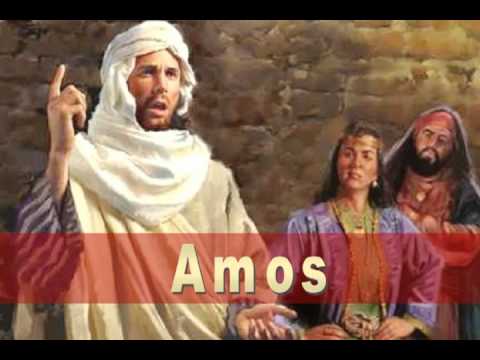
Tucked within the pages of the OT is a little-known book that bears the name Amos. Amos is one of those forgotten prophets of the Bible. He is called a minor prophet as the result of the length of its pages as compared to books like Isaiah or Jeremiah, but Amos is a Major Leaguer in what he had to say. He hit a homerun every time he opened his mouth! In fact, Amos is considered to be the first of the classical prophets. If this be the case, Amos is the oldest collection of sermonic literature that we possess.

Amos made his home in a place called Tekoa, about five miles south of Bethlehem. He was a keeper of sheep and a tender of Sycamore fruit. His background was that of agriculture, which when meeting him was evidenced by his speech, his smell and the clothes he wore. While his rough speech and tattered attire led those to whom he encountered to jump to the conclusion that he was an uneducated “country preacher,” yet found in the book of Amos is some of the best Hebrew in the OT.

Amos’ ministry spanned from a period of about 780-752 BC. Having a life-altering encounter with the Lord (7:15), he was commissioned to carry a much-needed message to those who lived in the Northern Kingdom, Israel. His name means “burden” or “burden-bearer.” And a passionate burdened he had for his kinsman. Amos lived in a day of religious and social decay, moral and religious degeneration, the rich were oppressing the poor, injustice prevailed in the courts, there was violence in the streets, robbery was a daily occurrence, dishonesty in leadership was commonplace, adultery was accepted as normal, true religion was mixed with pagan practices, abnormal behavior was accepted as normal, and while all the right religious rituals were being conducted outwardly there was no inner faith. Evil had become deeply entrenched, blinding the people to their own plight. While outwardly there was prosperity, Amos saw beneath the material prosperity to the poverty of morality, ethical integrity and spirituality that  pervaded society and the lives of the people.

Amos had a fire in his bones to speak out against all the moral, ethical and spiritual declension he saw flowing like an out-of-control river. The preaching of the country preacher was not received very well. He was called a rabble-rouser, a trouble maker, one who stirred the pot when all appeared well on the surface. Amos chapter 7 is a picture of how his message was received. He was at Bethel preaching against the sins of the nation and that judgment was coming unless there was repentance and a return to the Lord God of heaven. Amaziah, who was the polished, politically correct paid priest, didn’t like what he heard from the lips of Amos. Amaziah was a people pleaser, who preached the message that the people wanted to hear: sin is a word of the past and it matters not how you live, God will not judge sin so let go and “just do it,” mixing Judaism with paganism is permissible for we have to be tolerant, repentance is unnecessary and negative talk of judgment only hinders one from reaching their full potential. Amaziah was guided by political-correctness not by principle.

The message of Amos was just the opposite. Amos could not be bought. He preached that God is holy, righteous, and of moral character who calls on this creation and creatures to conform to His holy, ethical and moral order. Amos preached man is sinful, which is the root to all greed, dishonesty, abuse of others, adultery, violence, robbery and all the other destructive behavior seen in society. Amos preached that the only hope for humanity is to repent before a holy God, and if not, judgement will be the natural outflow and reaction of holiness against sin. Amos preached engaging in empty religious ritual is worthless if there is no genuine inner faith that leads to a relationship with the Living God. Amos was not concerned about political correctness, but divine principle.

Amaziah personally confronted Amos and told the “country, hay-seed preacher” to shut his mouth and go back to his sheep and fig-picking. When Amos courageously refused to curtail his message, Amaziah mailed a letter to the King Jeroboam II and told him Amos was conspiring against him by speaking negative words of judgement because of the sins of the nation and the people. Amaziah sought to use political leverage to hush-up Amos. With divine unction, Amos continued to proclaim the message given him by the Lord until, as tradition records, he was either beaten to death or pinned to a wall by a spear.

The conditions in which Amos lived truly resemble the conditions in which we live today. Sin and self-indulgent living flow in the streets like a river overflowing its banks. Like in the days of Amos, we have forgotten God and even dare Him to judge us…if after all there is even a God. We want “preachers” to preach messages that make us comfortable in our sins and that is tolerant of our unrighteous behavior no matter how abnormal it is. Political correctness trumps biblical correctness, and those who dare disagree are vilified. Evil has become deeply entrenched, blinding people to their own plight. We want “preachers” to tell us no matter what “religion” you embrace, they all will lead to the same god who doesn’t demand repentance or an inner faith that is anchored in a relationship with the Living God. And if an “Amos” proclaims a message other than what “Amaziah” proclaims they are called rabble-rousers, and efforts are made to silence them.

Amos needs to become the prophet of our age. Though efforts are continually enacted to silence the message that God is holy, man is a sinner, sin is destructive, and judgement is sure if repentance is not forth coming, we need preachers to don the mantle of Amos to unapologetically and lovingly proclaim the truth. How fierce the fires of judgment as Amos so clearly painted with his poetic words. Yet here is the Good News, our sin and the judgment of our God met on Calvary’s Hill, offering forgiveness and reconciliation to all who will embrace His atoning work. And in His resurrection, He was triumphant over sin, death and the devil, and to all who encounter Him in faith become partakers of His victorious life. The sufficiency of the Christ Event, from which flows so great a salvation, is driven home to our hearts and minds as we hear and heed the words of Amos, overwhelming in their divine intensity and long overdue in their necessity to be faithfully proclaimed.

It is past time that more “country preachers” go to town!

Blessings,
Dr. Dan

EZEKIEL: TRUTHS FROM A FORGOTTEN PROPHET

Ezekiel is one of the most interesting prophets in the Old Testament. If he were alive today, he would be labeled as a “strange bird,” out of step with society, and one who would be known to adopt bizarre behavior to lend imagery to the message he was called to preach. Ezekiel is a book which, because of its difficult passages and mysterious imagery, is often neglected and ignored, but there are many wonderful truths that lay buried within the pages of this extraordinary book.

Ezekiel was born about 623/22 BC, and writes during the time of Judah’s exile (1:2) to a people who were in exile. In 597 BC many Jews, including Ezekiel, were taken into Babylonian captivity. While many of the exiles did not believe the city of Jerusalem would ever fall, Ezekiel at age 30 was commissioned by the Lord (593 BC), that because of rampant sin and forgetting God Jerusalem would be destroyed in judgment for their willful sin. The words he spoke came to pass (586 BC), whereby then his message turned to God’s desire to bring about renewal and reconstruction among His people.

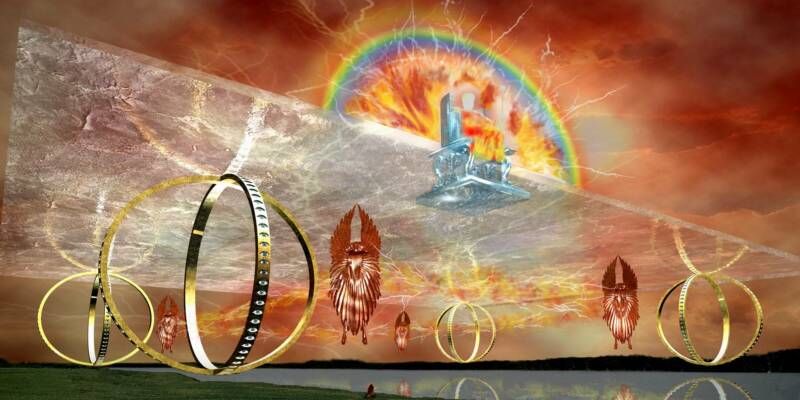
Ezekiel’s call to the prophetic office is one of the most vividly descriptive found in the Bible, as he tries to describe what his eyes in astonishment saw. What his eyes were privileged to witness could not be described with earthly words, but one truth is certain; he had a life-altering encounter with God. He recounts in chapters 1-3 his heavenly vision in most descriptive terms that leave us in worshipful awe. A brief summary follows.

The Whirlwind out of the North: One day while Ezekiel was by the River Chebar (1:3), the vision he experienced began by a whirlwind coming out of the North (1:4). The North signified the land of Israel’s invaders, Babylon. While the majority of those in exile argued Jerusalem would escape judgement, God will give to Ezekiel a message to deliver to the people that Jerusalem will be destroyed (Ezekiel 4).

The Four Living Creatures: After the whirlwind, the first thing that Ezekiel describes of his vision is four living creatures. He later reveals these creatures are cherubim (10:20); but in appearance they are a mixture of angel, animal, and human. They have four faces, that of a man, ox, lion, and eagle; representing intelligence, service, power, and swiftness, respectively.

The Great Wheels: Next to each living creature there were four giant wheels made of two wheels intersecting one another. The wheels are covered with eyes! The wheels moved in every direction and in unison all at the same time.

The Expanse: An expanse sits above the heads of the four living creatures, and above the expanse is a throne, and above the throne is a figure of a man (Divine-Human) gleaming like fire, surrounded by a rainbow-like radiance.

While we can never plumb the depths of Ezekiel’s heavenly vision, there are some wonderous truths that we can glean from what he is seeking to convey. Without getting lost in the details of his vision, there are seven truths that are most evident which are applicable to the day in which we live. We are living in rebellious and reckless times when people for the most part have forgotten God and in turn God’s people think He has forgotten them. Ezekiel’s vision, though, reminds God will eventually judge sin and, as well, is not indifferent to His promise to restore, renew and reconstruct when one repents.

In the imagery of Ezekiel’s vision, we learn:

First, God’s Audience. God’s audience was to those in exile, and Ezekiel would be God’s spokesperson to the people. The vision began by a whirlwind coming out of the north (1:4). The north signified the land of Israel’s invaders (Babylonian); judgement coming like a whirlwind from the north. Many of those in exile thought Jerusalem was invincible, but God gives to Ezekiel a message to deliver that Jerusalem will be destroyed because of her sin (Ezekiel 4). God could rightly judge without warning, but He sends forth His messengers to warn and demand repentance so they that man can never say he wasn’t first warned. While such warnings today may fall on deaf ears, the warnings and the invitation to repent must continue to be sounded to audiences before us.

Second, God is Awesome. God is above our comprehension. He is transcendent above our deepest thoughts and highest intelligence. Ezekiel tried to describe in human language He who cannot be described in words or grasped by our finite minds. How prideful of man to think that he in his limited intelligence can figure out or put in a box all that God is. And how arrogant is man to demand that the Infinite Mind of the universe explain to the finite mind of man that which he could not fully grasp or comprehend anyway.

God’s Awesomeness not only includes His transcendence, but His holiness. The fire about the One on the throne symbolizes eternal purity, and our inability to approach him in our impurity and sinfulness. That God is holy means that He is above sin, that He is righteous, that He is morally pure. Holiness is His self-affirming purity, which He will not allow to be soiled by man’s “unholiness.” All one can do when one realizes they are in the presence of such holiness is to bow and cry out, “I am woefully sinful and dwell in the midst of an unclean people.”

Third, God is Almighty. Ezekiel saw One sitting on a throne, whose throne was high above the breadth of the vast expanse. The One who sat upon the throne was called “Almighty” (1:24) suggesting the sovereignty of God’s rule. In spite of how hopeless or helpless things looked on earth, the Almighty, Sovereign Lord of the universe is still in control. He is not taken by surprise the chaos and confusion on earth; He is not shocked at man’s rebellion and sinful actions. Some thought that God had abandoned Israel (9:9), but the vision is to remind Ezekiel’s hearers that God is still in control even though the people are in exile.

Fourth, God is Active. Ezekiel describes four giant wheels made of two wheels intersecting one another. The wheels move in every direction and in unison all at the same time. This speaks of the truth that the One on the throne is not inactive but is active. The complexity of the wheels moving in every direction and in unison all at the same time speaks of the complexity of God’s activity in Providence, which to us is sometimes incomprehensible. In spite of the evil we see, in spite of things that occur which defy our logic and can’t be explained, God is active in the enforcing the laws of His divine Providence with precision. While we can not always trace the Hand of God, we can always trust the heart of God. Yes, God is active in the world in which we live.

Fifth, God is Aware. Ezekiel records that the wheels had eyes!! This speaks of the fact that God sees all. He is omniscient, knowing all things. Nothing escapes His watchful eye. Nothing slips by Him. No matter what takes place, it does not and will not slip by the all-seeing eye of the One who sits on the throne. Yes, the many eyes on the wheels represent the totality of God’s perceiving all things. Those in exile thought that God did not see what was happening (9:9), but the eyes in Ezekiel’s vision show that nothing can escape God’s vision.

Sixth, God’s Assurance. God commissions Ezekiel to carry a message to the exiled that He cares. Their sin had besmirched the holiness of God, yet the One on throne, through Ezekiel, assures them if they repent, He will forgive and restore. The rainbow is a symbol of assurance that God will keep his promises. God’s holy-love is active in calling men away from the destructiveness of their sin into the light of renewal and reconstruction. The Lord assures us that He cares by sending men like Ezekiel who warn that judgement is coming if there is no repentance from sin, but to those who repent, He promises forgiveness and a renewed and restored relationship with the living Lord is experienced.

Seventh, God instills Awe. In the presence of such a sight, all Ezekiel could do was fall on his face in surrender and listen to the voice of the One on the throne (2:1). Ezekiel’s vision serves notice that whoever would enter into the Lord’s service must have a clear vision of the One into whose service they are called and bow before Him in surrender. No one can share a message they first have not experienced or internalized themselves.

Oh, the wonderful truths found within Ezekiel’s amazing descriptive vision of that which is truly indescribable with human words, but nevertheless a reality. The truths which we find in Ezekiel are truly applicable in our day and time. God is on the throne, is active among us, and His divine Providence is and will bring about that which He has purposed for all creation and our individual lives. While warnings are continually issued that judgement is just reaction of God’s holiness to sin, few listen and the vast majority continue to ignore God’s gracious warnings and invitation to repent through His messengers.

This writer encourages one to prayerfully, reflectively and slowly read and reread the first three chapters of Ezekiel, and as one does ask the Lord to give each reader a fresh vision of the amazing God we serve and in renewal experience a transformed relationship with the God who longs to commune with each of us….and in spite of what circumstances may otherwise say, He is active in our world and in our lives.

Blessings,
Dr. Dan

ON WHAT DAY WAS CHRIST CRUCIFIED?

Every year when Easter rolls around, there resurfaces debates on what day of the week Jesus was crucified. One can read lengthy and complex articles that champion the argument that He was crucified on Wednesday of Holy Week: then one can read other articles that vehemently contend that Jesus was crucified on Thursday; and finally one can read arguments that uphold the traditional view that Jesus was crucified on a Friday. While volumes have been written on this issue, I will be concise as possible in expressing my understanding on which day Jesus was crucified. Let me say at the outset, while the day of His crucifixion may invite lively debate, the most important truth is that He WAS crucified for our sins and that He DID arise from the dead…and that is be to our focus.

Now to adequately address the question as to when Jesus was crucified, let us look at Scripture. Mark 15:42 is clear that Jesus was crucified “the day before the Sabbath” (Mk 15:42), which would be a Friday. John records that the day Jesus was crucified “was the preparation of the Passover” (Jh 19:14). The Greek word translated “preparation” is paraskeue. Gleason Archer writes, “The word paraskeus had already by the first century A.D. become a technical term for ‘Friday’ and since every Friday was the day of preparation for Saturday, that is the Sabbath. In Modern Greek the word for ‘Friday’ is paraskeue.….Therefore, that which might be translated literally as “the preparation of the Passover” must in this context be rendered ‘Friday of Passover Week’” (Archer, Bible Difficulties, (MI: Zondervan, 1982), 375-76). The noted Greek scholar A.T. Robertson writes of the phrase the preparation of the Passover, “That is, Friday of Passover week, the preparation day before the Sabbath of Passover week (or feast) (Robertson’s Word Pictures of the New Testament, “John”). Baptist scholar Herschel Hobbs in his commentary on John, asserts that the crucifixion “took place on the ‘the preparation,’ which was a technical term for Friday. Every Friday was called the preparation, (namely, for the Sabbath) (Hobbs, John, (MI: Zondervan, 1965), 89). The phrase “the day of preparation” normally was used to describe the day before the Sabbath, the day before being Friday (C. C. Torrey, “The Date of the Crucifixion According to the Fourth Gospel,” Journal of Biblical Literature 50:4 (1931), 241). It is clear the day in view in John 19:14, 31 is Friday, which corresponds to Mark’s account.

From the first-century Jewish historian Josephus we discover that the seven day festival was often designated ‘the Passover,’ and there can be no doubt as to the rendering ‘Friday.’ Josephus affirms that “the Passover” would refer to the whole eight-day feast of Passover and Unleavened Bread as well as the Passover day (Josephus, Antiquities, 14:2:1; 17:9:3). The day of preparation for the Passover, therefore, clearly refers to the Friday of the eight-day feast. This harmonizes with the other chronological references to the Passion Week in the Synoptic Gospels. While there are many commentators that build elaborate and complex arguments as to a what is considered a discrepancy between the Synoptic Gospels and John in regard to the time of Jesus’ crucifixion and that there were two Sabbaths that week; however, the predominance of the Scriptural evidence and an understanding that paraskeue is a technical term for Friday aligns all four Gospels with the crucifixion occurring on Friday.

Now the contention of those who object to a Friday crucifixion is that Jesus could not have been crucified on Friday as it would not have fulfilled the prediction of Jesus that He would be three days and three nights in the heart of the earth then rise from the dead on the third day (Matthew 12:40). Let it be noted that when one addresses the question as to what day Jesus was crucified one must not approach the Scriptures with Western thinking regarding time.   Our Western mind logically views the phrase “three days and three nights” to be literal, whereas in the Jewish mind of the first century any part of a day was considered a full day (1 Sam. 30:12-13; 2 Chron. 10:5, 12; Esther 4:1; 5:1). The key to resolving the issue “three days and three nights” lies in an understanding of Jewish idioms. (A Jewish idiom is an expression that its actual meaning is different from the meaning of the literal words that make up the expression or phrase (i.e., to “kick the bucket” means to die – “kick the bucket” is an English idiom or expression that its actual meaning is different from the meaning of the literal words that make up the expression)). The Jewish idiom “three days and three nights” can refer to a combination of any part of three separate days, and as in the case of Jesus remaining in the tomb for a portion of three days – Friday, Saturday and Sunday – it would be proper to state as the Gospel writers and Paul did that He arose on the third day (Mark 8:31; I Cor. 15:4), which was the first day of the week (Sunday) (Mark 16:9). Since Jesus was in the grave for part of Friday, all of Saturday, and part of Sunday—He could be considered to have been in the grave for three days. Furthermore, Mark 8:31 states that Jesus will be raised “after” three days. When the words of Jesus in Matthew 12:40 are seen from a Jewish perspective as a Jewish Idiom then He would not need to be in the grave a full three days and nights, but only three days – again in the Jewish mind of the first century any part of a day was considered a full day. It is understood this explanation does not satisfy everyone, yet it is less problematic than some of the complex and contorted explanations that have been put forth for a day other than Friday.

So, there is no contradiction between John and the Synoptics as the day on which Christ died – it was Friday, nor is there contradiction as to whether Jesus was raised on the third day – He was – as any part of a day was considered a full day! While this writer is confident with embracing the Scriptural and traditional view that Christ was crucified on a Friday, I would not fallout with anyone over the debate. The most important truth we need to focus upon is that Jesus DID die on the cross for our sins and that on the first day of the week (Sunday) our Lord  DID arise from the dead and ever lives! O, what a Savior!

Blessings,
Dr. Dan

WORSHIPPING THE SON OF RIGHTEOUSNESS WHO HAS RISEN WITH HEALING IN HIS WINGS

As Resurrection Sunday approaches when multitudes of Christians around the world will gather to celebrate the Resurrection of Christ, I have noticed several articles and statements on social media posted by well-meaning Christians that by gathering with fellow Christians for a Sonrise Service, one is engaging in ancient paganism. While I don’t usually respond to such articles, and even though I do believe such persons are well-intentioned, I feel compelled to address the issue for those who have legitimate questions as whether it is wrong to gather with fellow Christians for a Son Rise Service to celebrate our Lord’s Resurrection. Malachi spoke of those who revered the Lord and experienced the Sun of Righteousness arising with healing in His wings (Mal. 4:2). Are we not to worshipfully celebrate the Son’s Arising?

One needs to remember that the resurrection of Jesus Christ was celebrated in the spring-time for centuries in Christendom long before the word “Easter” was ever adopted in the English language as a label attached to the resurrection celebration. It should be pointed out we have many words in the English language that were connected with ancient pagan gods and practices, but we don’t accuse someone of engaging in paganism when they are involved in activities associated with those particular words. For instance, if someone wants to get technical, we should not eat cereal, nor make clothes of cloth, or ever call a religious song a hymn. You see, those three words are connected with pagan deities. For example, the word “cereal” comes from the name of the ancient goddess of agriculture, Ceres. The word “cloth” comes from Clotho, the spinster goddess who was said to spin the thread of life. The word “hymn” is thought to come from the god of marriage, Hymen, and in ancient times meant any song offered in praise or honor of a god or gods. But when we use “hymn” in our church services we mean a song sung in praise to the Christ of the Cross. When we use the word “cereal” or eat corn flakes or cheerios, we are not worshipping an ancient goddess. Cloth is cloth to us, we don’t connect it with a pagan deity. We don’t see anyone wearing clothes made of burlap sacks because they don’t want to be associated with cloth since the word is derived from the pagan deity.  As well, all the names of the days of the week were named after ancient deities, but no one worships those pagan deities when they use the days of the week when speaking nor does anyone think of worshipping the god the day was named after when a new day arrives.

Without going into a lot of detail, the present Christian celebration of “Easter” has more affinity and connection with the Jewish Passover than with ancient pagan associations. Jesus is the prophetic fulfillment of what the Passover sacrifice typifies and symbolizes, as He is the final Sacrifice for our sins. Over the years, I have attended a lot of Sunrise Services and not one of them ever had even a hint of paganism attached to them, but centered totally and completely on Jesus Christ. I will gather this Sunday morning, as I have in years past, with fellow believers to worship the Christ of the Cross, who conquered the cold, dark grave by rising from the dead. There will not be a speck of paganism in our gathering, but the worship of the King of kings and Lord of lords. We will not gather to worship the sun, but to worship the Son of Righteousness who arose from the dead with healing in His wings (Malachi 4:2). We will gather to lift our voices in praise to the One who took the challenge to wrestle with the enemies of humanity: sin, death and the devil…..and He defeated them all.

Now, if anyone gathers at a Sunrise Service to worship the sun and creation, then they gather for the wrong reason and, yes, they are embracing pantheism and an ancient pagan deity. However, if one gathers at a Sonrise Service, along with millions of other Christians, to worship the victorious, resurrected Christ, the Creator Himself, then one gathers for the right reason. I would much rather see Christians gather to worship Jesus and gain a better understanding of the meaning and practicality of his resurrection for our lives.

After all, should not Jesus’ resurrection be a cause of rejoicing and celebration for the Christian? And the truth be known, when I awake in the morning and watch the sunrise, I will celebrate the resurrection of Christ. As matter of fact, I celebrate His resurrection everyday…. for I serve a risen Savior who has Risen with healing in His wings.

He is Risen…celebrate the wonderful truth daily that the Son of Righteousness is forever alive!

Blessings,
Dr. Dan

THE REALITY OF SIN AND THE REMEDY OF A SAVIOR

Isn’t it odd that the more an individual or a society drowns in a cesspool of moral depravity, the more is dismissed the truth that man is a sinner who sins because he has a nature that has a propensity to defy His Creator? The more evil flourishes the more an individual or a society becomes blind to its own condition. Like a cancer, sin eats away at the spiritual and moral fiber of one’s soul which results in silencing the conscience and seductively blinding one’s eyes. Sadly, we are living in a day when such a concept regarding sin is making inroads in Christendom. As of late I have read several articles by Christian “leaders” who believe it is past time to do away with  such terminology as “original sin” and that humans are “sinners.” They contend such terminology should be regarded as offensive and untenable language in the twenty-first century. Instead of using such negative terminology, such “leaders” insist Christendom must focus on the “innate goodness” in man and realize that evil is only the absence of good. However, the fact of sin is evidenced by its manifestation being daily “played out” in society and every honest person recognizes it when they look within their own heart. While we may not all sin in like manner or to the same degree, nevertheless, observation and personal experience teach us we all sin.

Before proceeding, the term “sin” needs to be defined. The most common word translated “sin” in the NT (172 times) is the word Hamartia which means to miss the mark and pictures one whose arrow misses the intended target. It speaks of one who misses God’s intended purpose for their life, who willfully falls short of obedience to God’s divine law; one who is unable to comply with God’s holy demands by their own works. Our source for our developing a theology on sin is the Bible, God’s revelation to man. An initial question to be asked is, “Does man become a sinner by sinning, or does man sin because he is a sinner?” If the answer to this question is that man becomes a sinner by sinning, then ideally one given the proper environment and appropriate social interactions one could possibly avoid ever doing wrong! However, if man sins because he is a sinner, then a second question is raised, “How did we acquire our propensity to sin?”

The best way to answer these two questions is let the Scriptures speak. While many verses could be cited, some focus passages are noted:

• I Kings 8:46, “For there is no man that sins not.”
• Psalm 51:5, ” Behold, I was shapen in iniquity; and in sin did my mother conceive me.”
• Romans 3:23, “For all have sinned and come short of the glory of God.”
• Romans 5:12, ” Wherefore, as by one-man (Adam) sin entered into the world, and death by sin; and so death passed upon all men, for that all have sinned.”
• Romans 5:18, “Therefore as by the offence of one (Adam) judgment came upon all men to condemnation; even so by the righteousness of one (Christ) the free gift came upon all men unto justification of life.”
• Romans 7:18-20 “For I know that in me (that is, in my flesh,) dwelleth no good thing: for to will is present with me; but how to perform that which is good I find not. For the good that I would I do not: but the evil which I would not, that I do. Now if I do that I would not, it is no more I that do it, but sin that dwelleth in me.
• Ephesians 2:1-4, “And you has given life, who were dead in trespasses and sins….and were by nature the children of wrath, even as others.”
• 1 Cor. 15:22, ” For as in Adam all die, even so in Christ shall all be made alive.”

From these verses several truths become apparent that can hardly be denied.

1. All persons actively sin, all persons are universally sinful (I Kings 8:46, Romans 3:23).
2. Sin is both natural and personal (Romans 7:18-20). We sin because we are sinners by nature and choice.
3. Every person is born with a sin nature, and enters the world burdened with a nature of sin (Ps. 51:5).
4. Adam’s disobedience to God affected all mankind, man’s sinfulness is due to his connectedness with Adam from whom he has inherited his sinful nature (Romans 5:12-18).
5. Adam, as “father” of the human race, caused every person after him to be born with a nature that has the propensity to sin. One’s sinful nature is transmitted through procreation. (Romans 5:12).
6. Because man is a sinner by nature and choice, he is under just condemnation and stands guilty before a holy God (Romans 5:18; Eph. 2:1-4).
7. All humanity stands in need of grace, as man is unable in his own power to reestablish a relationship with God. (I Cor. 15:12)
8. While our connectedness with the offence of “one man” (Adam) results in judgment coming upon all men in condemnation, by the righteous life of Christ (the Second Adam), all who embrace Him as Savor receive free pardon from sin and the free gift of eternal life (Romans 5:18, I Cor. 15:12, 45).

The Bible is crystal clear that sin is “a dominant force, and the fact that all men are connected in the solidarity of sin” (H. Berkhof, Christian Faith (Grand Rapids: Eerdmans, 1979), 203). Adam’s sin did more than influence mankind in the sense of simply setting a bad example and that at birth we have an “unsinful” nature and become sinners only as the result of wrong choices. No, according to Scripture we sin because we inherit natural, innate corruption from Adam. While there are theologians and leaders today, who throughout Christendom, in an effort to appease the culture, encourage dropping terms like inherited or transmitted sin, or the term credited to Augustine used by most theologians, “Original Sin.” Dislike of the aforementioned terms is the result of an ever-increasing man-centered Christianity, where the focus is on man’s goodness and his ability to pull himself up to God by his own “boot straps.”  While “the truth of the doctrine [of inherited sin] may be challenged by those who repudiate the authority of Scripture; that it is a doctrine of Scripture can hardly be denied… That the first man’s lapse [Adam] from a state of innocence entailed disastrous consequences upon himself and his descendants” (Thomas Whitelaw, ‘The Biblical Conception of Sin’ in The Fundamentals, 11, 7-22). Even the rationalistic moral philosopher Immanuel Kant contended that human beings possess an innate propensity to evil and has a natural inclination towards moral corruption, his conclusion derived from personal and empirical observations of man and his behavior. (Kant, Religion within the Limits of Reason Alone, 1793, 6:18). And what Kant rightly discerned through personal and empirical observation, is clearly set forth by the Inspired Word of God.

Though man is a sinner by nature and choice, the Good News is that Christ is the remedy for the sin of humanity. Our Creator God, knowing man could never in his power deal with the universal problem of sin and man’s just condemnation before a holy God, clothed Himself in human flesh in the person of Jesus Christ, and becoming man’s Representative did for humanity what they could never do for themselves. John declared, “And ye know that he was manifested to take away our sins; and in him is no sin” (I John 3:5). Paul joyously wrote, “For [God] hath made [Christ] to be sin for us, who knew no sin; that we might be made the righteousness of God in him” (2 Cor. 5:21).

In Christ, the Representative of humanity, the holy-love of God provided a Savior who on our behalf complied with the holy demands of a righteous God and as well bore the judgement we justly deserved for not complying with His righteous and holy demands. “Christ hath redeemed us from the curse of the law, being made a curse for us” (Galatians 3:13). In Christ the sin debt that you and I owe, which we could never pay, was paid in full in Jesus Christ. He did for humanity what they could never do themselves. While the first Adam failed miserably, and his posterity inherited his rebellious, sinful nature, the Second Adam, Jesus Christ, who was tempted in all points as we yet without sin (Heb. 4:14), has provided for us all that we need to be able to stand uncondemned before a holy God. Paul proclaimed, “There is now no condemnation to them that are in Christ Jesus” (Romans 8:1). Christ’s resurrection is the proof that the sacrificial sin offering Christ offered to God on our behalf was more than sufficient to pay the sin debt and was accepted by the Father as “paid in full.”

Let us rejoice that though by the sinful actions of one (Adam) judgment came upon all men to condemnation; even so by the righteousness life of One (Christ) the free gift came upon all men unto eternal life (Romans 5:18). O, what a Savior!

Blessings,
Dr. Dan


CHRISTIANS AND THE CELEBRATION OF EASTER

Easter is a celebratory time in the life of Christians world-wide, as it is a time when special emphasis is placed on the crucifixion and resurrection of Christ. However, every year when Easter rolls around there are some Christians who become very vocal that no Christian should celebrate Easter, contending it has roots in paganism. Over the years I have read all the arguments, pro and con, as to Easter’s origin and whether Christians should or should not be engaged in any activities associated with the annual holiday. The arguments sometimes become more emotional than rational, more historical than practical, more hurtful than helpful.

From the very beginning of the church, Sunday, the day on which Christ arose from the dead, was a day Christians honored and a time for gathering for worship. By the middle of the second century it is known Christian communities engaged in annual festive celebration of the resurrection of Jesus. Historian and Christian scholar Philip Schaff confirms from the writings of early Church Fathers, the beginning of festivals celebrating the resurrection of Christ by the middle of the second century, and in some Christian circles much earlier (Schaff, History of the Christian Church, Vol 2, (New York: Scribner, Armstrong & Co., 1874), 246). Schaff notes that the early Christians commemorated the entire period between the death and resurrection of Christ with vigils, fasting, special devotions, meetings, culminating in a feast celebrating His victorious resurrection (246-247).

It is needful to understand our determining the time we today celebrate Christ’s Resurrection can be traced back to the Roman Emperor Constantine in 325 A.D. As Constantine came to power many Jewish Christians celebrated the resurrection immediately following the Passover festival according to their lunar calendar, which fell on the evening of the full moon, the 14th day in the month of Nisan (March/April), and as such from year to year fell on different days of the week. Gentile Christians desired to commemorate the resurrection on the first Sunday following Passover; and as such celebrating Christ’s resurrection occurred on the same day of the week (Sunday), but from year to year it fell on different dates. Both ways for determination in celebrating Christ’s resurrection could be traced back to apostolic traditions.

In 325 A.D., at the Council of Nicaea, a gathering of Christian leaders came together to grapple with various issues confronting the early church, and sought to arrive at a consensus as to a standardized time when Christ’s Resurrection should be celebrated. The Council of Nicaea arrived at a formula for calculating a date to separate the Christian celebration of Christ’s Resurrection from the Jewish celebration of Passover. While it was recognized that Christ’s resurrection and Passover were related historically, the Council of Nicaea contended that because Christ was symbolically the sacrificial Passover lamb, the holiday of Passover no longer had theological significance for Christians. They sought to resolve the issue by setting a date that would be the following Sunday following the first full moon after the spring equinox. That means that Easter as we know it today is always the first Sunday after the first full moon that falls on or after March 21, which can be as early as March 22 and as late as April 25. The Council also decided that if the full moon should occur on a Sunday and thereby coincide with the Passover festival, the Resurrection should be commemorated on the Sunday following. Coincidence of resurrection commemoration and the Passover was thus avoided.

While it is true pagan festivities were held during the vernal equinox in honor of the pre-Christian goddess Eostre of spring and renewal, the only reference to this festive time linked with the celebrating of the resurrection of Jesus comes from the writings of the Venerable Bede (673-735), a British Benedictine monk, who lived in the late seventh and early eighth century. Religious studies scholar Bruce Davis Forbes points out, “Bede wrote that the month in which English Christians were celebrating the resurrection of Jesus had been called Eosturmonath in Old English, referring to a goddess named Eostre. And even though Christians had begun affirming the Christian meaning of the celebration, they continued to use the name of the goddess to designate the season.” (Bruce David Forbes, America’s Favorite Holidays: Candid Histories, (Oakland, CA: University of California Press; 2015), 79-114).

Forbes asserts that for later Christians the name stuck, thus Easter remains the name by which the English, Germans and Americans refer to the time of Jesus’ resurrection. However, the annual spring celebration of the resurrection of Jesus was not called Easter until centuries after Christians began celebrating His resurrection. The celebration of Christ’s Resurrection is interwoven into the very fabric of Christianity and predates any sort of early medieval Anglo-Saxon considerations. Easter is clearly historically linked with the Jewish Passover, apostolic tradition, and its time celebrated determined historically by the Council of Nicaea in 325 A.D. Hence, one is not  historically accurate to assert celebrating the Resurrection of Jesus is a pagan holiday. Historical evidence even indicates that the name Easter has more in common with the old Germanic Indo-European root austron for “dawn,” corresponding to the celebration of the Easter Mass at dawn. But even if the name Easter was derived from a pre-Christian spring festival, this would only mean the name Easter was borrowed, not the character of the feast itself.

Anthony McRoy says it well, “And even if Christians did engage in contextualization—expressing their message and worship in the language or forms of the local people—that in no way implies doctrinal compromise. Christians around the world have sought to redeem the local culture for Christ while purging it of practices antithetical to biblical norms” (Anthony McRoy “Was Easter Borrowed from a Pagan Holiday?” Christianity Today, April 2, 2009).

Now let it be said, if one is fully persuaded that in good conscience one cannot observe Easter, then do not observe it. If one is convinced that it is linked to paganism in some way that one cannot honor God, then one needs to abide by that conviction. This writer will respect your position and support your right to exclude it as a Christian celebration. However, at the same time, if one is fully persuaded that one can honor, glorify and worship God through engaging in Easter activities that are for the purpose of exalting and uplifting the Resurrected Savior, then joyfully honor and worship Him in celebration and in Christian liberty. And it behooves those who are convinced they shouldn’t participate in the Easter celebration, not to cast aversion upon those who seize the time to honor, worship, and glorify the Risen Lord and use the time as a way to evangelize the lost.

Let us as Christians, redeem the time (Ephesians 5:16; Colossians 4:5). The Greek word “redeem” Paul uses is “karios,” meaning a time of opportunity. And Easter is a wonderful time to take advantage of an opportunity to point others to the truth about Christ that, “He is Risen.” It is an opportune time to proclaim that we serve a Savior who overcame sin, death and the grave. It is a time for those who but once a year darken the door of a church to hear the glorious news that Christ holds the keys to life and death in His hands, and with outstretched arms He invites all to come unto Him.

Whatever one’s position on Easter, let us not lose focus of the truth that for the Christian every day is Resurrection Day and invites celebration. Let every Christian, whether during the Easter season or any other time, be about the business of redeeming the time to exalt the glorious name of Christ who has conquered death and ever lives to transforms the lives of those who place their faith and trust in Him.

Blessings,
Dr. Dan


DID JESUS REALLY RISE FROM THE DEAD?

The central truth of the Gospel of Jesus Christ is that as the crucified Messiah, He was buried in a borrowed tomb and on the third day, the first day of the week, He arose from the dead. The Four Gospels are explicit in their presenting Jesus as the conquering Savior over the devil, sin and death. The centrality of the message in Acts is that Christ’s resurrection from the grave is the authenticating proof that Jesus’ death on the cross is efficacious in atoning for the sins of all humanity. The focus of the epistles is that Christ arose from the dead. And the book of Revelation pictures Jesus Christ as the victorious, risen Savior who is coming again.

The foundation of Christianity is the Christ Event, which encompasses the death, burial and resurrection of Christ. It is an historical event etched into fabric of time. If there is no resurrection then Christianity is based on a false premise and a faulty foundation. Paul wrote, “If Christ be not risen our faith is in vain and we are all men most miserable, and we are yet in our sins” (1 Corinthians 15:17). Well, did Christ really rise from the dead or have Christians been deluded? For centuries men have tried to come up with all kinds of theories in hopes of invalidating  the resurrection and in so doing strike a death blow to Christianity.

Seven such theories are briefly examined, each proving to fall woefully short in their attempt to invalidate the historical truth of His glorious Resurrection.

First, there is the Swoon Theory. This theory contends that Jesus didn’t really die on the cross, but He only passed out, fainted or was unconscious. Upon being taken down from the cross and placed in the tomb, the cool air revived Him and He escaped the tomb on His own power. Such a theory is laughable as the Scripture is clear the Roman soldiers declared Jesus dead and to make sure they pierced His side with a spear, His blood spilling out beneath the cross on which he was nailed (John 19:34). How was one whose body had been beaten and subjected to such torture, who had been declared dead, whose blood had flowed on the ground like a rushing stream, unwrap his own grave clothes, then find the strength to roll back the two-ton stone, then get by the Roman soldiers guarding the tomb, and then present Himself as a victorious Savior? Such a theory is preposterous.

Second, there is the Wild Beast Theory. This one is just as preposterous as the Swoon Theory. The theory contends that a wild beast(s) during the night crept into the tomb, dragged the body of Jesus off into the wilderness and devoured the remains, thus the reason the body of Jesus was never found and the tomb empty. The followers of Jesus taking advantage that the remains of Jesus had been devoured by wild beasts, began a rumor that He arose from the dead. Such a theory doesn’t explain how the wild beasts got by the guards which records reveal they remained at the tomb all night, moved the enormous stone, then unwrapped the graves clothes and never left a “mess” which the authorities would have quickly pointed out.

Third, there is the Mistaken Tomb Theory. This theory contends the women in the fading-darkness of the early daylight hours, with eyes blurred by tears, went to the wrong tomb. The tomb the women went to was empty and they mistook it for Christ having risen from the grave. This theory is truly unlikely, for if the women had gone to the wrong tomb the Roman authorities would have quickly pointed out their error. The Roman and Jewish authorities would have without hesitation produced the correct tomb containing the still-occupied body of Jesus. Let it be noted, the disciples corroborated the women’s report of the empty tomb by going in the daylight hours to the place where Jesus’ body had been lain, to find the tomb empty (John 20:1-9).

Fourth, there is the Stolen Body Theory. Some skeptics contend the body was stolen by the women, disciples or by Joseph of Arimathea. If the women took the body, who moved the huge stone for them and how would they have overpowered the Roman guards? The disciples didn’t steal by night Christ’s body as they were scared and fearing they would suffer the same fate as Jesus, were hid behind locked doors. Plus, how could the scared disciples have overtaken  in a fight the trained Romans soldiers guarding the tomb, broken the Roman seal on the stone and then moved the huge stone away. The disciples knew if they had tried such a stunt and were not successful, they would suffer punishment of death. It is highly unlikely that they would all have chosen to die for something that would have been practically impossible to do. And as well, eventually they, being the prime suspects if Christ’s body had been stolen, would have been caught.

Also, Matthew tells us that is was the religious leaders of that day who first devised the Stolen Body Theory. The chief priests and elders connived and paid the soldiers guarding the tomb to declare that the disciples came by night, while the guards were asleep, and took the body of Jesus. The guards “took the money and did as they had been instructed; and this story was widely spread among the Jews, and is to this day” (Matthew 28:11-15). Plus, it would have been impossible for the disciples to have taken Jesus’ body, for the Roman guards knew if they slept on the job it meant death, and how could eleven men moving the huge stone not wake-up the guards if they had been asleep?

Fifth, there is the Hallucination Theory. This theory contends that those who claimed they saw Jesus after the crucifixion were only imagining they saw Him but in actuality didn’t. This theory insists that the women and the disciples had such an overwhelming desire to see Christ again, coupled with their grief, along with the power of suggestion, resulted in a hallucination. The disciples didn’t expect to see Jesus again (Luke 24), and weren’t sure it was even Him even when they saw him! The biggest problem with the hallucination theory is that hallucinations are usually private and individual, and not experienced as a group. Yet, in one instance Jesus “appeared to more than five hundred brethren at one time” (1 Corinthians 15:6). That is a lot of hallucinations at one time!!

Sixth, there is the Spiritual Resurrection Theory. This writer had a teacher in college who actually held to this theory, that Jesus didn’t rise from the dead physically but he only arose spiritually…whatever that means. However, the description of the appearances of Jesus after His resurrection clearly indicate He had a real body. He was physically touched by Mary Magdalene (John 20:17), Thomas felt His wounds (John 20:27), and Jesus ate broiled fish with his disciples (Luke 24:41-43). One who is a spirit cannot be touched, and they most certainly have no need of eating solid food.

Seventh, there is the Imposter Theory. There are those who contend that the disciples really didn’t seen Jesus after his crucifixion, what they actually saw was an imposter who only pretended to be Jesus. Those who hold to this theory surmise it is true as evidenced by some who saw him didn’t recognize him immediately (Luke 24). However, in every case where there was no immediate recognition, the witnesses’ initial doubt about Jesus’ identity was replaced by an assurance that it indeed was Jesus. As well, Acts 1:3 tells us that Jesus “shewed himself alive after his passion by many infallible proofs, being seen of them forty days.” Forty days was ample time to give evidence as to whether He was an imposter or He was actually the risen Christ. Every account verifies the disciples saw the Risen Christ.

All theories attempting to explain away what was an actual historical event, have proven to be futile efforts. The records and writings from the Gospels, Paul and other New Testament writers regarding the Resurrection refer to eyewitness accounts, and such writings were written too early for legend to have overshadowed  the truth of their content. In the days and months after Jesus’ death, something caused the disciples to be transformed men. What was it that transformed them? They were moved from despair to joyous belief because they had seen the risen Savior. Their discouragement was replaced by the conviction that Jesus had risen from the dead. Their defeatist attitude was replaced with a victorious attitude because the risen Lord empowered them with His resurrection power. Their timidness was replaced by boldness as He was alive for ever more. Their hiding behind locked doors for fear they would lose their lives was replaced by a willingness to freely give their life for the One who was victorious over death. Their desire to cower in fear was replaced with a desire to spread the Gospel to the whole world because they were assured Jesus died for all and arose from the dead for all.

Today the tomb where the body of Jesus was laid remains empty. Why? Because Jesus triumphantly arose from the dead, victorious over the cold dark tomb. One will look in vain for Him among the grave stones, for He is not there, “He is risen!” And those who embrace that glorious Good News will discover as did the disciples, He will transform your life forever!!

O, what a Savior.

Blessings,
Dr. Dan