CREATED IN THE IMAGE OF GOD

This past week I have been meditating on Genesis 1:26-27, which states that man was created in the Image of God. Wow! What an awesome truth to consider. What does being created in the Image of God mean? It speaks to the uniqueness of each person. Being created in God’s Image indicates there is that which is in us that is similar to and representative of God and that is reflective of characteristics of God. There is something of the divine stamped upon our souls. The Image of God is not just something we possess, but is what we are. That we are created in God’s image is crucial in our understanding as to what makes us unique as humans.

While we are created in His image, the Bible does not define exactly what that means. However, there are several unique characteristics that distinguish man from animals that help us understand scripturally what it means to be created in His image. The Creator of this vast Universe in His holy-love created man with certain qualities that are intrinsic to His own nature.

(1) We are more than a physical being, but also a spiritual being. Man is not an evolutionary accident, but God breathed into man the breath of life (Genesis 2:7). The spiritual part of us gives us the capacity to fellowship with the Creator (who is spirit- John 4:24) and it is that part of us that will live beyond the grave. One who does not understand this fails to grasp the most important aspect of who we are as humans. 

(2) We are personal beings, who possess personality and self-consciousness. As a being with personality and self-consciousnesses we have the capacity to purpose and choose a path of destiny for our lives.  

(3) We possess a conscience, a moral compass that gives us an inward awareness of the difference between right and wrong. The conscience has been called the “echo of God’s voice” and reveals there is a Universal Lawgiver to whom we are answerable.

(4) We are relational beings. We have the capacity to have a relationship with our Creator and our fellowman. Man was not created to be an island of individualism, but to interact with his Creator and his fellowman.

(5) We are rational beings. We were created with the capacity to think, learn and know. Unlike animals, the Supreme Mind behind the Universe has given us minds to enquire, to think and to reason.

(6) We are emotional beings, who can love, hurt and feel inward joy and sorrow. Our various emotions enrich our lives and draws us closer to others and endears them to us and us to them.

(7) We are creative beings, who have an inner sense of responsibility to produce, create, compose, write, build, etc. The amazing creativity of man has given the world many wonderful inventions and innovations that have helped improve the human condition.

While we have been created in the Image of God, sin has marred, distorted, defaced and damaged His image within us. “All have sinned and come short of the glory of God” (Romans 3:23); therefore, the Image of God has been marred in each of us. What is sin? Sin is rebellion against the Maker of heaven and earth; it is willful munity against the Holy Father; it is desiring to be our own God and not giving the One who created us His rightful place in our lives.

Anthony Hoekama has written, “[Though] the image of God has been marred and corrupted by sin, we must still see fallen man as an image bearer fo God, but as one who by nature…images God in a distorted way” (Hoekema, Created in God’s Image, 1986, 31). Because of sin, fellowship with our Creator has been broken, morality has been perverted, personality damaged, relationships broken by selfishness, emotions skewed, creativity twisted, life devalued, and knowledge of the Holy replaced by false philosophies of deluded thinking. 

Thankfully, in Jesus Christ the damaged Image of God within us can be restored. Carl F. Keil and Johana F. Delitzsch write that the “concrete essence of the divine likeness was shattered by sin, and it is only though Christ, the brightness of the glory of God and the expression of His essence, that our nature is transformed into the image of God again”  (Keil & Delitzsch, Commentary on the Old Testament, 1996, 1:39).

In Jesus, we find “the image of the invisible God…For by him were all things created, that are in heaven, and that are in earth, visible and invisible…all things were created by him, and for him: And he is before all things, and by him all things consist…For it pleased the Father that in [Christ] should all fulness dwell” (Colossians 1:15-19). As we bring our marred and damaged image unto the fullness of Jesus, God’s image in us is renewed day by day as we walk with Him in restored fellowship. Augustine expressed it well: “You created us for yourself, O God, and our hearts will not rest until they find their rest in you.” In Christ, we find the relationship that fulfils and transcends all others. It is in Christ we discover the relationship that elevates and redeems human life and restores the marred Image of God in us.

The truth that we are bearers of His Image, even though damaged by sin, will shape our view and behavior toward one another. Since we are all stamped with the Image of God it means every life is sacred, precious and to be valued and respected. We are more than mere animals, but we have the very Image of God stamped on our souls. That being true, may we treat one another with dignity and worth as one who has been created in the Image of God….pointing others to the restoring, transforming and renewing power of Christ.     

Blessings,

Dr. Dan
WORSHIPPING THE SON OF RIGHTEOUSNESS NOT THE SUN

I received a note today from a well-meaning person informing me that by gathering with fellow Christians for a Sunrise Service, I was engaging in ancient paganism. Now, I don’t need a lecture on some pagan deity that surrounded ancient spring “Easter” celebrations, for I know history and the arguments well. While I don’t usually respond to such correspondence, even though I do believe the person is well-intentioned, I feel compelled to offer a reply.

One needs to remember that the resurrection of Jesus Christ was celebrated in the spring-time for centuries in Christendom long before the word “Easter” was ever adopted in the English language as a label attached to the resurrection celebration. It should be pointed out we have many words in the English language that were connected with ancient pagan gods and practices, but we don’t accuse someone of engaging in paganism when they are involved in activities associated with those particular words. For instance, if someone wants to get technical, we should not eat cereal, nor make clothes of cloth, or ever call a religious song a hymn. You see, those three words are connected with pagan deities. For example, the word “cereal” comes from the name of the ancient goddess of agriculture, Ceres. The word “cloth” comes from Clotho, the spinster goddess who was said to spin the thread of life. The word “hymn” is thought to come from the god of marriage, Hymen, and in ancient times meant any song offered in praise or honor of a god or gods. But when we use “hymn” in our church services we mean a song sung in praise to the Christ of the Cross. When we use the word “cereal” or eat corn flakes or cheerios, we are not worshipping an ancient goddess. Cloth is cloth to us, we don’t connect it with a pagan deity. We don’t see anyone wearing clothes made of burlap sacks because they don’t want to be associated with cloth since the word is derived from the pagan deity, Clotho. As well, all the names of the days of the week were named after ancient deities, but no one worships those pagan deities when they use the days of the week when speaking nor does anyone think of worshipping the god the day was named after when a new day arrives.

Without going into a lot of detail, the present Christian celebration of “Easter” has more affinity and connection with the Jewish Passover than with ancient pagan associations. Jesus is the prophetic fulfillment of what the Passover typifies and symbolizes.  Over the years, I have attended a lot of Sunrise Services and not one of them ever had even a hint of paganism attached to them, but centered totally and completely on Jesus Christ. I gathered this morning, as I have in years past, with fellow believers to worship the Christ of the Cross, who conquered the cold, dark grave by rising from the dead. There was not a speck of paganism in our gathering, but the worship of the King of kings and Lord of lords. We didn’t gather to worship the sun, but to worship the Son of Righteousness who arose from the dead with healing in His wings (Malachi 4:2). We gathered to lift our voices in praise to the One who took the challenge to wrestle with the enemies of humanity: sin, death and the devil…..and He defeated them all.  

Now, if anyone gathers at a Sunrise Service to worship the sun and creation, then they gather for the wrong reason and, yes, they are embracing pantheism and an ancient pagan deity. However, if one gathers at a Sunrise Service, along with millions of other Christians, to worship the victorious, resurrected Christ, the Creator Himself, then one gathers for the right reason. I would much rather see Christians gather to worship Jesus and gain a better understanding of the meaning and practicality of his resurrection for our lives.

After all, should not Jesus’ resurrection be a cause of rejoicing and celebration for the Christian? And the truth be known, when I awake in the morning and watch the sunrise, I will celebrate the resurrection of Christ again. As matter of fact, I celebrate His resurrection everyday…. for I serve a risen Savior.

He is Risen…celebrate the wonderful truth daily that the Son of Righteousness is forever alive!

Blessings,

Dr. Dan


IT IS FINISHED!

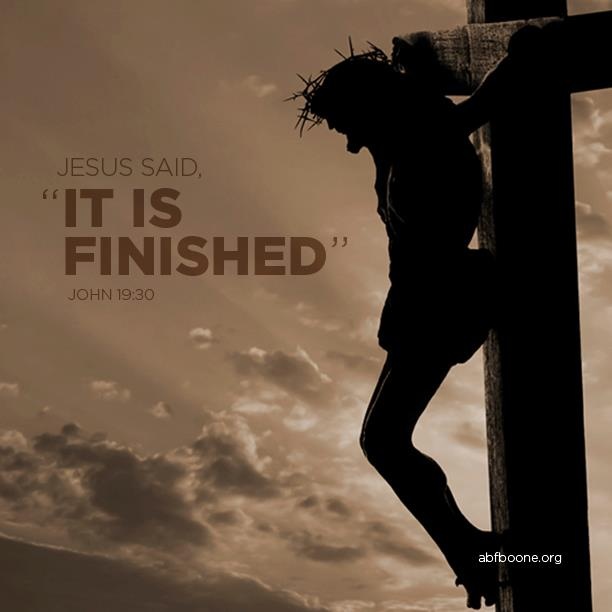
In John 19:30 one finds arguably the most important word that Jesus ever uttered. In the last minutes of his tortuous six hours hanging on the cross, shortly before He committed His spirit to the Father, He cried out through parched, cracked  and bleeding lips the word, “Tetelestai.”  While in the Greek it is one word, it took three English words to express its meaning, “It is finished.” O, what an utterance by the Christ of the Cross!

Never has one word been spoken which contains so much meaning. Charles Surgeon has eloquently written, “What an ocean of meaning in a drop of language, a mere drop. It would need all the other words that ever were spoken, or ever can be spoken, to explain this one word. It is altogether immeasurable. It is high; I cannot attain to it. It is deep; I cannot fathom it. IT IS FINISHED is the most charming note in all of Calvary’s music. The fire has passed upon the Lamb. He has borne the whole of the wrath that was due to His people. This is the royal dish of the feast of love.”

The word translated “It is finished” contains a wealth of meaning. Observing how the word “tetelestai” was commonly used in the ancient world serves as a doorway to understanding what Jesus accomplished on the Cross for us when he proclaimed, “It is finished.”

First, JOHN used the word when writing about Christ as the fulfillment of the Old Testament Messianic prophecies. John 19:28 records that in Christ all things were “accomplished” regarding His fulfillment of the Scriptures. The word John uses is “tetelestai”…..all has been completed, has been fulfilled, and has been accomplished. Of the over 300 prophecies surrounding the promised Messiah, Christ fulfilled every one of the them to the letter. Scripture’s fulfillment is finished, it has all been accomplished and completed in Jesus Christ. After His resurrection, Jesus explained to the two travelers on the road to Emmaus that He was the complete and perfect fulfillment of all the Messianic prophecies found in the Law, prophets, and the psalms (Luke 24:36-45). We need not look for another Savior…He has come, all is complete and finished in Jesus.

Second, SERVANTS used the word when having obediently completed a task for their master. With the job being faithfully finished the servant would proclaim, “tetelestai”…it is finished. As Jesus uttered “It is finished” He was proclaiming that he had obediently completed the task of obeying the Law of God perfectly which the Father had sent Him to do. As the faithful Servant of God, as the Representative of humanity, Christ lived the perfect life the holiness of God demands, providing for us His perfect righteousness that enables us stand before the Lord uncondemned. “For there is now no condemnation to them that are in Christ Jesus” (Romans 8:1).

Third, PRIESTS used the word when examining before offering an animal sacrifice for someone, and upon finding the lamb acceptable would say, “Tetelestai.” When Jesus cried, “It is finished” He was proclaiming as our High Priest that His Sacrifice was acceptable to the Holy Father. God’s Holiness demands justice against sin’s violation of defying His holy standards. But not only did Christ, as our High Priest, offer the Sacrifice, He was the Sacrifice. “He was the Lamb of God who came to take away the sin of the world” (John 1:29). Offering Himself as the sacrificial Lamb, He who knew no sin became sin for us that we might become the righteousness of God in Him (II Corinthians 5:21). Christ’s resurrection is God’s “Amen” that His Sacrifice was acceptable and the need to offer anymore sacrifices for sins is forever finished!  

Fourth, MERCHANTS used the word when a note or bill was paid, writing “tetelestai” across the note/bill signifying that it had been paid in full. Because of Christ’s perfect life and substitutionary death, the sin debt we could never pay was PAID IN FULL. Christ paid a debt He didn’t owe to pay a debt we could never pay. “For ye know the grace of our Lord Jesus Christ, that, though he was rich, yet for your sakes he became poor, that ye through his poverty might be rich” (II Corinthians 8:9).

Fifth, PRISONERS, guilty of a crime, were put in prison a “certificate of debt” listing the crimes and the penalty incurred was nailed to their cell door. When the prisoner had paid his debt to society, authorities would sign the “certificate of debt” with the word “tetelestai”….the debt has been paid. All humanity is guilty of rebelliously not complying with the holiness of God’s righteous Law, and we are imprisoned by our guilt and sin. Erwin Lutzer has written, “We can stand with confidence despite the thunder of the law and the lightening flash of justice, for we are safe beneath the cross. He paid the very last cent of the wages of our sins.”

Sixth, ARTISTS used the word when they made the last brushstroke on a painting, exclaiming, “Tetelestai” ….it is finished, it is done, it is complete. All of the Old Treatment promised pictures of the Messiah were fulfilled in Christ. Some examples: In Genesis, the Messiah is painted as the Seed of the Woman, in Jesus the portrait is finished. In Exodus, the Messiah is painted as the Passover Lamb, in Jesus the portrait is finished.  In Leviticus, the Messiah is painted as our High Priest, in Jesus the portrait is finished. In Deuteronomy, the Messiah is painted as the Great Prophet, in Jesus the portrait is finished. In Isaiah, the Messiah is painted as the Suffering Servant, the Heir to David’s throne and the One born of a virgin, in Jesus the portrait is finished. In Malachi, the Messiah is painted as the Son of Righteousness, in Jesus the portrait is finished. In every painting of Christ found in the 66 OT books, in Jesus every portrait is finished, completed, and hung as a Masterpiece.

Seventh, MATHEMATICANS used the word when after completing a complicated math problem, exclaimed, “Tetelistai”…..it is finished, it is done, it is complete. The spiritual math of humanity is incorrect in its thinking, believing that we can  “add” to our ledger enough good works that will add up to us obtaining salvation by our own efforts. The Bible is clear that by the works of the Law no one can be saved (Romans 3:20; Galatians 2:16). No one can ever do enough good works that will add up to self-justifying salvation.  Salvation, plus nothing and minus nothing, is found only in the Christ of the Cross. Our works “add-up” to nothing, but Christ’s Sacrifice on the cross is sufficient to save all who knell before Him in acceptance of his finished work.    

Eighth, CONQUERING WARRIORS used the word when victorious in battle, “tetelistai”…..it is finished, the victory is complete and victory has been accomplished. When Christ cried out, “It is finished” it was not a word of one who was defeated, but of a Conquering Savior who was victorious over sin, satan, death and the grave. As Jesus hung on the cross, the world said, “Aha” but three days later arising from the dead the world said, “Huh?” Our Champion accepted the challenge to do battle for our soul’s redemption against every evil foe… and He was victorious! He was victorious, and all those who place their trust in Him share in His victory. Halleluiah!

It is finished! What a grand utterance. We bow in awe before such majestic words. Thankfully, the redemptive work of Christ has been fully, finally and forever been accomplished.

It is finished!

Blessings,

Dr. Dan