WORDS OF WISDOM FOR WOUNDED WARRIORS

Pain is part of life. Whether it be physical, emotional, or mental pain, its thorns can rip deeply into one’s flesh or one’s psyche, leaving one in a state of excruciating discomfort and restless distress. Pain is the physical or mental suffering or discomfort experienced when we encounter the opposite emotions known from the joy, happiness, and the “good feeling” that can be found in life. Pain is the result of the loss of health or someone or something which we cherished dearly; something or someone which we valued as bringing meaning to our lives.

While physical pain can be torturous, the longer I live the more I have come to believe the pain that accompanies loss or rejection can bring unbearable ache and hurt in one’s innermost being that even medicine, time, or pills cannot abate. We all know the pain of losing a loved one through the doorway of death, we weep much because we loved much. Love always carries with it the risk of pain. When we love, there is always the risk that the joy can be turned into pain as the person may be snatched from us in death. Of course, if we live long enough, that will happen. That is part of the natural flow of life.

Over the years, the greatest pain can come from the rejection and abandonment by those we loved and valued in our lives. As a young person, most of us have experienced loving someone who, for a while, valued us, then rejected us and broke our hearts. Then there is the betrayal of someone we treasure as a friend, who we thought would always stand with us, then they turn against us and estrangement replaces friendship. Such pain rips our insides out. However, some of the worst pain is when one of your own loins, one who has our DNA stamped upon their very being, turns their back on you and desires to no longer be part of your life. They reject your Christian values to choose a path of moral relativism and in the process, reject you as a parent or guardian for holding such antiquated values that they perceive as harmful and no longer of value for them to follow. They throw out the baby with the bathwater. Such a rejection cuts to the very quick of one’s soul and the fabric of one’s innermost being. It leaves one asking, “What could I have done differently?”

To be rejected or abandoned by one who shares your DNA, raises more questions than answers. As a matter of fact, few answers are forthcoming, which can leave one confused and engulfed in a grief that resembles that of a death. It leaves one in a quandary to either (1) let go – to move on – not moving on because you quit caring, but they no longer care and they have let go — or (2) to wrings one’s hands in desperation and paralyzing grief and in the end miss out on sharing love with those who do care. I have always believed one should not wallow in the mud of nontoleration but pitch one’s tent where one finds celebration. Of course, we continue to pray for the wayward one who has abandoned their DNA for antichristian philosophies, which will eventually prove sorely lacking in a crucible of relativism and regret. There does come a time, though, life moves onward like a mighty river, and we must move with its flow or be swept away by stagnant grief that bogs one down from experiencing God’s high destiny for their life.

When the Rich Young Ruler was confronted with the demands of Jesus and walked away, the Master didn’t run after him. The Bible says, “Jesus looked at him, loved him” (Mark 10:21). Jesus loved him, but when the young man walked away, Jesus didn’t chase after him, but let him go — not because the Master no longer cared, but because the Rich Young Ruler didn’t care for Jesus’ answer. As well, we know that Jesus as He walked on earth, his brothers didn’t embrace Him, yet He never lost sight of His high calling. No doubt their unbelief and estrangement caused him great inward pain, but He never lost sight of His purpose and calling as He marched toward the cross.

Are you hurting within over forsaken and rejected love by those who share your DNA? Keep looking to Jesus, place all things in His hands, and like a flint, remain focused on the Christ of the cross. Trust the Lord and leave the consequences to Him. If you know someone who is enduring the pain of abandonment, don’t judge them, but pray for them and be their friend. The waters of abandonment can be murky, but the Captain of the Ship of Zion will guide the ship safely to shore…and it is hope those who have walked away like the Rich Young Ruler to walk a perceived different path will one day make their way to the Ship of Zion before it docks at the last harbor of life.

Is there any guarantee that those we have loved but have abandoned their Christian heritage and those with whom they share a blood connection will eventually find their way home like the Prodigal Son? No, there is no guarantee they will ever return. They may be like the Rich Young Ruler, walk away for good, never to be heard from again. Again, one must keep their eyes on Jesus and leave the outcome to Him. We are only answerable to the Lord for ourselves, so let us keep our eyes focused on our Lord…realizing His grace is sufficient and sustainable even in the throes of inward pain. Hang in there Wounded Warrior, for the stars shine brightest on the darkest nights. Remember, “Weeping May Endure for a Night but Joy cometh in the morning” (Ps 30:5).

Blessings,

Dr. Dan

DO APOSTLES EXIST TODAY?

Do Apostles exist today?  Most of Christendom contends that being an Apostle was limited to the beginning of the Church, that it was foundational in its functionality; therefore, there are no more Apostles today. However, some groups within Christendom contend that the gift of an Apostle is a continuing position, though maybe not in the same sense as the first Apostles.

Come, let us reason together.

 Let’s begin by a definition of the word “apostle”? The word is derived from the Greek word ἀπόστολος (apóstolos), literally meaning “one who is sent forth.”  It refers to a person who is sent, as a messenger or representative. The word was used to speak of a messenger, an ambassador sent off on a mission (i.e., like a commander of a naval force, or a messenger carrying a message for a king or royal dignitary). An “apostle” or “one sent forth” held the same authority as the person who was sending them.

The Greek word that is translated “apostle” is used 81 times in the New Testament.   The majority of the time, it refers to the Twelve Apostles, the ones Jesus sent out to be His witnesses of the resurrection. However, the word “Apostle” was used to designate other early Christian men other than the Twelve, such as Paul, Barnabas, and others.   The term specified an important foundational position in the early church by those who spread the Good News of Christ who met certain criteria.

First, an Apostle was to have seen the risen Lord. According to Scripture, an Apostle had seen the resurrected Christ. When the Eleven sought to replace Judas, who had betrayed Jesus and took his own life, one of the criteria to fill the position of Apostle, Peter stated that one “ordained must be a witness with us of Christ’s resurrection” ( Acts 1:22; 15-26).

The Apostle John reaffirms this in I John 1:1 of his visible witness to Christ, “That which was from the beginning, which we have heard, which we have seen with our eyes, which we looked upon, and our hands have handled, of the Word of Life (Christ).”  

Peter and the other disciples are declared to be Apostles, as they saw the risen Lord. And that he (Christ) was buried, and that he rose again the third day according to the scriptures: And that he was seen of Cephas (Peter), then of the twelve: (I Cor. 15:3-7).

As well, Scripture teaches us that Jesus “was seen of above five hundred brethren at once; of whom the greater part remain unto this present, but some are fallen asleep. After that, he was seen of James; then of all the apostles” (I Cor. 15:3-7).

So, not only were the original twelve apostles eyewitnesses of Jesus’ resurrection, but all who had the gift of an Apostle had to have seen the risen Christ. Barnabas is referred to as an “apostle” in Acts 13:2, 14:14, as well as Andronicus and Junias (Romans 16:7). No doubt there were other Apostles, as well. But the criteria was they had to have seen the risen Lord.

Paul, who was not one of the Twelve but was an Apostle, as he, too, saw the risen Lord.  Paul writes in I Corinthians 9:1: “Am I not free? Am I not an apostle? Have I not seen Jesus our Lord? Are not you my workmanship in the Lord?”

There are those who say Paul saw the resurrected Christ after He ascended back to heaven, so how could he have been an Apostle? Paul can rightfully be called an apostle because he was personally and visibly visited by Jesus (Acts 9), and, as we shall see, he fulfilled the same requirements that determined one’s Apostleship. 

Based on that criteria that one must have seen the resurrected Savior, only first-generation Christians could meet this requirement. Obviously, no one today would qualify as an Apostle if an Apostle had to be an eyewitness of the resurrected Christ Jesus.  

Second, an Apostle was chosen and commissioned by the Lord (Holy Spirit). In John 20:22, Jesus, after his resurrection, commissions His disciples to carry forth the message of the Gospel and breathed on them the Holy Spirit to empower them to do so.  In Acts 1, shortly before Jesus ascended back to Heaven, He again commissions those gathered to preach the Good News. Jesus’ commission was clearly given to those who saw the resurrected Savior.   

As for Paul, one born out of due time, the Scripture records that the Lord personally commissioned him. Paul writes in I Corinthians 15:8-9: “Then last of all He was seen by me also, as by one born out of due time. For I am the least of the apostles, who am not worthy to be called an apostle, because I persecuted the church of God.” Jesus personally appeared to Paul, the Lord saying unto him that “he is a chosen vessel unto me, to bear my name before the Gentiles, and kings, and the children of Israel” (Acts 9:15).

So, unless one has been personally and visibly visited by the resurrected Christ and personally commissioned to proclaim the Gospel, they would not meet the criteria of being an Apostle.

Third, an Apostle was associated with miraculous signs.  The Apostles had the ability to perform signs and wonders. Acts 2:43 reads. “For fear came upon every soul, and many wonders and signs were being performed through the Apostles.”

Paul wrote in 2 Corinthians 12:12 of his ministry there, “Truly the signs of an apostle were accomplished among you with all perseverance, in signs and wonders and mighty deeds.”

It was the apostles who were given special signs (miracles) to confirm their message (Hebrews 2:3-4).

One who today claims to be an Apostle, do signs and wonders and mighty deeds follow them?

Fourth, an Apostle was given special revelation.  In the early formation of the Church, there was no New Testament canon to teach or guide believers.  An Apostle was given special revelation by the Lord to instruct the people in correct doctrine and the truths pertaining to faith and practice. It was the “apostles’ teaching” in which the early church continued (Acts 2:42).  

Following his conversion to Christ, Paul spent time in Arabia, where he was personally taught by Christ (Galatians 1:12-17).  Paul’s message was not his own, but he writes, “For I neither received it from man, nor was I taught it, but it came through the revelation of Jesus Christ” (Gal. 1:12).

In Acts 10 Peter received a vision, a revelation, from the Lord in which he is taught about the universal scope of God’s salvation in Jesus Christ, the scope of salvation including both Jew and Gentile.  

On the Island of Patmos, the Apostle John, is personally given a revelation of Christ of messages he is to send to the seven churches. As well, John is caught up into heaven (Rev. 4) where he is given a message of “things that must surely come to pass” (Rev. 1:1). John’s special revelation is known in our Bible as the Book of Revelation.  John writes in Revelation 1:9-19 of the heavenly revelation he received: I, John, your brother and companion in the suffering and kingdom and patient endurance that are ours in Jesus, was on the island of Patmos because of the word of God and the testimony of Jesus. 10 On the Lord’s Day I was in the Spirit, and I heard behind me a loud voice like a trumpet, 11 which said: “Write on a scroll what you see and send it to the seven churches: to Ephesus, Smyrna, Pergamum, Thyatira, Sardis, Philadelphia and Laodicea.”  12 I turned around to see the voice that was speaking to me. And when I turned I saw seven golden lampstands, 13 and among the lampstands was someone like a son of man, dressed in a robe reaching down to his feet and with a golden sash around his chest. 14 The hair on his head was white like wool, as white as snow, and his eyes were like blazing fire. 15 His feet were like bronze glowing in a furnace, and his voice was like the sound of rushing waters. 16 In his right hand he held seven stars, and coming out of his mouth was a sharp, double-edged sword. His face was like the sun shining in all its brilliance. 17 When I saw him, I fell at his feet as though dead. Then he placed his right hand on me and said: “Do not be afraid. I am the First and the Last. 18 I am the Living One; I was dead, and now look, I am alive for ever and ever! And I hold the keys of death and Hades. 19 “Write, therefore, what you have seen, what is now and what will take place later.” (NKJV).

With the writing of Revelation by John, the canon of the New Testament was now complete. The canonical books being those necessary for faith and practice of believers for all generations, and since the canon of Scripture is now closed, there is no need for such revelation today as came to the Apostles. 

Fifth, an Apostle was a foundational “office” on which the church was built. Paul identified the office/position of an Apostle as foundational to the Church. In Ephesians 2:19-20, Paul wrote, “Now, therefore, you are no longer strangers and foreigners, but fellow citizens with the saints and members of the household of God, having been built upon the foundation of the apostles and prophets, Jesus Christ Himself being the chief cornerstone.” It was the Apostles who were the foundation of the church—with Jesus being the cornerstone.

Conclusion

Clearly, the work of apostleship was to lay the foundation of the Church in a sense secondary only to that of Christ Himself, thus requiring eyewitness authority behind their preaching. After the Apostles laid the foundation, others could build upon the Church. The foundation was laid in the first century. The responsibility of the Apostles, laying the foundation of the church, would also argue for their uniqueness confined to the first century. The Apostle’s foundational purpose is no longer necessary. Two thousand years have passed since the foundation was laid, and we are not still working on the foundation.

Taking those five requirements into consideration, it seems logical to conclude that there are a number of specific requirements for one being an Apostle that are impossible for anyone today to fulfill.  No biblical evidence indicates that the apostles were replaced when they died. Jesus appointed the Apostles to do the foundational work of the Church, and foundations only need to be laid once. After the Apostles’ deaths, other offices besides apostleship, not requiring an eyewitness relationship with Jesus, would carry on the work.

The responsibility of the Apostles, laying the foundation of the church, would also argue for their uniqueness. Again, two thousand years have passed since the foundation was laid, and we are not still working on the foundation.

Those who claim the office of an Apostle still exists today, often desire or claim Apostolic authority equal to the authority of the first-century Apostles. There is absolutely no Scriptural evidence to support such authority still exists. Paul warned against false Apostles in his day, (2 Corinthians 11:13), and it is a warning that no doubt needs to be heeded today.

Blessings,

Dr. Dan

SHOULD A CHURCH DISPLAY THE CROSS?

As Christians approach Easter, the cross stands as a universal visible symbol of the Christ Event. (By the Christ Event is meant the life, death, burial, and resurrection of Christ.) For it was upon the cross that Jesus Christ gave His life for the sins of humanity. While the cross is a powerful symbol of the work of Jesus Christ, some churches do not display the cross on the church’s premises. The main argument for a cross-free premise is that it is believed that worship should be icon-free, that worship is to be focused on Christ alone without any outside prompts giving “aid” to worship other than the proclamation of the Word. [See note at end.] Then there are those within Christendom who don’t display the cross because they are fearful it will be offensive to unbelievers and could actually hinder a possible Christan witness.

Yes, it is true, that whether or not a church displays a cross is a matter of local church policy, personal value judgment, and Christian liberty. However, it is the contention of this writer that there is much benefit in Christian churches displaying the cross. While there are many biblical and historical arguments as to why Christians and Christian churches should display the cross, let me share with you eight.

First, the Cross is Central to the Christian Faith. The cross is considered the most central symbol in Christianity, representing the pivotal moment of Jesus’ death that provided salvation for sinful humanity. One truth is certain, for Paul the cross stood at the center of the Christian faith. Paul wrote, “I determined not to know anything among you, save Jesus Christ and Him crucified (I Cor. 2:2). As Christians should we not to display the most central symbol of our faith for the world to see? For in the sight of the cross it has a certain self-evidencing power. 

Without the cross, the centrality of the Christian faith is built on a foundation that is not theologically sound.  We have a tendency to make secondary that which we don’t see as central. It was the cross where Jesus would die, giving his life as a ransom for lost humanity (Mk 10:45). That He was going to the cross was at the center of His teaching to His disciples. The centrality of the cross originated with Christ Himself. If it was central to Him, should it not be central to believers.  When the cross is displayed it visually shouts the centrality of the Christian faith.  When one preaches the centrality of the cross and its importance in God’s provision of providing salvation, what is the hearer to think when such an important symbol is not to be found in a House of Worship reminding one of the cross’ centrality? 

Second, the Cross is the Visual Symbol of Christ’s Vicarious Sacrifice. Every religion and ideology has its visual symbol which is a distinguishing feature of its history or beliefs. As examples, Marxism has its hammer and sickle; the Nazis had the Swastika; Judaism has the Star of David; Islam its crescent, etc. For Christians what has universally been the symbol that distinguishes the Christ Event – has it not been the cross? Seeing the cross serves as a tangible reminder of the suffering Jesus endured for humanity.  The Apostle Paul had a deep conviction that the cross was not something to be hidden, but something to be shown to men. He wrote in Galatians how he couldn’t understand how they could have slipped back into their old ways when he had made visible to them the Act of the Cross before their eyes (Gal. 3:1- “Before whose eyes Jesus Christ was clearly portrayed among you as crucified”).  The Greek word translated as “clearly portrayed” in the verse is the Greek word prographō; which means “to depict, portray, paint, before the eyes.” The word was used to speak of something which visibly set forth before a person’s eyes. Paul is saying that he had set forth before their eyes a visual picture of Jesus Christ crucified and his vicarious sacrifice on behalf of humanity. Prographō carries with it more than painting a picture with words, but in visibly seeing that which is being described – i.e., the symbol of the cross. In the early church, the Greek word Christos was a cryptogram (code), often in the form of a cross. From the second century onwards, Christians not only drew, but painted, and engraved the cross as a visual symbol of their faith.

There are those who say visible symbols in our worship, such as the cross, are unnecessary. However, Jesus sanctioned the use of two visual ordinances for the Church…the Lord’s Supper (Communion) and baptism. These visual ordinances speak to divine realities regarding the work and provision of Christ.  While not sanctioned as an ordinance, the cross is a visual symbol that speaks volumes as to the divine reality of the person and work of Christ, and within Christian liberty its display is not only permissible but can prove beneficial to the reality of one’s faith. 

Third, the Cross is an Expression of Faith Embraced. Since the beginning, Christians have identified themselves with the cross on which Jesus died. Whether it’s carved in wood or etched on our hearts, the cross is the chief symbol and defining reality of the Christian faith. Displaying a cross is a way for Christians and churches to openly profess their belief in Jesus Christ. Jesus died on behalf of humanity. In the cross Jesus Christ achieved something for us that by ourselves we never could have achieved. Thus, the cross is not something a believer would want to hide but embrace and put on display as it is an expression of the means by which Christ has provided for us salvation. 

Tertullian wrote about 200 A.D. that many Christians put the symbol of the cross on their clothes, shoes, and on their person (Tertullian, De Corona, Ch. III, 94). They were giving expression of the faith they embraced. The Apostolic Tradition of St. Hippolytus (215 AD) records that the sign of the cross was tradition on one’s personhood (forehead) when baptized, as it was the sign of Christ’s Passion.  The newly baptized believers were giving expression of the faith they had embraced. By the end of the first century, many Christians already viewed the cross as a significant symbol. However, it is contended that the first surviving public image of Jesus’ crucifixion was on the fifth-century wooden doors of the Basilica of Santa Sabina, which is located on the Aventine Hill in Rome (B.W. Longenecker, The Cross Before Constantine, 11).

So, displaying the cross is more than a cultural act in the Western world, but dates back to the earliest Christians and then onward.   

Fourth, the Cross is a Sign of Redemption and Hope. The cross symbolizes the victory over death and the promise of eternal life through Jesus’ resurrection. The cross is a sign of redemption and hope for the Christian. In and through the Cross Event men find redemption from their lostness and find hope to live a transformed life. Lost man needs to be redeemed and he needs hope that a changed life is possible.  What a marvelous object lesson the cross becomes as it serves as a visual “signpost” that points men to the hope of redemption and hope of a changed life is found in the Christ of the Cross. The cross lifts up the fallen and delivers the despairing.

The cross of Christ gives display of both God’s love and God’s holiness in the salvation of humanity. The renowned theologian Emil Brunner wrote, “The cross of Christ is the only place where the loving, forgiving, merciful God is revealed in such a way that we perceive that his holiness and his love are equally infinite” (Brunner, The Mediator, 464). Brunner adds that the cross is more than an idea, but reveals to us that which was conceived in the mind of God and “actually is”…giving to man both redemption and hope.

Fifth, the Cross Identifies the Church as a Place Where Believers in Christ Gather. It has previously been mentioned that every religion and ideology has a symbol by which it can be recognized. Should not the church display the cross as a way to identify it as a place where a believer of Christ gathers to worship? Richard Hooker, a sixteenth-century Anglican theologian, applauded the fact that the early church fathers, in spite of heathen scorn at the sufferings of Christ, “chose rather the sign of the cross than any other outward mark, whereby the world might most easily discern always what they were.” As well, the sign of the cross had a positive usefulness as it was “for us an admonition . . . to glory in the service of Jesus Christ” (Hooker’s quotes found in The Cross of Christ by John Stott, 22-23). When archaeologists dig through the ruins of antiquity, they have one certain way to identify a place of Christian worship. They look for a cross. When they find a cross painted on a wall, carved into stone, or even worked into a floor plan, they know they have found a church.

If a church doesn’t display a cross, what distinguishes it for those who are looking for a place of worship?   When one sees the symbol of the cross one knows that is a building where the worship of the Christ of the Cross is experienced. For the Christian, the display of the cross is a source of encouragement as well as a call to service.  Is one to conclude the cross is not important to those gathered if there is not a cross on display?

Sixth, the Cross for Paul was that in which he Gloried.  Paul wrote, “God forbid that I should glory, save in the cross of our Lord Jesus Christ” (Galatians 6:14). Paul’s theology was centered in the cross. The cross occupied his thinking, guided his steps, and illuminated his preaching. Does one think Paul would hide the symbol of the cross when it was central in all his thoughts and actions?  Would he not have used the cross as a visual object lesson to aid in his explanation of the Christ Event? He would no doubt have pointed to a display of the cross as containing its own appeal. It is at the cross we see the nature and character of holy God on full display – justice, holy-love, mercy, and grace embracing.

Paul’s life was an unbroken insistence on the essential centrality of the Cross. The cross is a reminder that our self-righteousness is insufficient before a holy God, but that we need Someone to do for us what we could never do for ourselves. Paul gloried in the cross of Christ, for on the cross divine mercy and justice were equally expressed and eternally reconciled. God’s holy-love was satisfied, wherein Paul rejoiced.  Like Paul, believers should glory in the cross and all that it represents, but if it is never on display are we not minimizing its importance.

Seventh, the Cross Refreshes our Minds where the Source of Our Salvation is Derived. That which we don’t keep fresh in our minds soon fades, is deemed unimportant, and soon is forgotten. The early church was familiar with the cross, but if preceding generations of Christians had concluded that displaying the cross was not necessary, we would have no visual concept of the cross. The mind can retain better that which in reality is experienced by the mind. In the Old Testament, the Lord asked the Jews to rehearse significant events so as to not forget them. Well, should not the Christ Event be perpetually rehearsed in our ears and minds by a display of the cross.  Again, that which we don’t rehearse in our minds we have a tendency to make secondary and eventually fade into insignificance. The cross is the standard of victorious grace which we must never forget.

Eighth, The Cross and Resurrection are Interconnected. Some say the cross should not be the focus of the Christian faith, but the resurrection. One must understand that when one speaks of the Christ Event, it includes His life, death upon the cross, His burial, and His triumphant resurrection. Again, the cross and resurrection are interconnected. They both echo the affirmation of God’s provision. While, yes, in the first century the cross was a symbol of death, it is much more than that as because of the resurrection it was transformed into a symbol of life. In the first century, men went to the cross to die, because of divine transformation men now go to the cross to find life…eternal life. The resurrection is the authenticating truth that Christ’s death on the cross was not one of defeat but one of triumph.  The Christ Event, the Act of the Cross, was one of conquest, and because Christ lives, we shall also. The cross is a symbol of Christ’s atoning sacrifice, of which the resurrection gives affirmation.

Conclusion

Taking into consideration the eight reasons articulated above, while each church has the right to express its own policies, value judgments, and Christian liberty, it is difficult for this writer to embrace a sound argument as to why a church would not want to display the cross. Paul saw in the death of Christ upon the cross an action of God by which He makes it possible for the sinner to come to Him and be forgiven and to be accepted by the One who is Holy Other. As an instrument used by the Lord to enable wayward man to find his way Home to Him, the question is, “Why would one not want to display such a powerful symbol that serves as a visual signpost which has eternal implications?”  Oh, that God would give us a deeper insightful Christocentric grasp of the pervasive influence of the Cross of Christ. May we not hide the use of such a powerful symbol, but prayerfully display it to the glory of God. 

Blessings,

Dr. Dan

[Note] The argument that the cross should be abandoned as a visual symbol in the church finds its roots in 2 Kings 18:3-4 when King Hezekiah destroyed the Brazen Serpent Moses had made at the Lord’s direction. The Hebrew children in the wilderness cried out for deliverance from being bitten my poisonous snakes (Numbers chapter 21) as a result of their complaining against Moses and God.  Moses was instructed to place a bronze snake on a pole and lift it up and all who looked upon it would be healed. (In John chapter 3 Jesus says, “As Moses lifted up the bronze snake in the wilderness and were healed physically, those who will look upon the Son of Man when He is lifted up on the cross will be healed of their sin.”) King Hezekiah, approximately 725 years later, destroyed the bronze snake Moses had made as the people began to worship it and were offering sacrifices to it (2 Kings 18).

VOLTAIRE’S PREDICTION, HOME AND THE BIBLE SOCIETY – TRUTH OR MYTH?

A story which Christian apologists have told for years involves the French philosopher Voltaire (1694-1778). The story purports that Voltaire, in his voluminous writings against Christianity and the Bible, predicted in 1776, “One hundred years from my day, there will not be a Bible on earth except one that is looked upon by an antiquarian curiosity-seeker.” As the story alleges, within fifty years after his death, in an ironic twist of Providence, the very house in which he once lived and wrote was used by the Evangelical Society of Geneva as a storehouse for Bibles and Gospel tracts and the printing presses he used to print his irreverent works was used to print Bibles. The story has been used repeatedly through the years by Christians as an example of the enduring intrinsic quality of the Bible and the futility of those who oppose the Inspired Volume.

For years there have been those who dispute this story as to its validity. Humanists, rationalists, agnostics, and atheists have called it an apocryphal story fabricated by Christians to bolster their argument that the Bible is inspired and possesses an intrinsic quality that enables it to withstand attacks by unbelievers. David Ross wrote an article in the Journal of the New Zealand Association of Rationalists and Humanists, vol. 77, no. 1, Autumn 2004, entitled “Voltaire’s House and the Bible Society,” in which he went to great lengths to dismiss the story as having any real basis in fact. Ross contends the story has been either fabricated or it began as a misunderstanding and has spread. Ross’ article and others like it are of such a convincing nature that books like Introduction to the Bible by Norman Geisler and William Nix, left it out of later editions.[1]

The question to consider, is there any validity to the story? Did Voltaire ever make such a prediction? Is there proof that the home in which Voltaire once lived, that after his death, was used as a storehouse for Bibles? After much research, this writer has come to the conclusion that the story is true and that those who seek to discredit the story do so because it gives credence to the argument of apologists of God’s providential preservation of His Word.

Voltaire

Voltaire was born in Paris, France in 1694. As a philosopher, historian and free thinker, he became a most influential and prolific writer during what has been called the Age of Enlightenment. From the beginning, Voltaire had trouble with the authorities for criticisms toward the government. He twice served brief prison sentences in the Bastille for being critical of a Regent. His first literary work appeared in 1718. During his life he wrote more than 20,000 letters and some 2,000 pamphlets and books and was a successful playwriter. While a Deist, he vehemently opposed the Christian faith and wrote many rather scoffing works expressing his disdain for the faith and the Bible. His railings against Christianity are filled with poisonous venom, calling the Christian faith the “infamous superstition.”

Several examples of his slanderous words against the Christian faith and the Bible are cited.

In 1764 he wrote, “The Bible. That is what fools have written, what imbeciles commend, what rogues teach and young children are made to learn by heart” (Voltaire, Philosophical Dictionary, 1764). “We are living in the twilight of Christianity” (Philosophical Dictionary). In a 1767 letter to Frederick the Great, King of Prussia, he wrote: “Christianity is the most ridiculous, the most absurd, and bloody religion that has ever infected the world…My one regret in dying is that I cannot aid you in this noble enterprise of extirpating the world of this infamous superstition.”[2] Voltaire ended every letter to friends with “Ecrasez l’infame” (crush the infamy — the Christian religion). In his pamphlet, The Sermon on the Fifty (1762) he attacked viciously the Old Testament, biblical miracles, biblical contradictions, the Jewish religion, the Christian God, the virgin birth and Christ’s death on the cross. Of the Four Gospels he wrote, “What folly, what misery, what puerile and odious things they contain [and the Bible is filled] with contradictions, follies, and horrors”[3] Voltaire regarded most of the doctrines of the Christin faith – the Incarnation, the Atonement, the Trinity, Communion – as folly and irrational.[4] And finally, “To invent all those things [in the Bible], the last degree of rascality. To believe them, the extreme of brutal stupidity!”[5]

Many more such quotes could be cited as to Voltaire’s disdain for Christianity, but those will suffice. Voltaire’s writings were so divisive that in 1754 Louis XV banned him from Paris. Relocating in December 1754 to Geneva, Switzerland, he purchased a beautiful chateau called Les Delices (The Delights). He lived there for five years until 1760 when as the result of his antagonistic writings and plays attacking Christianity, he was virtually driven from Geneva by the Calvinist Reformers. To escape the pressure from the Calvinists, Voltaire moved across the border to Ferney, France, where the controversial Frenchmen lived for eighteen years until the end of his life in 1778 at age 83. He continued to write until his hand was stilled in death.

Now the question arises as to the veracity of what some call an “apocryphal story.” While Voltaire’s disdain for the Bible is evident, did he ever make such a prediction and did any Bible Society ever use either of his residences, from where he wrote his blasphemous words against the Bible and the Christianity, as a warehouse to store Bibles? The answer to that question is an emphatic, “YES!”

The second part of the story will be dealt with first.

In August 1836, only fifty-eight years after Voltaire’s death, Rev. William Acworth of the British and Foreign Bible Society saw with his own eyes Voltaire’s former residence in Geneva, Switzerland, Les Delices, being used as a “repository for Bibles and Religious tracts.” The house at this time was occupied by Colonel Henri Tronchin (1794-1865), who served as the president of the Evangelical Society of Geneva from 1834-39.[6] The Tronchin family had long had associations with Voltaire that could be traced back to the 18th century. One of Henri Tronchin’s ancestor’s, Francis Tronchin, was Voltaire’s doctor. The Tronchin’s were prominent and wealthy residents of Geneva and even helped finance Voltaire in the publishing of some of his works.[7]
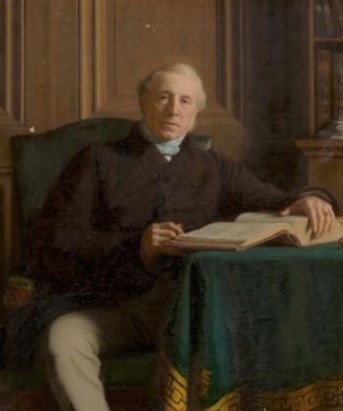
Henri Tronchin

While the Tronchin family was prominent and wealthy citizens of Geneva, they were not predominately spiritual. However, though it is not known exactly when, Henri Tronchin came to faith in Christ and embraced Protestantism. Studying literature at the Academy of Geneva, he later served as artillery captain on horseback in the Dutch army. Eventually rising in ranks to lieutenant-colonel of artillery, he married in 1824. A superb organizer and a great leader, he helped found the Evangelical Society of Geneva (c1833). He served as president of the Society from 1834 to 1839. Born 100 years after Voltaire, and occupying the former home of the infamous infidel, Tronchin used the spacious house to store Bibles and Gospel tracts. Rev. William Acworth of Queens College, Cambridge, appointed an agent of the British and Foreign Bible Society in 1829, was an eye witness to the stored Bibles and Gospel tracts.[8]

In The Missionary Register for 1836 of the BFBS, Acworth is recounting his travels in the spread of the Gospel. Having traveled over 2,000 miles in France on the business of the Society, in the summer of 1836 his travels took him to Switzerland in August of that year. Acworth recounts: “I went through Geneva, and was much refreshed by meeting the Committee of the Evangelical Society, with whose proceedings and objects I was so much gratified, that I wrote to this Society to make a liberal grant of 10,000 copies of the French Scriptures to promote the objects of that Society. Our committee have only granted 5,000; but I have no doubt they will, err long, send the other 5,000. Before I left Geneva, my friend observed. “Probably you will like to see the house where Voltaire lived, and where he wrote his plays.” Prompted by the spirit of curiosity, so characteristic of an Englishman, to visit the house of the celebrated infidel, I was about to put on my hat to walk into the county, when he said, “It is not necessary you should put on your hat” and he introduced me over the threshold of one room to another, and said, “tis the room where Voltaire’s play were acted for the amusement to himself and his friend.” And what was my gratification in observing that that room had been converted into sort of Repository for Bibles and Religious Tracts. Oh! my Christ Friends, that the spirit of infidelity had been there, to witness the results of other vaticinations [acts of prophesying] respecting the downfall of Christianity! I know that Voltaire said, that he was living “in the twilight of Christianity” but blessed be God! It was the twilight of the morning, which will bring on the day of universal illumination.”[9]

Only fifty-eight years after his death the former home of Voltaire in Geneva, Switzerland, was indeed serving as a storehouse for Bibles and Gospel tracts. While the Evangelical Society of Geneva did not actually purchase the house, Henri Tronchin, president of the Society, resided in the house, and used some of the rooms to store Bibles which Voltaire so vehemently opposed and prophesied Christianity’s downfall! Yes, an ironic twist of divine Providence.

Let it also be noted, only sixteen years after Voltaire’s death, in 1794, the presence of the Bible began making in-roads in the town where he spent the last eighteen years of his life, Ferney, France. On the very printing presses which Voltaire employed to print his irreverent works was used to print editions of the Bible and, according to the eyewitness account of Hannah More,  were printed on paper that had “been especially made for a superior edition of Voltaire’s works. The Voltaire project failed, and the paper was bought and devoted to a better purpose [of printing Bibles]!”[10]

In the book Letters from an Absent Brother, by Daniel Wilson, Bishop of Calcutta, which chronicles his travels through parts of Netherlands, Switzerland, Northern Italy, and France, he writes to his sister from Geneva on Wednesday evening, seven o’clock, October 1, 1823, concerning the distribution of Bibles in the town where Voltaire once lived: When I arrived at Paris, one of the first things I heard was that a Bible society had been established at Ferney, chiefly by the aid of Baron de Stael. What a noble triumph for Christianity over this daring infidel. One of the first effect of the revival of true religion or even of sound learning in France, I should think would be to lower the credit of this profligate, crafty, superficial, ignorant, incorrect writer. What plea can wit or cleverness, or the force of satire or the talent of ridicule or a fascinating style, or the power of brilliant description, form, in a Christian country, for a man who employed them all, with a bitterness or ferocity, of mind amounting to almost madness, against the Christian religion and the person of our Saviour.[11]

That a Bible society had been established in Ferney, France to help financially in the printing of Bible’s in the town where Voltaire once resided, is confirmed in the 1824 Report of the Protestant Bible Society at Paris containing the following sentence: A newly established branch at Ferney formerly the residence of Voltaire, has sent its first remittance, a sum of 167 francs.[12]

Further proof that the printing presses being employed to print Bibles were the ones Voltaire once used to print his blasphemous works is contained in a transcript from the Quarterly Papers of the American and Foreign Bible Society of 1837: “A Bible Society was some years since established at Ferney, once the residence of Voltaire—the prince of infidels. This noble enterprise for the propagation of the Christian religion is said to have commenced by Baron de Stael, and a few zealous Christians in that place. In the history of Bible Societies, this is truly a memorial event. That the antidote should issue from the very spot where the poison of infidelity for so many years disseminated; and the advocates of Christianity should in that very place print and circulate the sacred volume, as a sufficient shield against misrepresentations sophistry which he had there assailed divine revelation, are the events which the brilliant Frenchman would have pronounced impossible….Oh! That the gifted infidel could have been there, to witness the result and repent of his ratiocinations [reasoning]  respecting the downfall of Christianity. But, there is a point beyond which even divine forbearance does not extend” [13]

In 1845 Bibles were still being printed on printing presses Voltaire once employed in Ferney, France. The 1846 anniversary address of The American and Foreign Bible Society, Rev. Charles G. Sommers gave a stirring report on how the Bible was making penetration into various places around the world. When speaking about the Scriptures advancements in countries around the world (including France) in the previous year of 1845, Rev. Sommers stated,
“Much has indeed been accomplished, but much more remains to be done for the millions who are still without God, without Christ, and without hope in the world. It is true, indeed, and we thank God, that in nine years this Society has printed one million of books in forty-nine different languages, but hundreds of millions must be distributed among the famishing myriads of our race. By what other means can we hope to arrest the progress of infidelity and Romanism; now marching in triumph over the fields of our fair inheritance? When Pythagoras and Confucius were filling Europe and Asia with heresies, God raised up Ezra, the prophet, to compile and publish the books of the Old Testament, as an antidote to their delusions. And when Voltaire, Diderot, D’Alembert and Rousseau were laboring to crush the bleeding cause of Christ, God raised up against them the standard of the British and Foreign Bible Society; and it is a cause for grateful exultation that the same printing press which was employed to scatter the blasphemous tracts of the prince of French philosophers, has since been used at Ferney (France), to print the Word of God. The black confederacy raised their bulwarks to impede the march of truth, but they would have been equally successful, had they forged chains to bind the lightning, that cometh out of the east, and shineth even unto the west, as the precursor of the coming of the Son of man. Voltaire boasted that he had seen the twilight of Christianity, and that the pall of an endless night would soon cover it forever. Yes, sir, he did see the twilight, but he was mistaken as to the hour of the day—it was the twilight of morning, pouring its effulgence over the brim of the horizon of the nineteenth century, which he mistook for the rays of a setting sun.”[14]

Having established that Bibles were actually stored in Voltaire’s former Geneva residence and were being printed on printing presses he once employed in Ferney, France, did he ever make such a prediction that one hundred years after his death the Bible would no longer be read? A man who wrote 20,000 letters in his lifetime, it would be impossible to know all the statements he wrote or spoke. However, it was generally acknowledged and understood by those near the time Voltaire lived that he had made such a prediction either verbally or in writing which may no longer exist. Rev. Acworth in 1836, only fifty-eight years after Voltaire’s death, referred to the infidel’s “vaticinations [act of prophesying] respecting the downfall of Christianity! Such a remark indicates it was common knowledge that such a bold prediction had been made by Voltaire. In 1849, only seventy-one years after Voltaire’s death, William Snodgrass, an officer of the American Bible Society, stated in the giving of ABS’s annual report that “the committee had been able to redeem their pledge by sending $10,000 to France, the country of Voltaire, who predicted that in the nineteenth century the Bible would be known only as relic of antiquity.”[15] Again, such a remark indicates it was commonly acknowledged that Voltaire had made such a prediction.

Found in an interpretative book on many of the works of Voltaire published in 1823, only forty-five years after his death, the author, a contemporary of the Frenchman, details the fact that he brutishly sought to inspire contempt for the Christian faith and saw himself more influential than Martin Luther and John Calvin! Voltaire wanted a “religion to be without code, without laws, without dogma, without authority” and “laughed all these Christians who believed their religion was truly divine.” The author states that Voltaire in his fight against Christianity would stop “at nothing to annihilate” the Christian faith.[16] It is obvious those in Voltaire’s day believed his efforts were for the purpose of dismantling Christianity.

While this writer could not find the exact quote that usually accompanies the story, similar quotes could be found. In an 1855 biography of Voltaire, the author quotes him as stating in a letter to a friend, “It is impossible that Christianism survives.”[17] In an effort to assist in bringing about what he perceived would hurry the demise of “Christianism,” in 1776, at age 82, Voltaire brought to a culmination his disdain for the Bible when he published La Bible Enfin Expliquée (The Bible Fully Explained).[18] The two-volume work was Voltaire’s commentary on the whole Bible. His purpose in writing was to “make the whole building [of Christianity] crumble.”[19] Writing with feigned credulity in a satirical and scoffing manner, he wrote viciously, mockingly critical and skeptically of practically every book and verse in the Bible. His sought to expose, as he saw it, the foolishness and irrationality of belief in the Bible. Of his massive tome, in which he derided the Bible on every page, he stated, “The subject is now exhausted: the cause is decided for those who are willing to avail themselves of their reason and their lights, and people will no more read this [Bible].”[20]

From such an arrogant declaration it is clear Voltaire delusionally believed as a result of his La Bible Enfin Expliquée, he had struck a death blow to the Bible’s believability and the sun was setting on the Book’s influence and in time the Volume would become irrelevant. However, instead of the Bible becoming irrelevant and no longer believed, the Inspired Volume begins to increase in circulation….his former house, only fifty-eight years after his death, being used as a storehouse to house Bibles and Gospel tracts and printing presses he once employed to print his anti-Christian sentiments was being used to print Bibles!

Like all stories that are repeated over the years, the exact details and wording may vary, but it seems clear the key components of the story are very much true. The story of Voltaire serves as an example and a reminder that the foolish predictions and efforts of man to extinguish the Bible will come to naught. No skeptic’s scoffing hammer has ever made a dent in the Eternal Anvil of God’s Word. To those who attempt to do so, Jesus emphatically declares, “Heaven and earth shall pass away, but my words shall not pass away” (Matthew 24:35).

Amen!

Blessings,
Dr. Dan

Notes:
[1] Norman Geisler and William Nix, Introduction to the Bible, (Chicago: Moody Press, 1968), 124.

[2] Sarah Coakley, Faith, Rationality and the Passions, (MA: Blackwell Publishing, 2012), 37.

[3] Voltaire, Trans. Joseph McCabe, Selected Works of Voltaire, “The Sermon on the Fifty,” (London: Watts & Co., 1911), 178-180.

[4] Voltaire, ed. H.I. Wolff, Philosophical Dictionary, “Arius,” (New York, 1924), 253.

[5] Quote of Voltaire from his work God and Man, chapter xliv, found in James Parton, Life of Voltaire, Vol. II, (Boston: Houghton, Mifflin & Co, 1881), 429.

[6] Stelling-Michaud, Suzanne, Le livre du Recteur de l’Académie de Genève (1559-1878) (Vol 6), (Geneva: Librairie Droz, 1980), 72; also, Jean-Yves Carluer, “Henri Tronchin,” December 16, 2017, http://le-blog-de-jean-yves-carluer.fr/2017/12/16/henri-tronchin/ (Accessed March 12, 2019). In 1929 the Les Delices property was purchased by the city of Geneva, and now houses the Institute et Musee Voltaire, a museum founded in 1952 dedicated to the life and works of Voltaire.

[7]On Voltaire’s relations with the Tronchin family, see Deidre Dawson, Voltaire’s Correspondence: An Epistolary Novel (New York: Peter Lang, 1994), 101–126; also, George Valbert, “The Genevese Councilor François Tronchin and his relations with Voltaire”, The Revue des Deux Mondes, 1895, 205-216

[8] William Canton, A History of the British and Foreign Bible Society, 1845-1926, (London: J. Murray, 1903), 98.

[9] The Missionary Register for 1836, William Acworth, “Bible Notices in Switzerland and Italy,” (London: L&G Seeley, 1836), 352.

[10] The Gentleman s Magazine, July, August, September 1794; Samuel Bagster, The Bible of Every Land, (London, 1860), 167. Curiously enough, Bibles were printed on paper, which, according to Hannah More, had been specially made for a superior edition of Voltaire’s works. The Voltaire project failed, and the paper was bought and devoted to this better purpose. Monthly Extracts, 1848, August, p. 793.

[11] Daniel Wilson, Letters from an Absent Brother, (London, 1824), 187.

[12]Report of the British and Foreign Bible Society, Vol. 7, 1822, 1823, 1824, (London: J.S. Hughes, 1824), 17-18.

[13] Quarterly Papers of the American and Foreign Bible Society, No 11, New York, July 1837, “Bible Society at Ferney,” 21-22; also,  Proceedings of the Bible Covention which meet in Philadelphia April 26-29, 1837, (New York: John Gray, 1837), 21-22.

[14] Ninth Annual Report of the American and Foreign Bible Society, Presented at New York, May 15, 1846, (New York: John Gray, 1846), 48.

[15] Annual Report of the American Bible Society, 1849, Appendix, 98.

[16] Claude Francois Nonnottee, Erreurs de Voltaire, (Paris, 1823), 285-305.

[17] Eugene Noel, Voltaire, (Paris: F. Chamerot, 1855), 99.

[18] Arnold Ages, “The Technique of Biblical Criticism: An Inquiry into Voltaire’s Satirical Approach in La Bible Enfin Expliquée,” A Quarterly Journal in Modern Literatures, September 6, 2013, 67-79.

[19] Voltaire, La Bible Enfin Expliquée, (Alondres), 1776, 2.

[20] Voltaire, La Bible Enfin Expliquée, (Alondres), 1776; also; James Parton, Life of Voltaire, Vol. II, (Boston: Houghton, Mifflin & Co, 1881), 543.