A PROBLEM NO ONE WANTS TO TALK ABOUT

This is a subject few want to discuss, especially if it happens to you. This writer doesn’t relish writing about it, but it is a subject that needs addressing. For those affected, it can be a devastating, heartbreaking, and even embarrassing experience, leaving one feeling like a failure and frustrated. Yet this is an issue that is becoming more prevalent in the culture in which we live. It is an issue that can’t be swept under the rug. If it happens to you, what are you to do?  How is one to deal with it?  Ignoring the issue will not make it go away. Not talking about it will not make the issue disappear.

The issue becoming more prevalent today has to do with young adults disassociating themselves from their parents. In the current culture, a shift has occurred from traditional conservative ideological presuppositions and agendas that once prevailed and influenced society. Traditional ethics and morality have gradually been replaced by the Millennial Generation and Gen Z (those born between 1997-2012), that clashes with those of Baby Boomers.  The Millennial Generation is typically defined as people born from 1981-1996. Most Millennials are children of Baby Boomers, those born from 1946-1964.  This writer has not only seen this disassociating issue become a growing problem invading the lives of many families and touching a multitude of parents, for this writer it has become a painful reality on a personal level. It is hoped that what is written will be beneficial and helpful for those experiencing estrangement in the adult-child-parent relationship. In years gone by, it was common for adult children to be loyal to their parents even when all involved didn’t see eye to eye on every issue and subject. That is not the case in our current cultural climate.  

Let me clarify the tenor of the dissociation being addressed here.  I am not talking about those who disassociate from their parents because their parents were abusive or basically absent from their lives. That at least can be understood, but I am addressing dissociation where there is a difference in ideology, values, convictions, and principles among the young adult and the parents. At the root of the dissociation is  what this writer labels a “snowflake” mentality or ideology.     

Let me describe what is meant by “snowflake” ideology. This writer uses the term “snowflake” to describe a person who is easily offended, they are overly sensitive, and is emotionally fragile. Snowflake ideology doesn’t tolerate those who disagree with them or have principles or opinions differing from them. They seem to be unable to deal with opposing opinions, viewpoints, or lifestyles which differ from what they deem as key issues. Instead of seeking to find common ground, they disassociate themselves from those who are not in their ideological camp; even if it means “divorcing” themselves from their parents. Talking with a Christian counselor about this matter, he informed me this is a growing epidemic that is rooted in the culture of today.   

Interestingly, snowflake ideology preaches tolerance, yet they are the very ones who are intolerant. They are not interested in finding common ground, but they want complete surrender to their ideology or they will sever association with those who don’t capitulate to their views. Snowflake ideology considers any belief system that differs or clashes with theirs as dangerous, unsafe and a non-nurturing environment that is not to be tolerated. As a general rule, snowflake ideology considers Christian morality, values, and principles the biggest enemy to their limited and intolerant perspective. Snowflake ideology usually embraces the LGBTQ agenda, trangendersm, social justice issues, and is often anti-religious. While saying they are for equality, acceptance, and protection of all rights, it is only their rights of which they champion. Those “rights” are for those who adopt their agenda, and exclude those who adopt an ideology other than theirs…and this especially applies to those who embrace a Christian worldview.  

It is not this writer’s intent here to expound the fallacies or veracity of the snowflake ideology versus the Christian ideology, but how is a parent to respond when disassociation takes place with one’s grown children over ideological differences. As one who holds to a Christian worldview, Jesus said that the time would come when Christian disciples will find those of their own household, those of their own family, would be their worst enemies. We would love to say, “Say it ain’t so! Blood is surely thicker than water.”  However, it is not only so, but it is becoming more widespread in today’s culture. We know that even Jesus’ own brothers (half-brothers) were not believers when he walked on earth.

The question is, how do we respond?  

 From personal experience, it is devastating when you receive an email from one of your grown children that they no longer desire to be part of your lives. Reasons listed for such a decision were that our Christian values were seen as fostering “an unsafe and non-nurturing environment.”  Association could no longer be possible since we as parents didn’t support the LGBTQ agenda, transgenderism, and social justice issues, which put us on the wrong side of progressive history. We were called homophobic, misogynist, and scolded for our moral (biblical) views on sexual orientation and gender identity.  Our Biblical values and morality was said to be rooted in hate and intolerance, which undermines creating a safe and nurturing environment. We being on a different path morally and ethically, interactions could not continue.

To receive such an email cuts to the very quick of the very fabric of one’s soul. A child that you have loved for over three decades decides the morals, values, and principles they were taught growing up are now deemed unsafe and such values are rooted in hate and intolerance. A parent need not defend their values, principles, and convictions when harsh accusations are forthcoming. Defending one’s self usually proves unproductive, and, as well, falls on deaf ears that have already made up their mind. Without question, such a dissociation puts one in a tailspin that finds the grief process being experienced. The grief process has no timetable and one can find it takes time to work through it and come out on the other side.

There is first denial, that one of your children would forsake the values of their childhood and embrace a delusional morality of relativism. It makes you wonder how it happened that one you had in your home for almost two decades could abandon the values which we sought to instill in them. A parent always envisions having a close relationship with their adult children.  When an adult child cuts a parent off, it can evoke powerful feelings of guilt, regret, confusion, anxiety, helplessness; which one can deny such emotions, but they are still very real. Don’t deny how you feel. Cry, grieve…accept your emotions and response as normal. Let the tears freely flow. It is part of the healing process. One truth is certain…loving a child can bring one great pleasure or great pain.

There is anger, some of the anger is turned toward yourself that you in some way failed as a parent. The shame often associated with being rejected by an adult child can cause many parents to suffer in silence and isolation, they believing they must be a terrible parent for their own child to reject them.  You evaluate your own past dealings with them, and where you went wrong. However, one need not indulge in an unnecessary guilt-trip as it will prove unproductive.  There are no perfect parents, and I am sure any parent would change a few things if it were possible.  You can’t be a parent and not make mistakes, but that does not mean that our mistakes are the reason for the estrangement or that you deserve it. As well, you become angry at the now adult-child for being influenced by worldly values that are clearly proven snake oil.

There is bargaining in the form of prayer, that the wayward child will awaken to the error of their ways. Surely child and parent can find common ground, even in the midst of clashing ideologies. Can’t some boundaries be established that there will some subjects and issues not talked about for the sake of the family and grandchildren? But such boundaries don’t seem to be forthcoming.

 Yes, there is depression that one you raised, sacrificed for, and poured love into, has decided that worldly ideology is more important than blood kin and the parent-child relationship. There is the dawning reality because of the path they have taken and their dissociation that you will not see your child again or have any further interaction with them. That clearly can create depression, especially in the mother.   

At last, there is acceptance. There is no timetable as to when parents will arrive at acceptance. Some may never arrive there. Each of us grieves at our own pace. When an adult child “divorces” his parents, believe me there is grief. Now I can’t speak for everyone, I can only relate the experience of my wife and I. After the initial shock of the email, and receiving no response from correspondence we sent, we decided to do three things.

First, pray for the child that the Lord will open their wayward eyes and give sight to their blinded heart. No one can change someone’s mind once it is made-up, only the Lord can do that. Pray and leave them in the hands of the Lord. I realize that is easier said than done, but it must be done.

Second, we decided after some time to treat this as we would a death. In actuality, it is a death. It is death to a child-parent relationship. It is a death to grandkids that you may never see or hear from again. If that is not a death situation, I don’t know what is. Treating it as a death situation allows one to grieve. As with grief, there comes a time when it is time to move on. Yes, it is understood that grieving time varies with each individual.

Third, there needs to be a time when one moves on with their life. One thing I have learned, you can’t make someone have a relationship with you who doesn’t want, too. If someone, even a child, doesn’t want a relationship with you and desires to exclude you from their life, you can’t make them do otherwise. No amount of wishing, wringing of the hands, or sitting around depressed over the dissociation will change the situation. There has to come a time when one moves on, and instead of being paralyzed by a relationship you no longer have, begin investing in the loving relationships you do have. One can become so paralyzed by a broken relationship that they no longer enjoy the other relationships that have been placed in one’s life.  I have often said, “Don’t dwell where you are not tolerated, but enjoy the moments where you are celebrated.”  

Some would argue that the idea of moving on from an adult child’s rejection seems like giving up. After all, what kind of parent moves on with their life while they are estranged from their child? Because of such thinking, few parents do move on. They are like a car in a muddy field; they get stuck spinning their wheels, going nowhere. They sit staring at a silent phone, which never rings, or waiting for the mailman to deliver a letter of reconciliation, which never comes.  Some parents put their lives on hold until the child comes back into their lives. Well, that may never happen. A parent must face the fact that they may never come back into their lives.  However, getting on with one’s life despite what has taken place connects one with other people, other activities, and helps fill the void, allowing healing to occur. 

In moving on, in letting go, it is not that you no longer care; it is they who no longer care.  And you can’t make someone care.  When Jesus laid out the requirements to the Rich Young Ruler for following Him, the young man turned and walked away. It says Jesus beheld him and loved him, but Jesus didn’t chase after him. It wasn’t that Jesus no longer cared; it was the young man who no longer cared.  When the Prodigal Son wanted to leave the father’s house, the father let him go. Thankfully, he came back in time, but the father let him go with no guarantee that he would ever return.  

Yes, there comes a time we must let go of situations and people we can’t change. You can’t help people who are not willing to help themselves. Some parents put their lives on hold until the child comes back into their lives. Well, that may never happen. A parent must face the fact that they may never come back into their lives.  Even after an adult child’s rejection, a parent has the right to enjoy their life. That involves letting go.

Yes, it is painful to let go. But for one’s physical, emotional, and spiritual well-being there comes a time when we must let go and move on with our lives. Even though a child may abandon their parents, the Lord has not abandoned His children. There are times we must give a loved one over to the Lord and let Him deal with the issue.  We must not become paralyzed by a wayward child, for the Lord has much more for us to do for Him and others who appreciate the love we have to invest.  Yes, it hurts when a child rejects our love, but there are others who are and would be more than overjoyed to have that love invested in their lives. Moving on, one can better spend time and energy on people who want our company, on interests that are meaningful and fulfilling to us, and where we can make a difference. One is best served to remind oneself that one has other important relationships, and learn to focus on those.

One important act we must do in spite of the painful estrangement that is being experienced. We must follow the example of Jesus, who said in the presence of those who crucified him, “Father, forgive them for they know not what they do.”  It is easy to blame ourselves or blame others for the abandonment we are experiencing, but we must realize that the final choice of estrangement is our adult child. We must forgive them for their choice for the sake of our own sanity and well-being. We are offering forgiveness without requiring an act of contrition on their part. Withholding forgiveness keeps us hostage and is associated with emotional distress and can further bouts of depression. Granting them the gift of forgiveness is a gift to them and, as well, a gift to ourselves. 

One truth is certain about life, is that it is all about eventually learning to let go, even when we don’t want, too. As a parent, one’s job is to raise the child to the best of one’s ability and teach them how to be productive adults. If, during the process, they embark upon a path different from the way they were raised, we must remind ourselves that we can’t make choices for them or live their lives for them. Learning to let go is the best way to approach situations and people in our lives that don’t go the way we expect, including when our adult children choose to reject us.

I realize this is not an easy issue to discuss or even own up to the fact that it has happened to you, but happen it does. We have moved on and refuse to continue to dwell where we are not tolerated, but embrace where we are celebrated and where the love we have to share with others is appreciated. Whatever one does, one must not isolate oneself, but seek support from others who have experienced estrangement. Above all, one must keep their eyes on the Lord, realizing we are His children and whose strength and love undergird us no matter what comes our way. After all, no one understands the experience of estrangement more than our Lord; therefore, He bids us to come unto Him.    

Blessings,

Dr. Dan

WORDS OF WISDOM FOR WOUNDED WARRIORS

Pain is part of life. Whether it be physical, emotional, or mental pain, its thorns can rip deeply into one’s flesh or one’s psyche, leaving one in a state of excruciating discomfort and restless distress. Pain is the physical or mental suffering or discomfort experienced when we encounter the opposite emotions known from the joy, happiness, and the “good feeling” that can be found in life. Pain is the result of the loss of health or someone or something which we cherished dearly; something or someone which we valued as bringing meaning to our lives.

While physical pain can be torturous, the longer I live the more I have come to believe the pain that accompanies loss or rejection can bring unbearable ache and hurt in one’s innermost being that even medicine, time, or pills cannot abate. We all know the pain of losing a loved one through the doorway of death, we weep much because we loved much. Love always carries with it the risk of pain. When we love, there is always the risk that the joy can be turned into pain as the person may be snatched from us in death. Of course, if we live long enough, that will happen. That is part of the natural flow of life.

Over the years, the greatest pain can come from the rejection and abandonment by those we loved and valued in our lives. As a young person, most of us have experienced loving someone who, for a while, valued us, then rejected us and broke our hearts. Then there is the betrayal of someone we treasure as a friend, who we thought would always stand with us, then they turn against us and estrangement replaces friendship. Such pain rips our insides out. However, some of the worst pain is when one of your own loins, one who has our DNA stamped upon their very being, turns their back on you and desires to no longer be part of your life. They reject your Christian values to choose a path of moral relativism and in the process, reject you as a parent or guardian for holding such antiquated values that they perceive as harmful and no longer of value for them to follow. They throw out the baby with the bathwater. Such a rejection cuts to the very quick of one’s soul and the fabric of one’s innermost being. It leaves one asking, “What could I have done differently?”

To be rejected or abandoned by one who shares your DNA, raises more questions than answers. As a matter of fact, few answers are forthcoming, which can leave one confused and engulfed in a grief that resembles that of a death. It leaves one in a quandary to either (1) let go – to move on – not moving on because you quit caring, but they no longer care and they have let go — or (2) to wrings one’s hands in desperation and paralyzing grief and in the end miss out on sharing love with those who do care. I have always believed one should not wallow in the mud of nontoleration but pitch one’s tent where one finds celebration. Of course, we continue to pray for the wayward one who has abandoned their DNA for antichristian philosophies, which will eventually prove sorely lacking in a crucible of relativism and regret. There does come a time, though, life moves onward like a mighty river, and we must move with its flow or be swept away by stagnant grief that bogs one down from experiencing God’s high destiny for their life.

When the Rich Young Ruler was confronted with the demands of Jesus and walked away, the Master didn’t run after him. The Bible says, “Jesus looked at him, loved him” (Mark 10:21). Jesus loved him, but when the young man walked away, Jesus didn’t chase after him, but let him go — not because the Master no longer cared, but because the Rich Young Ruler didn’t care for Jesus’ answer. As well, we know that Jesus as He walked on earth, his brothers didn’t embrace Him, yet He never lost sight of His high calling. No doubt their unbelief and estrangement caused him great inward pain, but He never lost sight of His purpose and calling as He marched toward the cross.

Are you hurting within over forsaken and rejected love by those who share your DNA? Keep looking to Jesus, place all things in His hands, and like a flint, remain focused on the Christ of the cross. Trust the Lord and leave the consequences to Him. If you know someone who is enduring the pain of abandonment, don’t judge them, but pray for them and be their friend. The waters of abandonment can be murky, but the Captain of the Ship of Zion will guide the ship safely to shore…and it is hope those who have walked away like the Rich Young Ruler to walk a perceived different path will one day make their way to the Ship of Zion before it docks at the last harbor of life.

Is there any guarantee that those we have loved but have abandoned their Christian heritage and those with whom they share a blood connection will eventually find their way home like the Prodigal Son? No, there is no guarantee they will ever return. They may be like the Rich Young Ruler, walk away for good, never to be heard from again. Again, one must keep their eyes on Jesus and leave the outcome to Him. We are only answerable to the Lord for ourselves, so let us keep our eyes focused on our Lord…realizing His grace is sufficient and sustainable even in the throes of inward pain. Hang in there Wounded Warrior, for the stars shine brightest on the darkest nights. Remember, “Weeping May Endure for a Night but Joy cometh in the morning” (Ps 30:5).

Blessings,

Dr. Dan

DO APOSTLES EXIST TODAY?

Do Apostles exist today?  Most of Christendom contends that being an Apostle was limited to the beginning of the Church, that it was foundational in its functionality; therefore, there are no more Apostles today. However, some groups within Christendom contend that the gift of an Apostle is a continuing position, though maybe not in the same sense as the first Apostles.

Come, let us reason together.

 Let’s begin by a definition of the word “apostle”? The word is derived from the Greek word ἀπόστολος (apóstolos), literally meaning “one who is sent forth.”  It refers to a person who is sent, as a messenger or representative. The word was used to speak of a messenger, an ambassador sent off on a mission (i.e., like a commander of a naval force, or a messenger carrying a message for a king or royal dignitary). An “apostle” or “one sent forth” held the same authority as the person who was sending them.

The Greek word that is translated “apostle” is used 81 times in the New Testament.   The majority of the time, it refers to the Twelve Apostles, the ones Jesus sent out to be His witnesses of the resurrection. However, the word “Apostle” was used to designate other early Christian men other than the Twelve, such as Paul, Barnabas, and others.   The term specified an important foundational position in the early church by those who spread the Good News of Christ who met certain criteria.

First, an Apostle was to have seen the risen Lord. According to Scripture, an Apostle had seen the resurrected Christ. When the Eleven sought to replace Judas, who had betrayed Jesus and took his own life, one of the criteria to fill the position of Apostle, Peter stated that one “ordained must be a witness with us of Christ’s resurrection” ( Acts 1:22; 15-26).

The Apostle John reaffirms this in I John 1:1 of his visible witness to Christ, “That which was from the beginning, which we have heard, which we have seen with our eyes, which we looked upon, and our hands have handled, of the Word of Life (Christ).”  

Peter and the other disciples are declared to be Apostles, as they saw the risen Lord. And that he (Christ) was buried, and that he rose again the third day according to the scriptures: And that he was seen of Cephas (Peter), then of the twelve: (I Cor. 15:3-7).

As well, Scripture teaches us that Jesus “was seen of above five hundred brethren at once; of whom the greater part remain unto this present, but some are fallen asleep. After that, he was seen of James; then of all the apostles” (I Cor. 15:3-7).

So, not only were the original twelve apostles eyewitnesses of Jesus’ resurrection, but all who had the gift of an Apostle had to have seen the risen Christ. Barnabas is referred to as an “apostle” in Acts 13:2, 14:14, as well as Andronicus and Junias (Romans 16:7). No doubt there were other Apostles, as well. But the criteria was they had to have seen the risen Lord.

Paul, who was not one of the Twelve but was an Apostle, as he, too, saw the risen Lord.  Paul writes in I Corinthians 9:1: “Am I not free? Am I not an apostle? Have I not seen Jesus our Lord? Are not you my workmanship in the Lord?”

There are those who say Paul saw the resurrected Christ after He ascended back to heaven, so how could he have been an Apostle? Paul can rightfully be called an apostle because he was personally and visibly visited by Jesus (Acts 9), and, as we shall see, he fulfilled the same requirements that determined one’s Apostleship. 

Based on that criteria that one must have seen the resurrected Savior, only first-generation Christians could meet this requirement. Obviously, no one today would qualify as an Apostle if an Apostle had to be an eyewitness of the resurrected Christ Jesus.  

Second, an Apostle was chosen and commissioned by the Lord (Holy Spirit). In John 20:22, Jesus, after his resurrection, commissions His disciples to carry forth the message of the Gospel and breathed on them the Holy Spirit to empower them to do so.  In Acts 1, shortly before Jesus ascended back to Heaven, He again commissions those gathered to preach the Good News. Jesus’ commission was clearly given to those who saw the resurrected Savior.   

As for Paul, one born out of due time, the Scripture records that the Lord personally commissioned him. Paul writes in I Corinthians 15:8-9: “Then last of all He was seen by me also, as by one born out of due time. For I am the least of the apostles, who am not worthy to be called an apostle, because I persecuted the church of God.” Jesus personally appeared to Paul, the Lord saying unto him that “he is a chosen vessel unto me, to bear my name before the Gentiles, and kings, and the children of Israel” (Acts 9:15).

So, unless one has been personally and visibly visited by the resurrected Christ and personally commissioned to proclaim the Gospel, they would not meet the criteria of being an Apostle.

Third, an Apostle was associated with miraculous signs.  The Apostles had the ability to perform signs and wonders. Acts 2:43 reads. “For fear came upon every soul, and many wonders and signs were being performed through the Apostles.”

Paul wrote in 2 Corinthians 12:12 of his ministry there, “Truly the signs of an apostle were accomplished among you with all perseverance, in signs and wonders and mighty deeds.”

It was the apostles who were given special signs (miracles) to confirm their message (Hebrews 2:3-4).

One who today claims to be an Apostle, do signs and wonders and mighty deeds follow them?

Fourth, an Apostle was given special revelation.  In the early formation of the Church, there was no New Testament canon to teach or guide believers.  An Apostle was given special revelation by the Lord to instruct the people in correct doctrine and the truths pertaining to faith and practice. It was the “apostles’ teaching” in which the early church continued (Acts 2:42).  

Following his conversion to Christ, Paul spent time in Arabia, where he was personally taught by Christ (Galatians 1:12-17).  Paul’s message was not his own, but he writes, “For I neither received it from man, nor was I taught it, but it came through the revelation of Jesus Christ” (Gal. 1:12).

In Acts 10 Peter received a vision, a revelation, from the Lord in which he is taught about the universal scope of God’s salvation in Jesus Christ, the scope of salvation including both Jew and Gentile.  

On the Island of Patmos, the Apostle John, is personally given a revelation of Christ of messages he is to send to the seven churches. As well, John is caught up into heaven (Rev. 4) where he is given a message of “things that must surely come to pass” (Rev. 1:1). John’s special revelation is known in our Bible as the Book of Revelation.  John writes in Revelation 1:9-19 of the heavenly revelation he received: I, John, your brother and companion in the suffering and kingdom and patient endurance that are ours in Jesus, was on the island of Patmos because of the word of God and the testimony of Jesus. 10 On the Lord’s Day I was in the Spirit, and I heard behind me a loud voice like a trumpet, 11 which said: “Write on a scroll what you see and send it to the seven churches: to Ephesus, Smyrna, Pergamum, Thyatira, Sardis, Philadelphia and Laodicea.”  12 I turned around to see the voice that was speaking to me. And when I turned I saw seven golden lampstands, 13 and among the lampstands was someone like a son of man, dressed in a robe reaching down to his feet and with a golden sash around his chest. 14 The hair on his head was white like wool, as white as snow, and his eyes were like blazing fire. 15 His feet were like bronze glowing in a furnace, and his voice was like the sound of rushing waters. 16 In his right hand he held seven stars, and coming out of his mouth was a sharp, double-edged sword. His face was like the sun shining in all its brilliance. 17 When I saw him, I fell at his feet as though dead. Then he placed his right hand on me and said: “Do not be afraid. I am the First and the Last. 18 I am the Living One; I was dead, and now look, I am alive for ever and ever! And I hold the keys of death and Hades. 19 “Write, therefore, what you have seen, what is now and what will take place later.” (NKJV).

With the writing of Revelation by John, the canon of the New Testament was now complete. The canonical books being those necessary for faith and practice of believers for all generations, and since the canon of Scripture is now closed, there is no need for such revelation today as came to the Apostles. 

Fifth, an Apostle was a foundational “office” on which the church was built. Paul identified the office/position of an Apostle as foundational to the Church. In Ephesians 2:19-20, Paul wrote, “Now, therefore, you are no longer strangers and foreigners, but fellow citizens with the saints and members of the household of God, having been built upon the foundation of the apostles and prophets, Jesus Christ Himself being the chief cornerstone.” It was the Apostles who were the foundation of the church—with Jesus being the cornerstone.

Conclusion

Clearly, the work of apostleship was to lay the foundation of the Church in a sense secondary only to that of Christ Himself, thus requiring eyewitness authority behind their preaching. After the Apostles laid the foundation, others could build upon the Church. The foundation was laid in the first century. The responsibility of the Apostles, laying the foundation of the church, would also argue for their uniqueness confined to the first century. The Apostle’s foundational purpose is no longer necessary. Two thousand years have passed since the foundation was laid, and we are not still working on the foundation.

Taking those five requirements into consideration, it seems logical to conclude that there are a number of specific requirements for one being an Apostle that are impossible for anyone today to fulfill.  No biblical evidence indicates that the apostles were replaced when they died. Jesus appointed the Apostles to do the foundational work of the Church, and foundations only need to be laid once. After the Apostles’ deaths, other offices besides apostleship, not requiring an eyewitness relationship with Jesus, would carry on the work.

The responsibility of the Apostles, laying the foundation of the church, would also argue for their uniqueness. Again, two thousand years have passed since the foundation was laid, and we are not still working on the foundation.

Those who claim the office of an Apostle still exists today, often desire or claim Apostolic authority equal to the authority of the first-century Apostles. There is absolutely no Scriptural evidence to support such authority still exists. Paul warned against false Apostles in his day, (2 Corinthians 11:13), and it is a warning that no doubt needs to be heeded today.

Blessings,

Dr. Dan

THE JOURNEY CONTINUES – PART III

In Parts I and II, I have chronicled my 12-year journey with prostate cancer. I ended Part II with my beginning in March 2023 taking monthly Lupron shots.  I have been on monthly Lupron shots now for two years. How has my journey on Lupron shots been? 

Let me preface my answer by saying, “I am still alive and very blessed.” Life on Lupron is not a picnic by any means. It can at times be a living nightmare, but the trade-off is, that they are keeping the cancer dormant, and I am still alive. Regarding the side effects of Lupron shots, they are an unwelcome nuisance and do impact one’s life.

Lupron reduces the testosterone in the male, which prostate cancer cells feed upon. Testosterone is the “drive” which allows a man to be a man. At last check, my testosterone had been reduced to an alarmingly low level!! For a man my age (73), one’s testosterone level can range from 156 – 700 ng/dL, with normal being 300 – 350 ng/dL. I couldn’t see those numbers with binoculars!! Lupron eventually brings about chemical castration. The turtle for all practical purposes never goes outside the shell except to water the grass! And there is no longer any need to book the Honeymoon Suite unless it is for obtaining a good night’s sleep!  My favorite song has come to be the old gospel hymn, “Precious Memories!!!  Well, enough on that issue…you get the picture.  It is a God-send when one has a loving and understanding mate who loves you for who you are, and who takes seriously that “for better or worse” clause in the wedding vows. 

With low testosterone, your metabolism is shot to “you know what.” You start to gain weight. I was told by the doctor when I first started taking Lupron that I might gain five pounds.  That was either a gross understatement or outright falsehood. Well, I gained over twenty-five pounds. To help ward off weight gain, I diet, ride a stationary bike daily, or do an elliptical. I still occasionally run…maybe two to three times a week, but I can no longer run like I once did. With testosterone diminished, one finds the onset of growing fatigue takes hold as the day wears on, so I exercise in the morning, as my energy level is at its highest. I don’t depend on motivation to daily exercise, as sometimes I don’t feel like it, I embrace a mindset of commitment because I know I must.

One on Lupron finds the muscles begin to turn into mush. Because of loss of muscle mass from lack of testosterone, it is best to lift weights to help in slowing down that process. I lift weights about five times a week to try and maintain the muscle mass I do have.  This I know, lifting weights helps a bunch. One truth is for sure, I always feel better afterward. The best advice is to keep moving. Don’t become a couch potato.

In addition to the weight gain, one on Lupron becomes a victim of gynecomastia. That is a fancy name for “man boobs.”  When a teenage boy, such “sights” were appealing when on the opposite sex, but they are not too appealing when the mirror reveals they are on you!!! Yes, this is embarrassing and strikes at the core of one’s manhood.  I try to lift weights to tighten up my chest. While it helps some, but not as much as I would like.  When wearing a shirt, I wear an underneath t-shirt purposely made to help compress “them.”

Loss of bone density and joint pain is another problem for men on Lupron. If measures are not taken osteoporosis can occur. I take high-dose calcium tablets with vitamin D and Glucosamine to help slow the process and help with joint pain. One can take an infusion to ward off the onset of osteoporosis. I have not done that yet.

Then there are the hot flashes.  They come without warning and last anywhere from a few seconds to a minute.  Some are not too bad; others make you feel like you are on fire starting on the inside to progressing outwardly. Now I sympathize with women going through menopause.

Lupron can, as well, at times hold hostage Mr. Sand Man from visiting in the nighttime hour. Most nights I find it difficult to fall asleep and stay asleep. Also, urgency finds one having to take a couple of trips of necessity during the night. I treasure when sleep does overtake me, as it is no fun waking up more tired than when you went to bed!  An over-the-counter sleep aid is most helpful.  

One taking Lupron will find themselves experiencing at least once a month a volcanic emotional upheaval where you for no reason want to sit around and cry all day. The day arrives without warning. The day before the volcanic eruption and the day after you feel fine, it is just that one day you must deal with. On those days surround yourself with people who will make you laugh and light up your life, and listen to good upbeat songs.  

Not sure how common it is, but when the sun goes down, I from time to time feel chilled/cold for a bit and have to wrap up in a blanket. The length of time the coldness lasts is never the same, and then it will vanish as quickly as it came. And did I mention there are evenings I experience nausea for a brief time? The nausea can be curtailed by sipping on some Ginger Ale.

Like a five-gallon water bucket with a hole in it, by the end of most days, my energy level has seeped out. I just can’t seem to muster enough energy to make an appearance at a square dance!! I must admit there are times when I grow weary of feeling like I have been hit by a Mack truck.  But I remind myself I am still alive and very blessed.

While I have mentioned many physical side effects, there are also financial side effects. Suffice it to say insurance doesn’t always cover all the costs of the shots or the many doctor visits incurred. The total cost adds up quickly. I have learned what the Golden Years mean…the doctor gets all your gold!!!

Then there is the emotional toll of prostate cancer. It is always in the back of your mind if it has spread to other places, or what if the Lupron shots quit working, or how long will it be before it finally gets me?  Many can’t deal with the emotional toll. Current evidence indicates that the risk of suicide is increased among men diagnosed with prostate cancer, particularly those aged 75 years or older, twelve months after diagnosis, and treated with hormonal therapy (National Library of Medicine, August 2018). The suicide rate for men with prostate cancer, the rate is 274.7 per 100,000, which is about 3%. While that is not an extremely high number, any number is too high.

Despite all the effects of Lupron, I must say I am a very, very thankful man to still be hanging around. I am too blessed to be depressed. Those on this rocky road can’t give up, we must fight onward. While prostate cancer can take much from us it need not rob us of our ability to love those around us and enjoy their company as long as the Good Lord grants us life. Prostate cancer can touch our bodies, but we need not let it rob us of our inward emotions whereby we feel and love deeply. If anything, prostate cancer has enhanced my ability to feel deeply, be moved with compassion for others who are hurting, and appreciate the precious gift of everyday life.  I have grown to appreciate the true wealth of riches around me that transcend the material; such as the beautiful music of laughter, the gentle touch or embrace of a friend, the vitality of grandchildren, the kiss of a gentle breeze upon the cheek which signals you are alive, the amazing inward warmth when family expresses love to you, and the sight of another sunrise and sunset.

The journey with prostate cancer can be a long one and at times a rocky one. I have been on this journey for 12 years now…but I don’t plan on throwing in the towel or calling it quits.  Attitude is everything. A good attitude will find you soaring with eagles; a bad attitude will find you in the pits of despair. Whatever your journey, no matter how rocky the road is….press on, my friend. It is a great day to be alive.

Blessings,

Dr. Dan

THE JOURNEY CONTINUES – PART II

In Part One I began chronicling my 12-year journey with prostate cancer. The reader can refer to Part I for a refreshing of the mind. Suffice it to say that after being diagnosed in June of 2013, after 43 radiation treatments, life for the most part returned to normal and all was well. God was in the saddle, and all was right with the world. However, calm waters don’t stay calm forever. The stormy waves can become rather high and cause a sinking of the ship.After eight years of calm waters, the waves became without warning rather choppy.   

Fast forward eight years, which passed all too quickly into the vault of history. It was now 2021, and I was now 69 years old. When my PSA was checked in February 2021, it was elevated. The doctor was not concerned, but I was. Six weeks later, my PSA was checked once again, and it had gone up again. The doctor told me my numbers were not yet in the danger zone, and not to worry. However, I insisted on a scan. The doctor would later tell me he was thankful I insisted on having a scan.  Well, I knew my body, and I knew something was skewed.

To my dismay, the scan revealed some cancer cells had “escaped” from my prostate and settled in a couple of my lymph nodes. I was informed that because it was now outside the prostate it was categorized as Stage 4.  I was stunned.  “Stage 4” is not something you want to hear, because there is no “Stage 5.”  When I enquired about the solution, the doctor suggested radiation for the spots and to begin Lupron shots.  While I agreed to the radiation, I refused the Lupron shots as I had heard too many horror stories about the side effects.  Lupron would be an option when I had no more options.

Through the month of August 2021, I received 25 additional radiation treatments. My insides were now fried as counting my first radiation treatments of 43, I had now been zapped 68 times. I had to drink water consistently, if not I would start hurting. But drinking water is a small price to pay to keep hanging around.

Yes, that the cancer had spread was a bummer, but if possible I was not going to let it slow me down. To show one can be active and strong in the face of life’s potholes, I begin training for a half-marathon to be held that November. Even while undergoing radiation treatments, I trained every day to reach my goal. I refused to give in to my diagnosis. With the encouragement and help of great friends who trained with me and the Good Lord, I completed the half-marathon (13.1 miles) in 1:57:30…wearing a t-shirt that read, “Stronger than Cancer.”

I seemingly had no major problems and lingering side effects from the radiation and my PSA kept going down each time I had it checked. I was doing so well, I began training again to run road races. As 2022 dawned, I entered my 70th year on planet earth. I was most thankful to be doing so well. During 2022, competing in the 70–75-year-old age group, I ran 18 races, mostly 5K races.  I won my age group sixteen times, including capturing a silver medal in the 10K (6.1 miles) at the North Carolina Senior Olympics State Games…which I was most proud. At the race I again toed the line wearing my “Stronger than Cancer” t-shirt.

As 2022 came to an end I was looking forward to continuing my competing in age group road racing.  But a prediction my doctor made in August of 2021 became a reality. Since the cancer cells had gotten outside the prostate, the doctor informed me the radiation treatments were probably only a temporary fix. His prediction hung over me like a dark shadow, and was always lurking in the back of my mind. Well, the doctor was right. In February of 2023, approaching my seventy-first birthday, my PSA started rising again. A scan revealed it had now spread to four places, and radiation was no longer an option.  The doctor insisted I begin taking Lupron shots immediately. It was mid-March.  

When I asked the doctor what would happen if I did not take the shots, he emphatically but calmly replied, “You will die.”  He went on to add, “You do not want it to advance into your bones, that would be a painful death.”  This time I had no other options. Now backed into a corner with no way of escape, I agreed to begin taking the shots. However, I had been training hard to run in a 10K road race at the end of March, only a week after my seventy-first birthday. I asked the doctor if it would be alright if I ran the race for which I had been training. He agreed a couple of weeks would not matter, so he gave me permission to run in the race.  I knew it would probably be the last road race I would ever run, so I cherished every step of the 10K race. I ran exceptionally well, and won the 70-75 age group easily.

Another chapter in my life was about to close, and another chapter open…and it would be a road covered with much-broken pavement. On the last day of March 2023 I took my first Lupron shot. I was given the choice to take them monthly, every three months, or every six months. Don’t know if it would make any difference, I chose to take them once a month. The three-month and six-month shots are said to be on time-release, but that “stuff” is still in your body.

I have been on monthly Lupron shots now for over two years. How has my journey on Lupron shots been?     

Stay tuned for Part III for the answer.

Blessings,

Dr. Dan

THE JOURNEY CONTINUES – PART I

I have been thinking about writing this for some time. However, to do so requires me to become transparent and vulnerable.  However, when one has a desire to encourage others along life’s journey, transparency and vulnerability take a backseat to the main intent. Sometimes it is beneficial and encouraging when others openly share their experience, as the reader realizes they are not alone in their struggles on the road of life. So, I hope my words will serve as an encouragement to fellow struggling journeymen to keep pressing onward, and realize you don’t travel the road of life alone.

What I share will unfold in Three Parts. So, let’s unfold Part I.  

Life is truly a journey. It is a journey filled at times with smooth traveling roads that make the trip through life most enjoyable. However, the road of life is often filled with potholes, speedbumps, detours, and dead ends. I must say, I have been greatly blessed in my journey these seventy-three years. It has been filled with a mixture of smooth and broken roads, and the normal potholes and detours of life.  For the last twelve years, part of my journey has been on broken pavement that has required proper navigation for the journey to continue. It is a journey that involves prostate cancer.

In March of 2013, I went to my family doctor for my annual check-up.  I was 61 years old. As a person who had been an active runner since the age of thirteen, I assumed all would be well and life would continue on as usual. However, a couple of days after my examination, I received a disturbing call from my doctor that my PSA was significantly elevated from the previous year. I had no problems that indicated a high PSA. Anxiety seized my heart. I had always heard there are two types of men; those who have prostate cancer and those who are going to get it.

Making an appointment with an oncologist, all types of tests and medication were taken to see if the elevation could be reduced. However, nothing lowered my PSA. In June 2013 I had a prostate biopsy. That was without a doubt the most uncomfortable and intrusive procedure I have ever had done. There are not words to describe the experience. The nurse came in after it was over and asked if I was ok. My response was, “Well, I certainly don’t feel like going to the prom right now!!”  The doctor took twelve samples from my prostate to evaluate for possible cancer. I was told it would be a couple of days before I heard from the results. May I say, it was an anxious few days!

On the evening of June 13, 2013, as my wife and I sat down for supper, the phone rang. It was 6 o’clock. I knew intuitively who it was. Jumping up to answer the phone, after saying “Hello” I heard these words, “Mr. Merritt I wish I had good news for you, but you have prostate cancer. Of the 12 samples, nine of them were cancerous.”   I heard little else the doctor said. My heart dropped to my feet. I was stunned.  The doctor told me he would be in touch, and we would discuss treatment options. The news was devastating. Collecting my thoughts over the next few days, it was decided to take the bull by the horns and do what was necessary to lick this intrusion in my body.

If there was good news in the bad news, I was told the cancer was caught very early and treatable. I was given several treatment options, but it boiled down to two: to remove the prostate or have radiation. After consultation with the doctor, much thought, and prayer, I chose radiation. I was to have 43 radiation treatments. To say the least, I was filled with apprehension and uncertainty. I had three gold “radars” implanted in my prostate and was marked with tattoos in areas that no one else will ever see!

My radiation treatments began in September and my last one was on November 7, 2013. I requested for my treatments to be mid-morning so I could run early and then go get zapped. I had few side effects other than growing very tired by the end of the day. I must confess the treatments at first were most intimidating, as I went into a dimly lit room, lowered my pants in front of strange ladies, and lay on my back and stared at a red dot on the ceiling while this huge machine passed over me a couple of times. However, after a couple of weeks, it became part of my daily routine.  

A few weeks after my radiation treatments were over, the doctor took my PSA and it had been cut in half. Every six months I would have it rechecked and each time my PSA was lower than the time before. All was well for the next eight years, and life had seemingly returned to normal. I wish, though, that was the end of the story.  But it is not.

Stay tuned for Part II

Blessings,

Dr. Dan

SHOULD A CHURCH DISPLAY THE CROSS?

As Christians approach Easter, the cross stands as a universal visible symbol of the Christ Event. (By the Christ Event is meant the life, death, burial, and resurrection of Christ.) For it was upon the cross that Jesus Christ gave His life for the sins of humanity. While the cross is a powerful symbol of the work of Jesus Christ, some churches do not display the cross on the church’s premises. The main argument for a cross-free premise is that it is believed that worship should be icon-free, that worship is to be focused on Christ alone without any outside prompts giving “aid” to worship other than the proclamation of the Word. [See note at end.] Then there are those within Christendom who don’t display the cross because they are fearful it will be offensive to unbelievers and could actually hinder a possible Christan witness.

Yes, it is true, that whether or not a church displays a cross is a matter of local church policy, personal value judgment, and Christian liberty. However, it is the contention of this writer that there is much benefit in Christian churches displaying the cross. While there are many biblical and historical arguments as to why Christians and Christian churches should display the cross, let me share with you eight.

First, the Cross is Central to the Christian Faith. The cross is considered the most central symbol in Christianity, representing the pivotal moment of Jesus’ death that provided salvation for sinful humanity. One truth is certain, for Paul the cross stood at the center of the Christian faith. Paul wrote, “I determined not to know anything among you, save Jesus Christ and Him crucified (I Cor. 2:2). As Christians should we not to display the most central symbol of our faith for the world to see? For in the sight of the cross it has a certain self-evidencing power. 

Without the cross, the centrality of the Christian faith is built on a foundation that is not theologically sound.  We have a tendency to make secondary that which we don’t see as central. It was the cross where Jesus would die, giving his life as a ransom for lost humanity (Mk 10:45). That He was going to the cross was at the center of His teaching to His disciples. The centrality of the cross originated with Christ Himself. If it was central to Him, should it not be central to believers.  When the cross is displayed it visually shouts the centrality of the Christian faith.  When one preaches the centrality of the cross and its importance in God’s provision of providing salvation, what is the hearer to think when such an important symbol is not to be found in a House of Worship reminding one of the cross’ centrality? 

Second, the Cross is the Visual Symbol of Christ’s Vicarious Sacrifice. Every religion and ideology has its visual symbol which is a distinguishing feature of its history or beliefs. As examples, Marxism has its hammer and sickle; the Nazis had the Swastika; Judaism has the Star of David; Islam its crescent, etc. For Christians what has universally been the symbol that distinguishes the Christ Event – has it not been the cross? Seeing the cross serves as a tangible reminder of the suffering Jesus endured for humanity.  The Apostle Paul had a deep conviction that the cross was not something to be hidden, but something to be shown to men. He wrote in Galatians how he couldn’t understand how they could have slipped back into their old ways when he had made visible to them the Act of the Cross before their eyes (Gal. 3:1- “Before whose eyes Jesus Christ was clearly portrayed among you as crucified”).  The Greek word translated as “clearly portrayed” in the verse is the Greek word prographō; which means “to depict, portray, paint, before the eyes.” The word was used to speak of something which visibly set forth before a person’s eyes. Paul is saying that he had set forth before their eyes a visual picture of Jesus Christ crucified and his vicarious sacrifice on behalf of humanity. Prographō carries with it more than painting a picture with words, but in visibly seeing that which is being described – i.e., the symbol of the cross. In the early church, the Greek word Christos was a cryptogram (code), often in the form of a cross. From the second century onwards, Christians not only drew, but painted, and engraved the cross as a visual symbol of their faith.

There are those who say visible symbols in our worship, such as the cross, are unnecessary. However, Jesus sanctioned the use of two visual ordinances for the Church…the Lord’s Supper (Communion) and baptism. These visual ordinances speak to divine realities regarding the work and provision of Christ.  While not sanctioned as an ordinance, the cross is a visual symbol that speaks volumes as to the divine reality of the person and work of Christ, and within Christian liberty its display is not only permissible but can prove beneficial to the reality of one’s faith. 

Third, the Cross is an Expression of Faith Embraced. Since the beginning, Christians have identified themselves with the cross on which Jesus died. Whether it’s carved in wood or etched on our hearts, the cross is the chief symbol and defining reality of the Christian faith. Displaying a cross is a way for Christians and churches to openly profess their belief in Jesus Christ. Jesus died on behalf of humanity. In the cross Jesus Christ achieved something for us that by ourselves we never could have achieved. Thus, the cross is not something a believer would want to hide but embrace and put on display as it is an expression of the means by which Christ has provided for us salvation. 

Tertullian wrote about 200 A.D. that many Christians put the symbol of the cross on their clothes, shoes, and on their person (Tertullian, De Corona, Ch. III, 94). They were giving expression of the faith they embraced. The Apostolic Tradition of St. Hippolytus (215 AD) records that the sign of the cross was tradition on one’s personhood (forehead) when baptized, as it was the sign of Christ’s Passion.  The newly baptized believers were giving expression of the faith they had embraced. By the end of the first century, many Christians already viewed the cross as a significant symbol. However, it is contended that the first surviving public image of Jesus’ crucifixion was on the fifth-century wooden doors of the Basilica of Santa Sabina, which is located on the Aventine Hill in Rome (B.W. Longenecker, The Cross Before Constantine, 11).

So, displaying the cross is more than a cultural act in the Western world, but dates back to the earliest Christians and then onward.   

Fourth, the Cross is a Sign of Redemption and Hope. The cross symbolizes the victory over death and the promise of eternal life through Jesus’ resurrection. The cross is a sign of redemption and hope for the Christian. In and through the Cross Event men find redemption from their lostness and find hope to live a transformed life. Lost man needs to be redeemed and he needs hope that a changed life is possible.  What a marvelous object lesson the cross becomes as it serves as a visual “signpost” that points men to the hope of redemption and hope of a changed life is found in the Christ of the Cross. The cross lifts up the fallen and delivers the despairing.

The cross of Christ gives display of both God’s love and God’s holiness in the salvation of humanity. The renowned theologian Emil Brunner wrote, “The cross of Christ is the only place where the loving, forgiving, merciful God is revealed in such a way that we perceive that his holiness and his love are equally infinite” (Brunner, The Mediator, 464). Brunner adds that the cross is more than an idea, but reveals to us that which was conceived in the mind of God and “actually is”…giving to man both redemption and hope.

Fifth, the Cross Identifies the Church as a Place Where Believers in Christ Gather. It has previously been mentioned that every religion and ideology has a symbol by which it can be recognized. Should not the church display the cross as a way to identify it as a place where a believer of Christ gathers to worship? Richard Hooker, a sixteenth-century Anglican theologian, applauded the fact that the early church fathers, in spite of heathen scorn at the sufferings of Christ, “chose rather the sign of the cross than any other outward mark, whereby the world might most easily discern always what they were.” As well, the sign of the cross had a positive usefulness as it was “for us an admonition . . . to glory in the service of Jesus Christ” (Hooker’s quotes found in The Cross of Christ by John Stott, 22-23). When archaeologists dig through the ruins of antiquity, they have one certain way to identify a place of Christian worship. They look for a cross. When they find a cross painted on a wall, carved into stone, or even worked into a floor plan, they know they have found a church.

If a church doesn’t display a cross, what distinguishes it for those who are looking for a place of worship?   When one sees the symbol of the cross one knows that is a building where the worship of the Christ of the Cross is experienced. For the Christian, the display of the cross is a source of encouragement as well as a call to service.  Is one to conclude the cross is not important to those gathered if there is not a cross on display?

Sixth, the Cross for Paul was that in which he Gloried.  Paul wrote, “God forbid that I should glory, save in the cross of our Lord Jesus Christ” (Galatians 6:14). Paul’s theology was centered in the cross. The cross occupied his thinking, guided his steps, and illuminated his preaching. Does one think Paul would hide the symbol of the cross when it was central in all his thoughts and actions?  Would he not have used the cross as a visual object lesson to aid in his explanation of the Christ Event? He would no doubt have pointed to a display of the cross as containing its own appeal. It is at the cross we see the nature and character of holy God on full display – justice, holy-love, mercy, and grace embracing.

Paul’s life was an unbroken insistence on the essential centrality of the Cross. The cross is a reminder that our self-righteousness is insufficient before a holy God, but that we need Someone to do for us what we could never do for ourselves. Paul gloried in the cross of Christ, for on the cross divine mercy and justice were equally expressed and eternally reconciled. God’s holy-love was satisfied, wherein Paul rejoiced.  Like Paul, believers should glory in the cross and all that it represents, but if it is never on display are we not minimizing its importance.

Seventh, the Cross Refreshes our Minds where the Source of Our Salvation is Derived. That which we don’t keep fresh in our minds soon fades, is deemed unimportant, and soon is forgotten. The early church was familiar with the cross, but if preceding generations of Christians had concluded that displaying the cross was not necessary, we would have no visual concept of the cross. The mind can retain better that which in reality is experienced by the mind. In the Old Testament, the Lord asked the Jews to rehearse significant events so as to not forget them. Well, should not the Christ Event be perpetually rehearsed in our ears and minds by a display of the cross.  Again, that which we don’t rehearse in our minds we have a tendency to make secondary and eventually fade into insignificance. The cross is the standard of victorious grace which we must never forget.

Eighth, The Cross and Resurrection are Interconnected. Some say the cross should not be the focus of the Christian faith, but the resurrection. One must understand that when one speaks of the Christ Event, it includes His life, death upon the cross, His burial, and His triumphant resurrection. Again, the cross and resurrection are interconnected. They both echo the affirmation of God’s provision. While, yes, in the first century the cross was a symbol of death, it is much more than that as because of the resurrection it was transformed into a symbol of life. In the first century, men went to the cross to die, because of divine transformation men now go to the cross to find life…eternal life. The resurrection is the authenticating truth that Christ’s death on the cross was not one of defeat but one of triumph.  The Christ Event, the Act of the Cross, was one of conquest, and because Christ lives, we shall also. The cross is a symbol of Christ’s atoning sacrifice, of which the resurrection gives affirmation.

Conclusion

Taking into consideration the eight reasons articulated above, while each church has the right to express its own policies, value judgments, and Christian liberty, it is difficult for this writer to embrace a sound argument as to why a church would not want to display the cross. Paul saw in the death of Christ upon the cross an action of God by which He makes it possible for the sinner to come to Him and be forgiven and to be accepted by the One who is Holy Other. As an instrument used by the Lord to enable wayward man to find his way Home to Him, the question is, “Why would one not want to display such a powerful symbol that serves as a visual signpost which has eternal implications?”  Oh, that God would give us a deeper insightful Christocentric grasp of the pervasive influence of the Cross of Christ. May we not hide the use of such a powerful symbol, but prayerfully display it to the glory of God. 

Blessings,

Dr. Dan

[Note] The argument that the cross should be abandoned as a visual symbol in the church finds its roots in 2 Kings 18:3-4 when King Hezekiah destroyed the Brazen Serpent Moses had made at the Lord’s direction. The Hebrew children in the wilderness cried out for deliverance from being bitten my poisonous snakes (Numbers chapter 21) as a result of their complaining against Moses and God.  Moses was instructed to place a bronze snake on a pole and lift it up and all who looked upon it would be healed. (In John chapter 3 Jesus says, “As Moses lifted up the bronze snake in the wilderness and were healed physically, those who will look upon the Son of Man when He is lifted up on the cross will be healed of their sin.”) King Hezekiah, approximately 725 years later, destroyed the bronze snake Moses had made as the people began to worship it and were offering sacrifices to it (2 Kings 18).

MEMORIES OF A CHRISTMAS LONG AGO

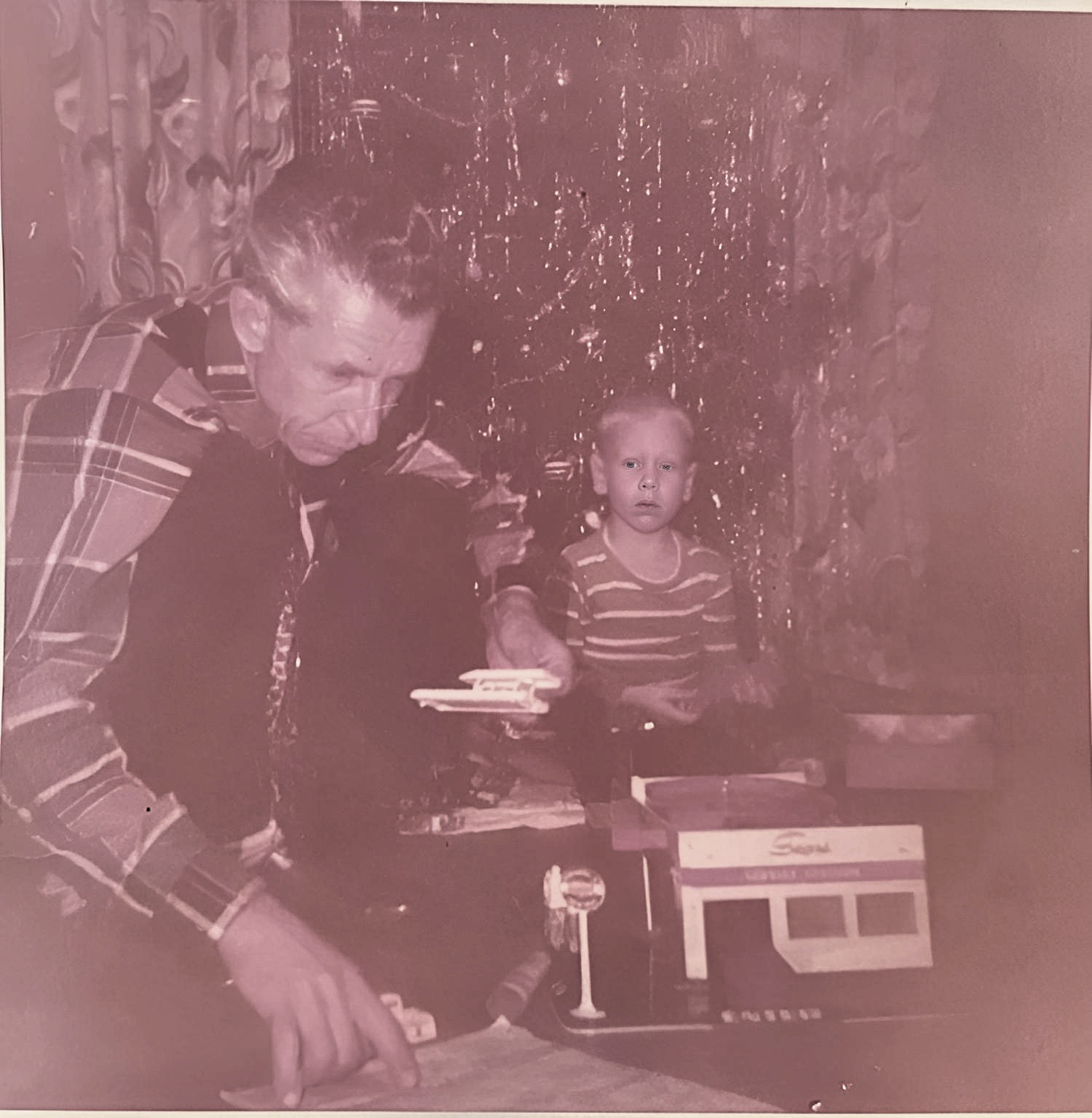
 Memories of a Christmas Long Ago. Every year as another year swiftly flows down the river of time, I become nostalgic and like to thankfully remember special Christmas’ gone by.  At Thanksgiving my daughter asked me, as a boy growing up was there a Christmas that was a most memorable one. I told her I was about five or six years old, I had gotten a play filling station for Christmas that was brought by Santa Claus.  It had all the “furnishings” of a filling station of that day, from gas pumps, to a lift to change the oil in a car, a lift to change tires, cars, attendants, etc. I knew there was a photo my mother had taken of that Christmas Day long ago. However, it had been years, years since I had seen it and wasn’t sure it still existed.  Recently after going through many, many pictures my mother saved, I surprisingly, delightfully, and thankfully found the photo!! My mother had written on the back “December 1957.” Wow…that was 67 years ago!   I would have been five years old.  The filling station was not assembled. I guess Santa was in a hurry and forgot to put it together. The photo shows my father reading the directions and putting it together, while I with a deer in a headlight look, watched him patiently assemble all the parts.  My father was a master machinic and I think he enjoyed the Christmas present more than I did!!!  It was my favorite Christmas as it was something I remember even as a five-year-old my father and I doing together and then he playing “filling station” with me after it was all assembled. Christmas is a magical time…this Christmas make some memories. One is never too young or too old to make precious memories.  Help make someone’s Christmas a memorable one. May everyone have a blessed Christmas Eve and a Merry Christmas to all.    

Blessings,

Dr. Dan

WEAKNESSES INHERENT IN THE SOCIAL GOSPEL/SOCIAL JUSTICE MOVEMENTS

Many churches within Christendom today have become heavily involved in the Social Gospel/Social Justice Movements. Such churches major and focus on various issues and ills that plague society. They champion many causes that are cited as negative roots that are planted deeply in the fabric of society that must be dealt with and eradicated.  While by all means, as Christians we should fight injustice when it rears its head and we must reach into the social ills of society and seek to help people break the spiritual chains of circumstances and behavior that are binding them. Nothing is wrong with seeking to influence society and working within society for the better. But there is a clear weakness inherent in the Social Gospel/Social Justice Movements.

The danger is that one can become so involved in the Social Gospel/ Social Justice Movements, one forgets the Biblical Gospel of the atonement, the salvific work of Christ on the cross. Too often those involved in such movements, with good intentions, are not seeking first the Kingdom of God and His holiness/righteousness found in the transforming power of the cross. The goal of the Social Gospel/Social Justice movement, at best, is a kingdom of man with God to serve it, rather than a kingdom of God, with man to serve it. The power of God’s Kingdom is not simply the hope of bringing about reform in man, but bringing about redemption and righteousness. The goal of the Gospel of Christ is not merely improvement, but divine transformation. You can’t bring about change without the cross at the center.  The Social Gospel/Social Justice is keen about establishing a kingdom which glorifies human ideals, but seeks not a Kingdom that glorifies the atoning cross of Christ and that it is through regeneration that men are changed ethically/morally and socially. True change in humanity and society is only possible, not by presenting only lofty ideals, but it is the power of the cross which enables moral change and can guarantee social change in society. The cross is the pure spring from which flows the “goodness” (righteousness) which makes possible a better social state or order. Jesus called it, “Being born from above” (John 3).

Only when the cross is at the center of our “good works” can one find reconciliation to both God and man.  Christ is more than an ideal and more than a historical person, Christianity is more than a system, found in the Christ of the Cross is atonement for man’s sins, the cross being the center of a holy and moral universe. It is the cross which testifies of God’s holiness and that sin must be dealt with…sin being the root cause of man’s misery.  The atoning cross must not be replaced with simple human dignity and lofty ideals that seek to bring about social justice without changing the human heart from which flows the problems in the first place.  One can be enthusiastic about a message which glorifies human ideals, but fails to say anything about God’s righteousness and God’s way, about Christ and His cross as the only way to “reform” society through redemption of the individual. It is not a cultured society that is need, but a society with men and women who have experienced conversion in Christ.

Most often the enthusiasm for the Social Gospel/Social Justice dismisses the cross, and the truth that man’s woes will only find answers when the will of man yields to the obedience of the atoning Gospel of the cross.   No laws can do it, and no change of circumstances, but only Jesus Christ. The Social Gospel/Social Justice fails to focus on the individual’s need for repentance and regeneration, but focuses more on that change must come from society as a whole. It is not the individual that is guilty before a holy God, but it is the masses within society that creates moral, economic, and physical chaos. The woes of society are shifted from persons as an individual, unto society at large. The more public or societal we can make “sin” the more it is divorced from the responsibility of the individual and shifted to society as a whole. As well, the answer sought for human woes lies with the ingenuity of man, not a divine action from a proactive, God of holy-love. Yet there can be no societal change without individual change through personal repentance and regeneration, which is the work of the atoning cross. The Social Gospel dismisses theology and doesn’t see the need to proclaim a God who is holy, and who demands repentance from sin. Man, it is thought, is capable of creating his own ethic, and it need not have its source in a holy God, a God of moral order. Protest as one might, an ethic that changes the heart must have its source flow from the holy-love of God, which holy-love was on full display in the atoning cross of Christ. And to speak of judgement is forbidden, a big no-no. Yet judgment is holiness’ necessary reaction to sin in a holy God.  When a church begins to focus more on the Social Gospel/Social Justice Movements, over the power of the Christ of the cross, such a church will have lost its compass and drift into theological liberalism.

While are to be involved in society to bring about change, change doesn’t occur by becoming like society. Our theology must be Christocentric, and must be distinct from society in order to shine the Light of Christ upon its sinfulness in order to provide an avenue of change by atonement through the cross not humanistic ideals.  Let us never be ashamed of the cross of Christ, for there alone the final and public righteousness of God is revealed to fallen humanity. Moral order and civility must be anchored in the cross, and such order lies in the truth of a holy God wherein is found His supreme interest for the world which is reflected in the One who gave us the atoning cross.

Blessings,

Dr. Dan

THANK YOU

I want to take the time to say a big “Thank You” to all who have obtained a copy of my latest book, “There Are No Shortcuts To Success.” More than I anticipated have obtained a copy. For over half a century as a minister and as a coach, I have helped mentor runners to achieve success they never thought possible. Found within the 473 pages of There Are No Shortcuts To Success, I share interesting stories from my vast storehouse of memories, and with the stroke of a pen paint vivid pictures that success is achieved through hard work and, yes, failure. Failure is often a key ingredient to successful accomplishments, but failure never has to be final. Inducted into the Surry County (NC) Sports Hall of Fame (2022) after many years of helping runners achieve success on and off the track, the inspiring stories shared come from each place I have coached. In each story the reader will sense some of the excitement, and disappointment, that was experienced, and the hard work involved in the chasing of dreams.  Dreams remain daydreams until they are acted upon through a consistent work ethic. Whatever dream has been lying within the heart, There Are No Shortcuts to Success will inspire and motivate the reader to begin to pursue those dreams until they become a reality.  If you haven’t obtained a copy, you can get your copy today by going to Amazon.com (see video below)

Blessings,

Dr. Dan.