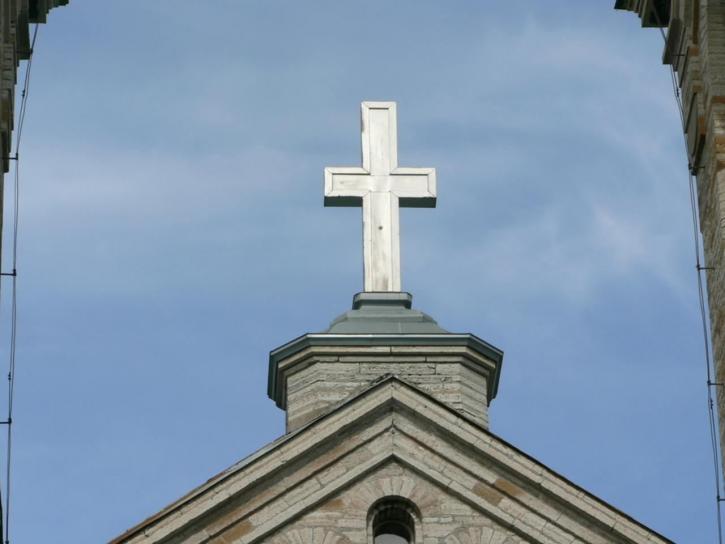
As Christians approach Easter, the cross stands as a universal visible symbol of the Christ Event. (By the Christ Event is meant the life, death, burial, and resurrection of Christ.) For it was upon the cross that Jesus Christ gave His life for the sins of humanity. While the cross is a powerful symbol of the work of Jesus Christ, some churches do not display the cross on the church’s premises. The main argument for a cross-free premise is that it is believed that worship should be icon-free, that worship is to be focused on Christ alone without any outside prompts giving “aid” to worship other than the proclamation of the Word. [See note at end.] Then there are those within Christendom who don’t display the cross because they are fearful it will be offensive to unbelievers and could actually hinder a possible Christan witness.
Yes, it is true, that whether or not a church displays a cross is a matter of local church policy, personal value judgment, and Christian liberty. However, it is the contention of this writer that there is much benefit in Christian churches displaying the cross. While there are many biblical and historical arguments as to why Christians and Christian churches should display the cross, let me share with you eight.
First, the Cross is Central to the Christian Faith. The cross is considered the most central symbol in Christianity, representing the pivotal moment of Jesus’ death that provided salvation for sinful humanity. One truth is certain, for Paul the cross stood at the center of the Christian faith. Paul wrote, “I determined not to know anything among you, save Jesus Christ and Him crucified (I Cor. 2:2). As Christians should we not to display the most central symbol of our faith for the world to see? For in the sight of the cross it has a certain self-evidencing power.
Without the cross, the centrality of the Christian faith is built on a foundation that is not theologically sound. We have a tendency to make secondary that which we don’t see as central. It was the cross where Jesus would die, giving his life as a ransom for lost humanity (Mk 10:45). That He was going to the cross was at the center of His teaching to His disciples. The centrality of the cross originated with Christ Himself. If it was central to Him, should it not be central to believers. When the cross is displayed it visually shouts the centrality of the Christian faith. When one preaches the centrality of the cross and its importance in God’s provision of providing salvation, what is the hearer to think when such an important symbol is not to be found in a House of Worship reminding one of the cross’ centrality?
Second, the Cross is the Visual Symbol of Christ’s Vicarious Sacrifice. Every religion and ideology has its visual symbol which is a distinguishing feature of its history or beliefs. As examples, Marxism has its hammer and sickle; the Nazis had the Swastika; Judaism has the Star of David; Islam its crescent, etc. For Christians what has universally been the symbol that distinguishes the Christ Event – has it not been the cross? Seeing the cross serves as a tangible reminder of the suffering Jesus endured for humanity. The Apostle Paul had a deep conviction that the cross was not something to be hidden, but something to be shown to men. He wrote in Galatians how he couldn’t understand how they could have slipped back into their old ways when he had made visible to them the Act of the Cross before their eyes (Gal. 3:1- “Before whose eyes Jesus Christ was clearly portrayed among you as crucified”). The Greek word translated as “clearly portrayed” in the verse is the Greek word prographō; which means “to depict, portray, paint, before the eyes.” The word was used to speak of something which visibly set forth before a person’s eyes. Paul is saying that he had set forth before their eyes a visual picture of Jesus Christ crucified and his vicarious sacrifice on behalf of humanity. Prographō carries with it more than painting a picture with words, but in visibly seeing that which is being described – i.e., the symbol of the cross. In the early church, the Greek word Christos was a cryptogram (code), often in the form of a cross. From the second century onwards, Christians not only drew, but painted, and engraved the cross as a visual symbol of their faith.
There are those who say visible symbols in our worship, such as the cross, are unnecessary. However, Jesus sanctioned the use of two visual ordinances for the Church…the Lord’s Supper (Communion) and baptism. These visual ordinances speak to divine realities regarding the work and provision of Christ. While not sanctioned as an ordinance, the cross is a visual symbol that speaks volumes as to the divine reality of the person and work of Christ, and within Christian liberty its display is not only permissible but can prove beneficial to the reality of one’s faith.
Third, the Cross is an Expression of Faith Embraced. Since the beginning, Christians have identified themselves with the cross on which Jesus died. Whether it’s carved in wood or etched on our hearts, the cross is the chief symbol and defining reality of the Christian faith. Displaying a cross is a way for Christians and churches to openly profess their belief in Jesus Christ. Jesus died on behalf of humanity. In the cross Jesus Christ achieved something for us that by ourselves we never could have achieved. Thus, the cross is not something a believer would want to hide but embrace and put on display as it is an expression of the means by which Christ has provided for us salvation.
Tertullian wrote about 200 A.D. that many Christians put the symbol of the cross on their clothes, shoes, and on their person (Tertullian, De Corona, Ch. III, 94). They were giving expression of the faith they embraced. The Apostolic Tradition of St. Hippolytus (215 AD) records that the sign of the cross was tradition on one’s personhood (forehead) when baptized, as it was the sign of Christ’s Passion. The newly baptized believers were giving expression of the faith they had embraced. By the end of the first century, many Christians already viewed the cross as a significant symbol. However, it is contended that the first surviving public image of Jesus’ crucifixion was on the fifth-century wooden doors of the Basilica of Santa Sabina, which is located on the Aventine Hill in Rome (B.W. Longenecker, The Cross Before Constantine, 11).
So, displaying the cross is more than a cultural act in the Western world, but dates back to the earliest Christians and then onward.
Fourth, the Cross is a Sign of Redemption and Hope. The cross symbolizes the victory over death and the promise of eternal life through Jesus’ resurrection. The cross is a sign of redemption and hope for the Christian. In and through the Cross Event men find redemption from their lostness and find hope to live a transformed life. Lost man needs to be redeemed and he needs hope that a changed life is possible. What a marvelous object lesson the cross becomes as it serves as a visual “signpost” that points men to the hope of redemption and hope of a changed life is found in the Christ of the Cross. The cross lifts up the fallen and delivers the despairing.
The cross of Christ gives display of both God’s love and God’s holiness in the salvation of humanity. The renowned theologian Emil Brunner wrote, “The cross of Christ is the only place where the loving, forgiving, merciful God is revealed in such a way that we perceive that his holiness and his love are equally infinite” (Brunner, The Mediator, 464). Brunner adds that the cross is more than an idea, but reveals to us that which was conceived in the mind of God and “actually is”…giving to man both redemption and hope.
Fifth, the Cross Identifies the Church as a Place Where Believers in Christ Gather. It has previously been mentioned that every religion and ideology has a symbol by which it can be recognized. Should not the church display the cross as a way to identify it as a place where a believer of Christ gathers to worship? Richard Hooker, a sixteenth-century Anglican theologian, applauded the fact that the early church fathers, in spite of heathen scorn at the sufferings of Christ, “chose rather the sign of the cross than any other outward mark, whereby the world might most easily discern always what they were.” As well, the sign of the cross had a positive usefulness as it was “for us an admonition . . . to glory in the service of Jesus Christ” (Hooker’s quotes found in The Cross of Christ by John Stott, 22-23). When archaeologists dig through the ruins of antiquity, they have one certain way to identify a place of Christian worship. They look for a cross. When they find a cross painted on a wall, carved into stone, or even worked into a floor plan, they know they have found a church.
If a church doesn’t display a cross, what distinguishes it for those who are looking for a place of worship? When one sees the symbol of the cross one knows that is a building where the worship of the Christ of the Cross is experienced. For the Christian, the display of the cross is a source of encouragement as well as a call to service. Is one to conclude the cross is not important to those gathered if there is not a cross on display?
Sixth, the Cross for Paul was that in which he Gloried. Paul wrote, “God forbid that I should glory, save in the cross of our Lord Jesus Christ” (Galatians 6:14). Paul’s theology was centered in the cross. The cross occupied his thinking, guided his steps, and illuminated his preaching. Does one think Paul would hide the symbol of the cross when it was central in all his thoughts and actions? Would he not have used the cross as a visual object lesson to aid in his explanation of the Christ Event? He would no doubt have pointed to a display of the cross as containing its own appeal. It is at the cross we see the nature and character of holy God on full display – justice, holy-love, mercy, and grace embracing.
Paul’s life was an unbroken insistence on the essential centrality of the Cross. The cross is a reminder that our self-righteousness is insufficient before a holy God, but that we need Someone to do for us what we could never do for ourselves. Paul gloried in the cross of Christ, for on the cross divine mercy and justice were equally expressed and eternally reconciled. God’s holy-love was satisfied, wherein Paul rejoiced. Like Paul, believers should glory in the cross and all that it represents, but if it is never on display are we not minimizing its importance.
Seventh, the Cross Refreshes our Minds where the Source of Our Salvation is Derived. That which we don’t keep fresh in our minds soon fades, is deemed unimportant, and soon is forgotten. The early church was familiar with the cross, but if preceding generations of Christians had concluded that displaying the cross was not necessary, we would have no visual concept of the cross. The mind can retain better that which in reality is experienced by the mind. In the Old Testament, the Lord asked the Jews to rehearse significant events so as to not forget them. Well, should not the Christ Event be perpetually rehearsed in our ears and minds by a display of the cross. Again, that which we don’t rehearse in our minds we have a tendency to make secondary and eventually fade into insignificance. The cross is the standard of victorious grace which we must never forget.
Eighth, The Cross and Resurrection are Interconnected. Some say the cross should not be the focus of the Christian faith, but the resurrection. One must understand that when one speaks of the Christ Event, it includes His life, death upon the cross, His burial, and His triumphant resurrection. Again, the cross and resurrection are interconnected. They both echo the affirmation of God’s provision. While, yes, in the first century the cross was a symbol of death, it is much more than that as because of the resurrection it was transformed into a symbol of life. In the first century, men went to the cross to die, because of divine transformation men now go to the cross to find life…eternal life. The resurrection is the authenticating truth that Christ’s death on the cross was not one of defeat but one of triumph. The Christ Event, the Act of the Cross, was one of conquest, and because Christ lives, we shall also. The cross is a symbol of Christ’s atoning sacrifice, of which the resurrection gives affirmation.
Conclusion
Taking into consideration the eight reasons articulated above, while each church has the right to express its own policies, value judgments, and Christian liberty, it is difficult for this writer to embrace a sound argument as to why a church would not want to display the cross. Paul saw in the death of Christ upon the cross an action of God by which He makes it possible for the sinner to come to Him and be forgiven and to be accepted by the One who is Holy Other. As an instrument used by the Lord to enable wayward man to find his way Home to Him, the question is, “Why would one not want to display such a powerful symbol that serves as a visual signpost which has eternal implications?” Oh, that God would give us a deeper insightful Christocentric grasp of the pervasive influence of the Cross of Christ. May we not hide the use of such a powerful symbol, but prayerfully display it to the glory of God.
Blessings,
Dr. Dan
[Note] The argument that the cross should be abandoned as a visual symbol in the church finds its roots in 2 Kings 18:3-4 when King Hezekiah destroyed the Brazen Serpent Moses had made at the Lord’s direction. The Hebrew children in the wilderness cried out for deliverance from being bitten my poisonous snakes (Numbers chapter 21) as a result of their complaining against Moses and God. Moses was instructed to place a bronze snake on a pole and lift it up and all who looked upon it would be healed. (In John chapter 3 Jesus says, “As Moses lifted up the bronze snake in the wilderness and were healed physically, those who will look upon the Son of Man when He is lifted up on the cross will be healed of their sin.”) King Hezekiah, approximately 725 years later, destroyed the bronze snake Moses had made as the people began to worship it and were offering sacrifices to it (2 Kings 18).
 Reflections from dr. dan...