IT CAN BE DONE!

There is too much hatred and division in society today. No one seems to be able to get along with others because of the diversity in individuals. Yet it is possible to bond in friendship with someone in whom diversity exists. It is possible to find commonality with those with whom we don’t necessarily “geehaw.” In the fall of 1971, as a college sophomore attending Campbell University,  there came out for cross country a young man named Jerry Dodgion, nicknamed “Bugs.” He only had one year of college left as he had dropped out to join the Marines. After a four year hitch in the military, he returned to college to finish his degree. It turned out he had no athletic eligibility left because of his age, so since he couldn’t run on the team, he became the team manager. Jerry and I were as opposite as yea and nay. We were like light and darkness.   The likelihood of he and I becoming friends was slim and  none.

Yet, in spite of being polar opposites we became friends… good friends. We were as opposite as yea and nay. We were like oil and water. I was 19, he was 27. I was 6 ft ½ inch, he was 5 ft 9 inches. He was a hardcore Marine veteran who had served in Vietnam, I at the time was a pacifist. He was from Virginia, I was from North Carolina. I was a Christian, he was not. He was a math major, I was a religion major. I disliked math, he disliked religion. I was soft spoken, he was outspoken. I was an introvert, he was an extrovert. He was abrasive and said whatever he thought, I kept things to myself and bit my tongue. He was constantly drinking coffee for the caffeine boost, I detested coffee because of the artificial  boost it gave! We disagreed on most every topic we discussed.

The picture is from an article about a marathon Bugs and I ran together in January 1972.

We seemingly had nothing (and I mean nothing) in common, so how did we become good friends? There was one interest we had in common that we both loved….running. Running was our ground of commonality. We trained together, hung out together, ate together, ran races together. The picture is from an article about a marathon Bugs and I ran together in January 1972. We were almost inseparable. Where you saw one you saw the other. We added to the mosaic of who each of us were. We remained friends and in contact beyond our college days. He came to hear me preach several times after I entered the ministry, and the last time I saw him he had started going to church. Sadly, “Bugs” died in April 1996 of an unexpected heart attack. He was only 51. I still miss my friend…the friend in whom we had nothing in common!!

The point of my reminiscing is that it is possible to find common ground with those with whom we may have more diversity than commonality. It would truly be a better world if we laid down our hate, biases and prejudices, and sought to find the commonality in each other and to exhibit love instead of intolerance. It is possible….for “Bugs” and I are proof it can be done!

Blessings,

Dr. Dan


THE ANTICHRIST SPIRIT IS AMONG US

The Bible says in the last days “perilous times” shall come (2 Tim 2:3). The word “perilous” is packed with imagery, picturing a ferocious beast pouncing on its defenseless prey tearing the catch to pieces. We are living in such times, as we witness the spread of mayhem in the streets and the seeds of moral confusion, social unrest,  financial uncertainty, overt Marxist activism and spiritual deception being sown throughout society. We are witnessing the widening of the crack in the dam that had once held back the flood of evil, man’s heart spilling forth unrestrained lawlessness. John in his first epistle writes that the “spirit of antichrist, whereof ye have heard that it should come; and even now already is it in the world” (I John 4:1-3).

The aged Apostle writes that we can know we are in the last hour because of the existence and activity of the spirit of antichrist permeating society. John writes, “Children, it is the last hour; and as you have heard that antichrist is coming, so now many antichrists have come. Therefore, we know that it is the last hour” (2:18). Now what did John mean by the last hour? The “last hour” (called the “last days” by Paul) is the entire period of time between the first coming and second coming of Christ. However, as the Second Coming of Christ draws nearer, evil will escalate and grow worse and worse (2 Tim. 3:13). There is no question that is happening before our very eyes.

What is meant by the “spirit of antichrist” permeating society? What are the characteristics of the “spirit of antichrist?” Interestingly, the only place in the NT where the word “antichrist” is found is the epistles of John (I John 2:18 (twice), 2:22, 4:3, 2 John 7). The word “antichrist” (Gk ἀντίχριστος/antichristos) is a combination of two Greek words “anti” meaning against or instead of and “Christos” meaning Messiah, Christ, the Anointed One. It is clear from the books of  Daniel and Revelation there is coming a day when there will be a person who will rise to power who will oppose Christ, who will be against all that Christ stands for, who will portray himself as a “savior” but will be a counterfeit Christ.  Before the personage of the Antichrist will be revealed and accepted by the masses, there must be a “spirit of antichrist” that pervades society in order to pave the way for the Antichrist to ascend to power. Today we are witnessing the unfolding of the “antichrist spirit” which is paving the way for his revealing.

How do we recognize the antichrist spirit that is already working among us? John points out several  distinguishing characteristics of the antichrist spirit.

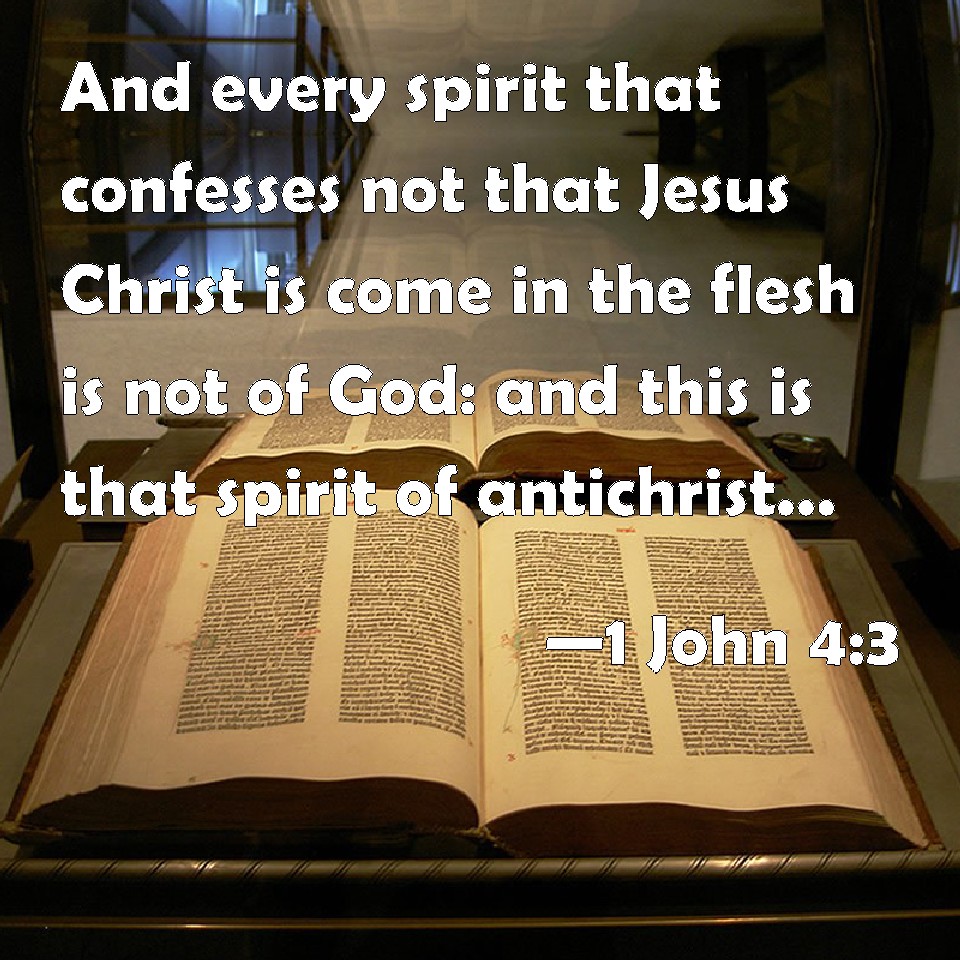
First, the spirit of antichrist rejects the deity of Jesus and that He was God in the flesh. The antichrist rejects the incarnation of Christ. John writes, “Who is a liar but he that denieth that Jesus is the Christ? He is antichrist, that denieth the Father and the Son” (1 John 2:22). He further writes in I John 4:3, “And every spirit that confesseth not that Jesus Christ is come in the flesh is not of God: and this is that spirit of antichrist” (I John 4:3). While society can’t deny the historical reality of Jesus, the antichrist spirit portrays Jesus as a mere man who held high ideals, leaves us an excellent example of how we should live, a wonderful teacher, but He was not God become a man. Of course, if Jesus is not the God-Man, He is incapable of providing for us salvation and deliverance from our sins.

Second, the spirit of antichrist rejects the existence of sin. John writes, “If we say we have no sin, we deceive ourselves and the truth is not in us… If we say that we have not sinned we make him a liar, and his word is not in us” (I John 1: 9, 10). The antichrist spirit seeks to convince man that he is not a sinner alienated from his Creator and in rebellion against a holy God, but he is capable of summoning  innate good within him and by his own power and reason bring about the utopia the human heart desires. Of course, if man is not a sinner the message of the cross is unnecessary.  If there is one truth human history has proven is that man is a sinner whose heart is desperately wicked, that man is out of tune with his Creator, and man left to His own power and reason divorced from God only creates a chaotic mess. If one thinks otherwise, just watch the news, read the newspaper, and look in the mirror. The evidence is overwhelming from experience and Scripture that man is a sinner and to contend otherwise is to deceive one’s self.

Third, the spirit of antichrist rejects the moral and ethical precepts of the Bible. John writes, “If…we walk in darkness, we lie, and do not the truth” (1:6). The antichrist spirit seeks to promote the fallacy that truth is relative and changing according to the whims of society, and the moral and ethical precepts of the Bible are archaic, outdated and those who proclaim those truths are out of touch with reality. The antichrist spirit seeks to convince man that he is smart enough to create his own morality a part from any Divine influence. The antichrist spirit seeks to silence those who promote biblical morality as necessary for an orderly society. It is clear today the rejection of biblical morality and ethics has plunged society into a slide toward implosion and self-destruction.

Fourth, the spirit of antichrist rejects that salvation is found only in Christ. John writes, “And we have seen and do testify that the Father sent the Son to be the Savior of the world. Whosoever shall confess that Jesus is the Son of God, God dwelleth in him, and he in God” (4:14-15). The antichrist spirit is not altogether against “religion” as long as it is a Christless and crossless “religion.” The antichrist spirit opposes the teaching that Christ is the only “Savior of the world” and the only path to a restored relationship with God. The antichrist spirit promotes there are many ways to God and for one to think Jesus is the only way  one is considered to be narrow minded.  

Fifth, the spirit of antichrist seeks to combine “worship” of the state with “religion.” John’s wording in 1 John 4:14 is deliberate and pointed when he writes that Jesus is “Savior of the world.” The Greek phrase  σωτῆρα τοῦ κόσμου (sotera tou kosmou), has reference to  the Roman Emperor who was called σωτῆρα τοῦ κόσμου,  savior of the world.  Emperor worship was the state religion of the Roman Empire and Roman citizens were expected once a year to acknowledge and give their allegiance to Rome and the emperor. The Roman Empire and the Emperor were seen as supreme. John in calling Jesus “Savior of the world,” σωτῆρα τοῦ κόσμου (sotera tou kosmou), was committing a capital offence,  as he is clearly teaching that salvation is not wrapped up in the supremacy of the state or the emperor, but only in Jesus Christ who alone deserves our worship and allegiance as Savior of the world.  When the Antichrist appears, he will combine the state with a christless religion to form a one world system and will expect the masses to swear their allegiance to both. One would have to be blind not to see the antichrist spirit is quickly moving society in the direction of combining both the state and a christless religion into a one-world system where the state is supreme and the Antichrist is worshipped (2 Thessalonians 2:10-12; Rev. 13:8).

Sixth, the spirit of antichrist in opposing Christ seeks to silence the voice of the church.  As has already been seen, the word antichrist means that which opposes or is against or instead of Christ (I John 2:18 (twice), 2:22, 4:3, 2 John 7). Today the radical progressive left and most  left-wing groups and movements are clearly opposed to the Christ of the cross and the Christian faith. Christianity is a barrier to their agenda of fundamentally changing America and ushering in a godless and Marxist culture.  They are coming after the church. The spirit of antichrist has attached itself to many well-meaning “social justice” groups, the ultimate goal being to silence the church, rid society of Christian influences and create a culture devoid of a Christian voice.   The rush to remove every statue, the changing the names of buildings, businesses, logos, etc. that are deemed to be offensive, is nothing more than the insidious undercurrent of the spirit of antichrist eventually labeling the church as being offensive. The ultimate goal of the antichrist spirit,  like the advancement of the ocean’s evening tide, is to remove from culture the voice of the church; thus, clearing the path for the Antichrist to step into power without significant opposition. One would have to completely shut their eyes to the reality of the day not to see this unfolding.

Yes, the spirit of antichrist  has clearly permeated our culture today. Some may say, “You are overreacting.” My friend, the alarm needs to sound even louder, not less. Everything in our culture today, from the news media, the economy, much of academia, much of professional sports, Hollywood, leftist politics, the apostate churches, has been infected by the spirit of antichrist and opposes the spiritual, moral and ethical teachings  of Christ and Scripture. These avenues of communication desire to deceive people into a false view of who Jesus is and what He taught.

The clock is ticking toward the unfolding of the Great Tribulation as found in the Book of Revelation.  As the spirit of antichrist spreads at an alarming rate, the person of the Antichrist is waiting to step forth from the shadows as soon as all the pieces of the puzzle are put in place (2 Thessalonians 2:6-8).  Yes, the spirit of antichrist is here. It must be recognized that we are in a spiritual war today. We must keep our eyes on Jesus, our noses in the Word and our ears attuned to hear the trumpet sound. Let us pray for a discerning spirit that we will not become vulnerable to the deception of the spirit of antichrist that is among us.

A final word, even with the  pervasive spread of the spirit of the antichrist today, there is no need for the Christian to fear. John reminds us that the Spirit of truth indwells every believer and that we “are of God, little children, and have overcome them: because greater is [Christ] who is in you, than he that is in the world” (I John 4:4). May our confidence rest in that assuring truth.

Blessings,

Dr. Dan

A TEST OF THE GENUINENESS OF OUR LOVE FOR CHRIST

As one reads through First John, the aged Apostle lists many stringent “tests” as to whether one’s Christian profession is genuine. It is easy to say we are Christians, that we love the Lord, but do our lives harmonize with what we profess? In First John 5:3 the Beloved Disciple writes,  “For this is the love of God, that we keep his commandments; and his commandments are not grievous.”    John says in this verse our love for the Lord is revealed by two factors: (1) we keep His commandments, and (2) His commandments are not grievous or a burden to us.

First, John indicates our love for the Lord is confirmed by our keeping His commandments. The verb translated “we keep” (τηρῶμεν of tēréō) is present tense, active voice, meaning we habitually and actively keep his commandments.  Tēréō (τηρέω) was a word used to speak of a guard intently guarding his prisoner or any object of value, to guard something carefully. Metaphorically it meant to keep, to observe, to carefully obey. The genuineness of one’s love for the Lord is reflected in one living a life that is seeking to live out the principles and truths of God’s Word, to have a biblical worldview which is expressed in one’s lifestyle. John makes it clear that one’s proclaiming they love the Lord must be backed up by a life actively obeying the truths of God’s Word. If we are not seeking to live a life that honors our Savior and we are ignoring the precepts of His Word, John tells us no matter how loud we proclaim our profession our words are empty as a bucket in a dry well.

Second, John indicates our love for the Lord  is expressed in an attitude that embraces His commandments without grievousness,  without seeing them as a burden. John writes that if we love the Lord then we will not see His commandments as grievous (5:3). The Greek word translated “grievous” (βαρεῖαι from βαρύς – Barus), is found six time in the NT and is translated heavy once, weighty twice and grievous three times. The word “barus” was used to speak of anything heavy or weighty (rock, weight, load, etc.) which presses down on a person with oppressive force. Metaphorically it meant any trouble, burden or problem which weighs us down and becomes spiritually, emotionally, physically or psychologically oppressive to us. So, figuratively “Barus” refers to that which brings affliction, struggle, burdensome or oppression into our lives.

John in using the word “barus” indicates that if we love the Lord His commandments are not a burden or seen as oppressive to us.  When someone says they love the Lord but seeks to cast off God’s moral standards, ethical principles, and virtuous values because it is believed they keep one from expressing their own human impulses and compulsions, then John says while one may say they love the Lord they in reality do not. We are living in a day when many who claim the name of Christ, see God’s commandments as a hindrance in their being able to express their “humanity” and, therefore, seek to cast off His restraints as being grievous (Proverbs 29:18). There are too many professing Christians today when it comes to embracing the moral and ethical principles of the Bible have said, “Let us tear off [His] chains and free ourselves from [His] restraints” (Ps 2:3). Such thinking only reveals one’s profession is false. Man’s sinful nature rebels and is repulsed by the commandments of God, but if one has been born from above by the work of the Spirit, the Lord give’s us a new nature which is not repulsed at the commandments of the Lord but embraces them. We embrace them because we know His commandments have our best interest in mind as we travel the bumpy roads of life.

As Christians we see His commandments as positive, healthy, and as guiding us into being what humanity is meant and designed to be. As Christians we should approach the Bible not as chore to read, but as a love letter wherein we hear our Savior’s voice and find out how He would have us live in our pilgrimage on earth.   Our love for God is proved only by keeping His commandments and they certainly should not seem burdensome or grievous to obey the commands of the One whom we love. Keeping the commandments of God is evidence of our love for the Lord and shows that our love is more than in word and tongue but in our attitude and actions.  The Lord’s commandments are not heavy and burdensome to the regenerate soul, to one in communion with Christ, and to one who has had the love of God shed abroad in their heart.  If in our profession of Christ, we see the Lord’s commandments as a burden that cramps our style, then our profession lacks substance and our words ring hollow.

We love Him because He first loved us (I John  4:19). William Barclay has written, “Our response to Christ is the response of love, and for love no duty is too hard and no task too great. That which we would never do for a stranger we will willingly attempt for a loved one. What would be an impossible sacrifice, if a stranger demanded it, becomes a willing gift when love needs it.”

The Good News is that our Lord empowers us to follow Him. God does not give us his commandments and then go off and leave us to ourselves. He is forever by our side to enable us to carry out what He has commanded. What is impossible for us becomes possible with God. While the commandments of Christ we may find at times difficult, burdensome they are not.  But our Lord never laid a commandment on man without giving him the strength to obey it. And every commandment laid upon us provides another chance to show our love for Him.

Yes, if we call ourselves Christians, John offers two stringent tests that prove our love for the Lord: (1) we habitually keep His commandants, and (2) His commandments are not seen as a burden to us, but an opportunity to reflect our love for Him. Clearly, John’s words give us reason to pause and reflect upon our profession in Christ. Is our profession that we love Him not only expressed in our words, but reflected in an attitude that embraces His commandments in obedience which is visible in our daily lives?

Blessings,

Dr. Dan

UNDERSTANDING FIRST JOHN 3:9 – THOSE BORN OF GOD “CANNOT SIN”

 When one reads the Epistle of First John in the English translation (KJV), the reader may draw the conclusion that John not only contradicts himself but that he establishes an impossible test in determining the genuineness of one’s Christian profession, that being “Christian perfection.”  It appears the aged Apostle contradicts himself when one reads what he states in 2:1 compared with 3:9. Is this the case or is there a satisfactory explanation as to what John meant?

In I John 1:8 he makes it clear that all men are sinners and only the provision of Jesus is able to forgive our sins. John writes in 1:8, “If we say that we have no sin, we deceive ourselves and the truth is not in us.” This could be called John’s equivalent to what Paul stated in Romans 3:23, “All have sinned and come short of the glory of God.” All men are sinners and need a Savior. And for one who recognize their sinfulness John writes, “If we confess our sins, he (Father/Jesus) is faithful and just to forgive us our sins, and to cleanse us from all unrighteousness.” (1:9).

Now once one is a Christian John expresses his desire, “My little children, these things write I unto you that ye sin not” (2:1a). That is the goal, the desire, to sin not. But what if as Christians we do sin? John gives us good news, “And if any man sin, we have an advocate with the Father, Jesus Christ the righteous (2:1b). When a Christian does sin we have a lawyer, a go-between, an intercessor, and one who pleads our case before the Father who secures our forgiveness, Jesus Christ the righteous.  While the goal, desire and ideal is not to sin, John realizes that as finite creatures the reality is that at times we will sin, but Christ has made provision by His Advocacy to secure our forgiveness and restore our broken fellowship with the Father.

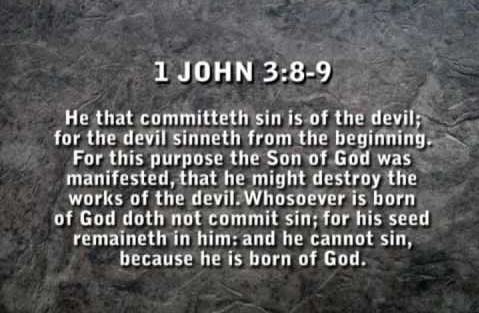
Now when we come to I John 3:9, the Apostle makes a startling statement which appears to contradict what he stated in I John 2:1. In the KJV 3:9 reads, “Whosoever is born of God doth not commit sin; for his seed remaineth in him: and he cannot sin, because he is born of God.”

In 2:1 John recognizes that no Christian measures up to the ideal of not sinning; therefore, the need for an Advocate. However, as 3:9 is translated in the KJV it appears John is saying the proof we are genuine Christians is that we don’t sin anymore! Is John advocating Christian perfectionism as to whether we are saved or not? To gain a proper understanding of the verse let us look at in its context by examining I John 3:4-9, which  reads, “Whosoever committeth sin transgresseth also the law: for sin is the transgression of the law. And ye know that he was manifested to take away our sins; and in him is no sin. Whosoever abideth in him sinneth not: whosoever sinneth hath not seen him, neither known him. Little children, let no man deceive you: he that doeth righteousness is righteous, even as he is righteous. He that committeth sin is of the devil; for the devil sinneth from the beginning. For this purpose the Son of God was manifested, that he might destroy the works of the devil. Whosoever is born of God doth not commit sin; for his seed remaineth in him: and he cannot sin, because he is born of God.” (KJV)

In 3:4 John says sin manifests itself in lawless rebellion and willful defiance of God, His character being expressed in the Law. In 3:5 John proclaims that Christ, who had no sin, came to earth for the purpose of taking away our sins. In 3:6 John informs us as Christians we need to abide in Him so we will not keep on doing sin. Let it be pointed out the Greek word translated “abide” is a present active participle, meaning to continually remain or abide in Him. The word translated “sin” in the Greek is present indicative active, indicating continual action. In other words, John says in 3:6 if you are not continually abiding in Christ but instead are living in continual sin, you don’t know Him! In 3:7 John says those that continually “doeth” righteousness (“do” Gk poieō) – present active participle, indicating habitual action) prove they are righteous.  In 3:8 he writes that those who continually commit sin are of the devil. Again, the Greek word translated “committeth” is a present active participle, indicating habitual action. Then in 3:9 John writes that whosoever is born of God does not continually commit sin, doesn’t live a habitual lifestyle of sin. Once again, the word translated “commit” is a present active participle, meaning one born again doesn’t live a lifestyle of sin.  The reason the Christian doesn’t live a lifestyle of sin, is God’s seed, His divine life, remains in the believer (3:9). The life principle of Christ indwells the believer who instills within the Christian the desire to flee from sin and enables the Christian to live a victorious life whereby sin is not the habit or way of one’s life.

Now we come to the translation that appears contradictory and has created controversy. John adds in 3:9 that because the “seed” of God abides in the believer, “he cannot sin, because he is born of God.”  The Greek phrase is οὐ δύναται ἁμαρτάνειν (ou dunatai hamartanein).While “he cannot sin” or “not able to sin” is a strict translation it fails to bring out the true thought that is consistent in 3:4-9 and is revealed in the Greek tense of  hamartanein. As has been pointed out, the word translated “commit” in verse 9 is a present active participle, denoting action that is habitual. Gleason Archer insightfully comments, “In one respect this otherwise adequate translation fails to bring out one very important feature of the hamartanein (to sin) after ou dynatai (not able), a present infinitive in Greek implies continual or repeated action.” [1] In other words, no one who is born of God engages in a lifestyle sin. To do so is proof one hasn’t been born of God.

S.M. Baugh also points out that the phrase ou dunatai hamartanein, translated “cannot sin,” is a present infinitive. Baugh writes, “The fact that John chose to use the present infinitive…shows he was thinking about ‘sinning’ in v. 9 as a characteristic action. Hence, John does not teach ‘perfectionism’ that Christians can experience sinlessness in this life. Rather, when he says ou dunatai hamartanein he teaches that the genuine Christian cannot be characterized by a life of unrepentant sin.” [2]

Kenneth Wuest succinctly writes that “cannot sin” in verse 9 is “the present infinitive, [which] in Greek speaks of continuous, habitual action, never the mere fact of the action…The translation therefore is, ‘He is not able to habitually sin.’ The Greek text here holds no warrant for the erroneous teaching of sinless perfection.” [3]

While there are other explanations which seek to explain 3:9, the above explanation as to what is meant by the translation “cannot sin” is both consistent with the thought of John of in 3:4-9 and doesn’t contradict 2:1. While for this writer the KJV is the preferred translation for reading and studying, I John 3:4-9 in the ESV gives a good sense of what John is seeking to convey:  Everyone who makes a practice of sinning also practices lawlessness; sin is lawlessness. You know that he appeared in order to take away sins, and in him there is no sin. No one who abides in him keeps on sinning; no one who keeps on sinning has either seen him or known him. Little children, let no one deceive you. Whoever practices righteousness is righteous, as he is righteous. Whoever makes a practice of sinning is of the devil, for the devil has been sinning from the beginning. The reason the Son of God appeared was to destroy the works of the devil. No one born of God makes a practice of sinning, for God’s seed abides in him; and he cannot keep on sinning, because he has been born of God.” (ESV)

John is clear that those who live a lifestyle of sin, who habitually practice sin, are not saved and are not genuine followers of Christ. It might be added, in order the Christian not find a loophole to sin C.H. Dodd has astutely suggested, “The apparent contradiction is probably not to be eliminated, though it may be qualified, by grammatical [astuteness].” [4] The Christian’s life should be markedly different from an unbeliever.  For one to say they are a Christian and live in habitual sin, John doesn’t mince words, “You are a liar and the truth is not in you” (1:8-10). The teaching of John through his epistle refutes those who contend that because of grace one can live a life of habitual sin. Let it not be so in our lives, but instead heed the words of John, “And now, little children, abide in him; that, when [Christ] shall appear, we may have confidence, and not be ashamed before Him at His coming” (I John 2:28).

Blessings,

Dr. Dan

Footnotes

[1] Gleason Archer, Encyclopedia of Bible Difficulties (Grand Rapids, MI: Zondervan, 1982), 428-429

[2] S.M. Baugh, A First John Reader, (P&R Publishing, 1999), 50-51.

[3] Kenneth Wuest, “I John,” In These Last Days (Grand Rapids, MI: Eerdmans Publishing, 1957), 150.

[4] C. H. Dodd, “The Johannine Epistles,” The Moffatt New Testament Commentary (London, 1946),  80.



A MADMAN OR A PROPHET?

We are clearly living in a USA, as the theologian Francis Schaeffer (1912-1984) described, which is now in a “post-Christian era.” America began as a nation founded on Biblical principles and a strong belief that guidance from “Divine Providence” was behind its formation. How, then, did we get to the place in our country where we now see the abolition of belief in a Supreme Being and the belief there no longer exists absolute moral values which were given to us by our Creator for the purpose of guiding human behavior and the preservation of order in society?

When the USA was barely a hundred years removed from the signing of the Declaration of Independence, there was a “prophet” living in Germany who “prophesied” the day would come when Western civilization would declare God to be dead, reject the Christian faith, and adopt the philosophy of nihilism. The word nihilism comes from nihil, a Latin root meaning “nothing” or “that which does not exist.” Nihilism is the belief that there is no basis for absolute truth and rejects the existence of all religious, ethical and moral principles. Nihilism believes that established moral, social, religious and political systems must be destroyed in order to pave the way for the replacement of new forms of moral and political structures. Nihilism advocates anarchy and revolutionary activity to achieve such an objective.

One would have to be blind not to see that the dark shadow of nihilism is falling across this land in the advancement of godless secular humanism; in the formation of groups and movements, many with Marxist connections, who are calling for the destruction of traditional moral values; lawlessness, violence, and vandalism in the streets; disrespect for authority and law and order; the calling for the removing of all statues and monuments that have any hint of being offensive; and the call for replacing the current religious and economic systems, which are considered obsolete, with new ones that will rest on the shifting sands of relativism.

How did we get to this point in our society? In the nineteenth century there lived in Germany a philosopher named Friedrich Nietzsche (1844-1900). He was a self-proclaimed atheist, who “prophesied” that Western culture would eventually reject Christianity, declare “God is dead,” and nihilism would be embraced. How right he was! Nietzsche’s views were extreme, and many of his day considered his views bizarre. Eventually his extremist writings pushed him to mental and emotional exhaustion, and he spent the final years of his life in a state of insanity. While some label Nietzsche a madman, some of his views have proven prophetic.

The son of a Lutheran pastor, Nietzsche attacked Christianity relentlessly, declaring  “God is Dead.”  He “prophesied”  the day would come when Western culture would proclaim the “death of God.”[1] He contended the “death of God” would occur when Western man’s consciousness rejected Christian values and morality and dismissed Christian “truth” as being the ultimate ground and support of all reality. According to Nietzsche, “Nihilism is the belief that everything deserves to perish, to be destroyed…This includes the belief in God and an essentially moral order [as] untenable.”[2] Once God is rejected, traditional values must be abandoned, as well. With Christianity rejected, according to Nietzsche, man will be forced to look within and rely upon himself where “there is no one to command, no one to obey, no one to transgress.” [3] If the God of the Bible does not exist, reasoned Nietzsche, then the moral values taught in the Bible will no longer have sway in society.[4] Once Biblical values are rejected man will face an ominous dilemma, for to proclaim the death of God is to deny what once gave society ultimate meaning and value, and there will be no alternative but to embrace nihilism, which will bring chaos.

Nietzsche  foresaw the day when Western culture would enter a state of culture decline and man would find himself helplessly caught between two worlds, one dead and the other powerless to be born. Nietzsche feared when the Christian worldview was no longer the dominant influence of the thought of Western culture, it would be replaced by a liberalism that was incapable of giving birth to a new world. He was correct in his prediction. Liberalism today is giving birth to a culture that is still born, bringing forth a cultural of death not renewed life. Ignoring history doesn’t change the fact that Western culture is rooted in Christian values, and to remove those values the foundation of society dissolves into dust. And that is exactly what we are witnessing today as nihilism begins to pervade our culture and society.

Nietzsche being an atheist, he rejected the premise that there existed absolute truth and values; therefore, once Nihilism is embraced, man is free to be his own God and create his own morality and ethics. [4] However, what Nietzsche didn’t comprehend (and all those who follow such thinking), is that once God is declared as non-existent, society implodes because culture is built on the quicksand of ever-changing relativism. Nietzsche was confident that through reason man could find alternative truth and morality by which he could live. He falsely thought man could become fully human without God, but in reality, without God man becomes less than human. The consequences of living without God and morality only leads to hopelessness, despair and self-destruction.

Time has proven Nietzsche’s basic “prophecy” correct, in that Western culture has gradually denied that God is necessary and the abandonment of Christian values. This has resulted in the denial of absolute truth and that moral values exist, which has led to the embracing of nihilism and chaos in society.  Philosopher Peter Kreeft succinctly states, “One need not share Nietzsche’s atheism to agree with his historical, not theological, dictum that “God is dead”—i.e., that faith in God is dead as a functional center for Western civilization, that we are now a planet detached from its sun. One need not share Nietzsche’s refusal of morality and natural law to agree with his observation that Western man is increasingly denying morality and natural law…” [6]

As Christians we should not be resigned to the current societal climate in which we are living, we must be courageous trumpeters who are consistently sounding the alarm of the dire consequences that result when God is dismissed from culture and Biblical values are abandoned. It is painfully clear that we are living in a society that no longer views life from the perspective of a Biblical worldview, but sadly a godless humanistic view of life is sweeping the land.[7] Man refusing divine revelation, he is left to his own version of what is truth and reality, which has no fixed ethics. It is up to Christians to proclaim without apology the truth that reality is found in the revelation God has given to humanity in Jesus Christ and through His inspired Word, the Bible. The “freedom” that nihilism promotes leads to chaos, bondage and ultimately collapse.

Francis Schaeffer wrote shortly before his death, “Learning from the mistakes of the past, let us [Christians] raise a testimony that may still turn both the churches and society around—for the salvation of souls, the building of God’s people, and at least the slowing down of the slide toward a totally humanistic society and an authoritarian suppressive state.” [8]

Nietzsche’s “prophecy” of descent into nihilism is being fulfilled in our current culture and as Christians we must be about the business of defending the reality of revealed truth found in Jesus Christ. What we are witnessing today in actuality is not the death of God, but we are witnessing the death of man spiritually, morally, socially, and further alienation from his Creator. As man distances himself from his Creator, his love for his fellowman also wanes….and while shouts call for exhibiting respect for the integrity and sanctity of human life the opposite occurs because God who gives value and dignity to human life has been rejected.

Unless there is repentance on behalf of Christians, prayer for a return to a Christian worldview permeating society, and a proclaiming with boldness the truth of the Gospel that Christ redemptive grace embraces all humanity, the “prophecy” of Nietzsche will be fully realized in a culture that will drown in the dark and deathly waters of nihilism. There is no hope outside Jesus Christ, individually or societally.

Blessings,
Dr. Dan

Footnotes

[1] Friedrich Nietzsche, The Portable Nietzsche, ed. Walter Kaufman (New York: Penguin Books, 1960), 95-96.
[2] Friedrich Nietzsche, The Will to Power, tr. Walter Kaufman (New York: Vantage Books, 1967), 18-19.
[3] Nietzsche, Portable, 143.
[4] Norman L. Geisler and Paul D. Feinberg, Introduction to Philosophy (Grand Rapids: Baker Book House, 1980), 408.
[5] Francis Golffing, The Genealogy of Morals, (New York, 1956), 288, 296-298.
[6] Peter Kreeft, C. S. Lewis for the Third Millennium (San Francisco: Ignatius Press, 1994), 107.
[7] Francis Schaeffer, A Christian Manifesto (Westchester: Crossway Books, 1981), 17-18.
[8] Francis Schaeffer, The Complete Works of Francis A. Schaeffer, Vol. IV (Westchester: Crossway Books, 1982), 274.