WHEN GOD BECAME A MAN

There would be no Christmas without Christ. Christmas without Christ is only a festive feel-good time that has no eternal or impactful significance. That Christ was born is a historical reality. While His birth is confirmed by writings even outside Scriptural references, the Scripture is our best source for discovering who this Jesus is and why His birth is so celebrated. Matthew, writing with the Jewish reader in mind, beautifully paints Jesus as the King of the Jews, the One that has legal right the throne of David and who even commands from afar Wise Men from the East to come and worship He who  is born King of the Jews. Luke, writing with the Gentile reader in mind, vividly paints Jesus as the Son of Man, the Perfect Man, the Man for all men, and descending from Adam came to do what Adam could not do. As the Second Adam He came to live a perfect life, defeat temptation and be victorious over the Foe who defeated the first Adam. Mark, writing with the Roman reader in mind, humbly portrays Christ as the Servant of God. Mark doesn’t focus on the birth of Christ, but focuses on His deeds. With almost half the Roman Empire being slaves the genealogy and birth of a servant was unimportant in the Roman mind only one’s deeds, and Christ had plenty of them!
Ah, but John….He traces Jesus’ genealogy and birth not from Adam, Abraham, or David, but He goes all the way back to the beginning….not just the beginning of time but before time….he reaches back into eternity! So much is packed into John 1:1-3, “In the beginning was the Word, and the Word was with God, and the Word was God. The same was in the beginning with God. All things were made by him; and without him was not anything made that was made.”

These verses proclaim that Christmas is about when God became a man.
It is clear by “the Word” in John 1:1-3 the Apostle is speaking of Christ. The Greek word for “Word” is Logos, meaning that through Christ God has spoken, He has declared Himself, He has expressed Himself to humanity. Jesus is the incarnate Logos, the incarnate Word. Notice what John says about this Babe whose cry broke the silence of the Bethlehem night.

First, Christ is eternal. “In the beginning was the Word” (Jh 1:1). Christ was always with God. There never was a time when the Word (Christ) was not.

Second, Christ is equal to God. “The Word was with God” (Jh 1:1). The word “with” means face to face with God. This speaks of equality and intimacy. Christ was not lesser than God, but equal with God.

Third, Christ was God. “The Word was God” (Jh 1:1). Christ is eternally God, is equal with God and is God Himself. Christ is the fullness of God, the state of being God (Col. 2:9). As the Logos, Christ Jesus is God in self-revelation and redemption.

Fourth, Christ is the Creator. “All things were created by Him” (Jh 1:3). The Word in John 1:1-3 is the One of Genesis 1 who spoke by His Word all things into existence. The Word (Christ) created the universe, and at Bethlehem He came to visit the earth which He had created.

In 1:14 John reveals a profound truth. He writes that the Word who is eternal, is equal to God, who was God, and who created all things, “And the Word was made flesh, and dwelt among us, (and we beheld his glory, the glory as of the only begotten of the Father,) full of grace and truth.”

WOW!

We catch our breath at such a declaration. We are astonished at John’s pronouncement. We scratch our heads at its mystery and profoundness. We in stunned silence seek to grasp John’s words. What? Our God became flesh and dwelt among us….can it be? Yes, that is the profoundness, yet the simplicity of Christmas…the Babe found in the stable’s manger in Bethlehem was our God who had come to dwell among us. That is the wonder of Christmas. Christmas is about when God became a man.

A Greek philosopher once stated that if God was to ever make an impact upon earth, He would have to become a man. Well, in Christ God became flesh, full of grace and truth, and has dwelt among us. Because of our sinfulness we could never go to where He is, but in His holy-grace He clothed Himself in human flesh to come to where we are. The Creator became a man to do for us what we could never do for ourselves, to provide a perfect Sacrifice for our sins. As He hung upon the cross with His arms outstretched, in His loving grace He bid men to come and be embraced by His long arms of salvation. And those arms of sacrificial grace are sufficient to amass unto Himself all who will come unto Him.

As the shepherds hurried in the darkness of the night to see the Baby Jesus, their eyes were privileged to gaze upon Him who was the Light of the world and who had come to chase away the darkness in our lives. He who lay beneath the twinkling stars had created the stars. The powerful truths behind the words of John leave us in awe and drives us to our knees in worship. And as we gather around the cradle at Christmastime, we do so cognizant of the truth that the coming of Christ in history is the coming of God the Redeemer. In His coming He offered a Sacrifice rent from His very own heart. The Sacrifice was made to God by Himself in His Son, and it was made to His own holy nature on behalf of you and me.

Yes, Christmas is truly a time to celebrate, for our God became flesh and dwelt among us!!

Merry Christmas,
Dr. Dan
ONE NAME WOULD NOT DO

As we celebrate the Christmas season, time pauses for a brief moment when even people who don’t profess to be followers of the Babe born in Bethlehem are confronted with the name Jesus. O, the name Jesus. It is the name that has been endeared by millions and through history has commanded the attention of nations, felled many an army, toppled countless rulers, baffled philosophers, perplexed sceptics, captured the imagination of artists, struck the cords of music in the hearts of composers, moved the pen of writers, and held in reverence by those who worship Him. Yes indeed, there is something about that name.

When the angel Gabriel appeared unto Mary that she had been chosen to bear the promised Christ Child, the angel informed Mary, and later informed her betrothed husband Joseph, they “shall call his name JESUS: for he shall save his people from their sins” (Matthew 1:21).

As one reads through the Bible one truth is abundantly clear, Jesus was given many names which describe the character of the One whom we sing, “Jesus, Jesus, Jesus, there is just something about that name.” Shakespeare posed the question, “What’s in a name?” Well, in biblical times a name had significant meaning, as a name would denote a characteristic or something related to a person that was a particular feature or identifying trait of the individual. While a name is descriptive, it is also restrictive as it seeks to highlight the dominate character trait of an individual.

When it comes to Jesus one name would not do in describing the wonder of who He was and is. No one name, nor a thousand names, can define or describe Jesus Christ. If one could speak with the tongue of men and angels and one could speak every known language on earth, one would still come up short of fully describing this One named Jesus. The more we know of Him, the more we discover there is to learn about Him. A brief look at some of the names the Bible uses to paint a portrait of the character of Jesus, while revealing much about Him, only scratch the surface of His wonder.

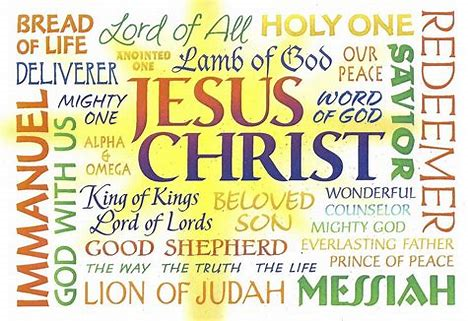
Though not exhaustive by any means, some of the names given to Jesus that shine light on the wonderment of His personhood are: Wonderful, Counselor, Mighty God, Everlasting Father, Prince of Peace (Is. 9:6-7), the Seed (Gen. 3:15), One born of a Virgin (Is 7:14), Son of God (Mark 1:11), Alpha and Omega (Rev. 22:13), the Ancient of Days (Dan 7:9), Image of the Invisible God ( Col. 1:15), Heir of all Things (Heb 1:2), Radiance of God’s Glory (Heb. 1:3), Exact Representation of God’s Being (Heb 1:3), the Word (John 1:1-3), the Beloved (Eph 1:6), the Only Begotten Son (Jh 3:16), I AM (Jh 8:58), Dayspring from on High (Lk 1:78), the Indescribable Gift (2 Cor 9:15), the Anointed One, the Ruler (Dan 9:25), Son of David (Matt. 1:1), the Branch (Isa 11:1), Arm of the Lord (Isa 53:1), the Babe (Luke 2:12), Immanuel (Matt 1:23), Holy One (Mark 1:24), Brother (Prov 17:17), the Nazarene ( Matt. 2:23), the Carpenter (Mark 6:3), the Galilean (Lk 23:6), the Man (I Tim 2:5-6), Son of Man ( Matt 20:28), the Prophet (Matt 21:11), the Teacher (Jh 3:2), the Great Physician (Lk 4:23), the Chosen One (Is 42:1), the Servant (Phil. 2:7), Man of Sorrows (Is 53:3), Rabboni (Jh 20:16), Shiloh ( Gen. 49:10), the Star (Num 24:17), the Scepter (Num 24:17), Redeemer (Job 19:25), Lilly of the Valley ( Song of Sol 2:1), the Rose of Sharon (Song of Sol 2:1), the Root (Isa 11:10), Leader and Commander (Is 55:4), Lord of Righteousness (Jer. 23:6), King (Zech 9:9), Messenger of the Covenant (Mal 3:1), Sun of Righteousness (Mal 4:2), Bridegroom (Matt 9:15), Friend (Matt 11:19), Horn of Salvation ( Lk 1:69), Lamb of God (Jh 1:29), Water of Life (Jh 4:10), Saviour (Jh 4:42), Judge (Acts 10:42), Our Passover (I Cor 5:7), Rock (I Cor 10:4), the Last Adam ( I Cor 15:45), Chief Cornerstone (Eph 2:20), the Head (Eph 4:15), All in All (Co 3:11), Our Hope (I Tim 1:1), Master (Matt 8:19), Mediator (I Tim 2:5), Author and Perfecter of Our Faith (Heb 12:2), Ransom ( I Tim 2:5-6), Our Wisdom (I Cor 1:30), Our Sanctifier (I Cor 1:30), Advocate (I Jh 2:1), Potentate (I Tim 6:15), King of Kings and Lord of Lords (I Tim 6:15), Pioneer of Our Salvation (Heb. 2:10), the Apostle of our Profession (Heb 3:1), High Priest (Heb 6:20), Overseer (I Peter 2:25), Atoning Sacrifice (I Jh 2:2), the Amen (Rev 3:14), the Faithful and True Witness (Rev 3:14), Lion of the Tribe of Judah (Rev 5:5), the Bread of Life (Jh 6:35), the Light of the World (Jh 8:12), the Door (Jh 10:9),the Good Shepherd (Jn 10:11), the Resurrection and the Life (Jh 11:25), the Way, the Truth and the Life (Jh 14:6), the True Vine (Jh 15:1), the Almighty (Rev 1:8), the Living One (Rev. 1:18), the Offspring of David (Rev, 22:16), Faithful and True (Rev 19:11), the Bright and Morning Star (Rev. 22:16), Lord (Jh 20:28), and God (Jh 20:28).

He is all those names and much, much more. Oh, how I wish I could describe Him to you!! But He is indescribable. One name just wouldn’t do and a thousand are inadequate to ever reveal the radiance and luster of this One called Jesus .

O, what a Savior!

Merry Christmas,
Dr. Dan

WHEN GOD BECAME A SERVANT

The marvel of Christmas is that the Babe born in Bethlehem was God manifest in the flesh coming to earth as a servant (Phil. 2:7).  What a truth! Paul called the incarnation a great mystery. And that it is. Most every Christmas someone asks me the question, “When the Word (Jesus), who was God (John 1:1-3), came to earth as a man, did He cease to be fully God? What did Jesus give up (empty himself of) when He clothed Himself in the flesh of man?”

While seeking to answer this question, it is recognized that we can only get a glimpse into a divine mystery which escapes our ability to fully comprehend. But we will seek to climb this spiritual Mt. Everest as far as our finite minds will allow us.

Paul writes in Philippians 2:5-11  5 Let this mind be in you which was also in Christ Jesus, 6 who, being in the form of God, did not consider it robbery to be equal with God, 7 but made Himself of no reputation, taking the form of a servant, and coming in the likeness of men. 8 And being found in appearance as a man, He humbled Himself and became obedient to the point of death, even the death of the cross. 9 Therefore God also has highly exalted Him and given Him the name which is above every name, 10 that at the name of Jesus every knee should bow, of those in heaven, and of those on earth, and of those under the earth, 11 and that every tongue should confess that Jesus Christ is Lord, to the glory of God the Father.

This passage speaks of the self-humiliation of Christ as He took upon Himself the form of a servant to come to earth to provide for us what we could not provide for ourselves. He left heaven’s glory to be clothed in human flesh to be our Savior. In Philippians 2:7, the phrase “made Himself of no reputation” in the Greek means “he emptied himself.” The particular Greek word form ἐκένωσεν (ekenōsen) (from kenóō) does not occur elsewhere in the New Testament, except in this passage. While usage of the word kenóō spoke of removing things from a container, until the container was empty, the word was also used to apply to where one lays aside or empties themselves of their rank and dignity and assumed a humbler rank and role. The King of Glory assumed the role of a servant!!

When he came to earth what did Christ empty himself of or set aside? Some see the verse as implying that Christ, who is the eternal Word (John 1:1-3), relinquished some aspects in the possession of His divine power and attributes. However, if Christ gave up any of His divine attributes can His act on the cross be a saving act since only One who is the God-Man can save sinful man? The answer, Christ did not give-up any of His divine attributes on earth He only self-limited Himself in the full use of them. While veiling Himself in our flesh, He did not cease to be what He was (God) when He assumed the form of a servant. Christ didn’t relinquish His divinity, He limited Himself in the full use of the divine attributes He possessed. He “emptied” Himself of the full use of all His divine attributes and by His divine power self-limited Himself in their use in some instances. Christ did not empty Himself of deity, but of its full outward manifestation. Christ was undiminished deity and perfect humanity united without contradiction in one person.

It is only because Christ is God in the flesh, the eternal Word, that He can self-limit Himself in the full use of His Godness. More than an emptying or a loss of divinity, there was a choosing on Christ’s part, as the God-Man, a self-limiting of His full divinity while on earth. As an example, Jesus said to His disciples when speaking of when He would return, “But of that day and hour knows no man, no, not the angels which are in heaven, neither the Son, but the Father” (Mark 13:32). Jesus, though God in the flesh, relinquished and limited, while on earth, knowledge of the exact day and hour when He would return. While on earth Christ temporarily set aside in some instances His omniscience (ability to know everything), He didn’t actually empty himself of the attribute He just chose to self-limit His full use of it.

As well, while on earth Christ, as a man, was limited in His ability to be at more than one place at one time. He limited His omnipresence (ability to be with everyone at the same time) which He had with the Father. As with His omniscience, while on earth Christ temporarily set aside His omnipresence, He didn’t actually empty himself of the attribute He just chose to self-limit His use of it.

Christ, while on earth, set aside the full use of His omnipotence in some instances in order to become a servant in our human likeness to dwell amongst us in order to provide salvation for us. He did not cease to be what He always had been but of certain attributes there was a self-limitation on His part in the use of them. One is truly omnipotent (all-powerful) when they can actually limit their omnipotence as Christ did!!

He who hung the stars in the sky, came to dwell in a lowly manger. He who created man became a man. He who created the earth came to walk on the earth. He who men bow to worship, stooped to wash His disciple’s feet. He who created the sun to shine, died in darkness that we could dwell in His light. He could never be the King of our eternal future if He was not King of the eternal past.

So, when Christ came to earth there was a self-limitation of His divine attributes rather than a self-emptying Himself of them. Because of His holy-love for humanity He limited Himself in the full use of all His attributes though they remained in Him in potential, but not all were used in actuality. For in Christ dwelt all the fullness of the Godhead (Colossians 2:9); therefore, He was, by His power, actually able to self-limit Himself in the use of all His divine attributes. As the insightful theologian P.T. Forsyth wrote, “Christ’s emptying (self-limiting) of Himself is not regarded as the loss of true Godhead, but the condition of it. The freedom that limits itself to create freedom is true omnipotence, as the love that can humble itself to save is truly almighty.” In other words, God in Christ is truly powerful because He has the power to self-limit His power in order to act in saving power on the cross and in the resurrection.

Having such a Savior resulted in Paul exclaiming, “At the name of Jesus every knee should bow, of those in heaven, and of those on earth, and of those under the earth, and that every tongue should confess that Jesus Christ is Lord, to the glory of God the Father” (Phil 2:10-11).

O, what a Savior.

Merry Christmas,
Dr. Dan

THE IMPORTANCE OF THE VIRGIN BIRTH

As Christmastime is upon us, there comes into focus an often-forgotten Biblical truth that is essential to our understanding of who Jesus is and an underlying truth upon which Christianity rests. It is a truth that is mentioned or alluded to in many Christmas carols like Silent Night, Hark! The Herald Angels Sing, Little Town of Bethlehem, and There’s a Song in the Air. Each of these carols speak of the Virgin Birth of Jesus. Sadly, there are those within Christendom who see the Virgin Birth as nonessential to the faith and irrelevant in understanding who Jesus was/is.

While the Church for the most part has been guilty of only focusing on the Virgin Birth at Christmas, it is the foundation on which other central doctrines of the Christian faith are built. To reject the Virgin Birth is to dismiss the truthfulness of Scripture, the deity of Christ, the sinlessness of His life, His being qualified to die for our sins, and a host of other related Christian truths related to Christ and the Christian faith.
Why is the Virgin Birth essential? Before we can answer that question let us define what is meant by the Virgin Birth. When the angel announced to Mary that she would bear the Christ Child, she responded, “How can this be seeing I have never known a man?” While she and Joseph were engaged, they had never had sexual relations. The angel told Mary that the birth of Jesus would not come about by the ordinary method of human generation, but by a totally unique action of God and the Holy Spirit. What was impossible with man was possible with God. Jesus was divinely conceived in the womb of Mary without the seed of a man. Mary conceived Jesus as result of the supernatural work of the Holy Spirit who overshadowed her (Matthew 1:20-21). The historical record clearly reveals that Joseph was not the earthly father, and matter of fact he wanted “to put her away” (Matthew 1:18-19). Told in a dream by an angel that the child in Mary’s womb was the long-promised Messiah, Joseph remained loyal to Mary and only had relations with her after Jesus was born.

So, the Biblical record is clear that Mary was a virgin when Jesus was conceived in her womb by the supernatural work of the Holy Spirit.

Having defined the Virgin Birth, why is it essential, important and necessary in our understanding as to who Jesus is and what He came to do? The Virgin Birth is important for several reasons.

First, the Virgin Birth reveals the truth and accuracy of Old Testament prophesies. In Genesis 3:15 the Lord identified the coming Messiah, who would be born of woman, and who would deal a destructive blow to Satan, as “her seed.” The Scripture is clear to say “her seed” and not the seed of a male. The promised Messiah was not to have an earthly father, he was to be divinely conceived. He would have to be divinely conceived in order to bring a destructive blow to Satan.

In Isaiah 7:14, the poetic prophet prophesied that one of the signs in  identifying the coming Messiah was that he would be born of a virgin. Some critics are quick to point out that the Hebrew word is “almah” which means “young maiden” and can mean other than a virgin. While that is true, the word “almah” is used seven times in the OT to refer to an unmarried woman who is sexually pure. As well, in the Septuagint, the Greek translation of Hebrew OT, the Jews translated the Hebrew word “almah” into the Greek “parthenon” which clearly means virgin. So, the Jews themselves understood the prophecy in Isiah 7:14 referred to a virgin birth.

That Jesus was born of a Virgin verifies the truth, accuracy and inspiration of the OT prophecies.

Second, the Virgin Birth affirms the deity of Christ, that He is the God-Man. The NT teaches that man’s sin and guilt before a holy God is so great, that a Savior must come from outside of man’s efforts and works; the Savior being both human and divine. Since humanity cannot produce such a Redeemer, the heavenly Father in the Virgin Birth provided a Savior who was wholly God and Man.

The Bible is clear Jesus was both God and Man. John writes, “In the beginning was the Word [Jesus], and the Word was with God, and the Word [Jesus] was God… 14 And the Word became flesh, and dwelt among us, and we saw His glory, glory as of the only begotten from the Father, full of grace and truth” (John 1:1, 14). Paul writes, “For in Him [Jesus] all the fullness of Deity dwells in bodily form” (Colossians 2:9).

The Virgin Birth was necessary to bring about the unique nature of Jesus. In His conception, humanity and deity were fused together by the Holy Spirit and Jesus came forth as the God-Man. He was not half man and half God, Jesus was 100% man and 100% God. We see Him as man when He grew weary, when He slept, when He wept, when He experienced pain, when He was thirsty and hungry. We see Him as God when He walked on water, when He cast out demons, when He spoke and the storms obeyed Him, when He fed the 5,000, when He healed the sick, and when He raised the dead.
Christ could not be the God-Man if He had not been born of a Virgin, if there had not been a miraculous fusing together by the Holy Spirit of both humanity and deity. If Jesus had been born of natural parentage, a biological father, and the biological mother, then his deity would be undermined.

Third, the Virgin Birth affirms the sinlessness of Jesus. Without the Virgin Birth one cannot account for Christ’s sinlessness, His perfect life. The Virgin Birth was necessary for Jesus to be pure from sin. All who are born into this world are born with a sinful nature.  Our sinful nature is derived  from our father, he got it from his father, and so forth and so on all the way back to Adam. If Jesus had had an earthly father, he would have inherited a sinful nature and He would have been no different from you and I. Because Jesus’ father was God the Father, not the seed of man, but the seed of a woman, there was no sin flowing in His veins. He was victorious over sin and Satan His whole earthly life (Luke 4, Hebrews 4:15).

Because Jesus was sinless, He was accepted as the spotless Sacrifice for our sins. God would only accept a Lamb without blemish (Num 19:2; Deut 17:1), if Christ ever committed one sin, He would have been disqualified from being “the Lamb of God that came to take away the sin of the world” (John 1:29). If Christ was not sinless, He could not have been the perfect Substitute for humanity. As the sinless God-Man, Christ took the hand of holy God and the hand of sinful man in order that the wall of alienation be removed whereby restored fellowship can be experienced. If Christ had not been born of a Virgin that would not have been possible.

Fourth, the Virgin Birth assures us of the supernatural. Skeptics reject the Virgin Birth as being impossible and contrary to natural reason. To accept the Virgin Birth is to affirm the supernatural, to affirm the miraculous. For us to have a supernatural Savior we need a supernatural intervention by God to bring it to pass. The Virgin Birth was God’s trumpet that He has done something extraordinary, He has done something that man cannot fully explain, that He has done something that could only take place as the result of a miracle. As the angel told Mary, “With God nothing is impossible” (Luke 1:35-45). In the Virgin Birth God broke through the chain of human generation and brought into the world a supernatural Savior.

The God whose supernatural presence came upon Mary, continues to work supernaturally in the lives of those whose hearts have been awakened to the saving power of Jesus Christ. Because Christ was supernaturally conceived, He has the power to supernaturally save and forgive the sins of all who will sincerely come to Him in contrition and repentance. Salvation can only come to humanity through the supernatural power from a supernatural Savior who was conceived supernaturally. The miracle of the Virgin Birth assures us that the miracle of individuals experiencing the New Birth is possible.

As we embark upon the Christmas Season, there is no detail in the Christmas story more important than the Virgin Birth. If there is no Virgin Birth, if the conception and birth of Christ didn’t unfold as the Scripture records, then Christmas has lost its meaning and humanity has no Savior. Donald Macleod eloquently writes, “The virgin birth is posted on guard at the door of the mystery of Christmas, and none of us must think of hurrying past it. It stands on the threshold of the New Testament, blatantly supernatural, defying our rationalism, informing us that all that follows belongs to the same order as itself and that if we find it offensive there is no point in proceeding further” (Macleod, The Person of Christ, InterVarsity Press, 1998, 37).

If one denies that Jesus is the God-Man, then the lights of Christmas grow dark and man has nothing to celebrate. But there is Good News, the miracle of the Virgin Birth assures us the lights of Christmas shine brightly and they shine upon the cross of Christ where humanity can find supernatural grace to pardon all our sins.

O, what a Savior!!

Blessings,
Dr. Dan